Card Player Magazine, available in print and online, covers poker strategy, poker news, online and casino poker, and poker legislation. Sign up today for a digital subscription to access more than 800 magazine issues and get 26 new issues per year!
.jpg)
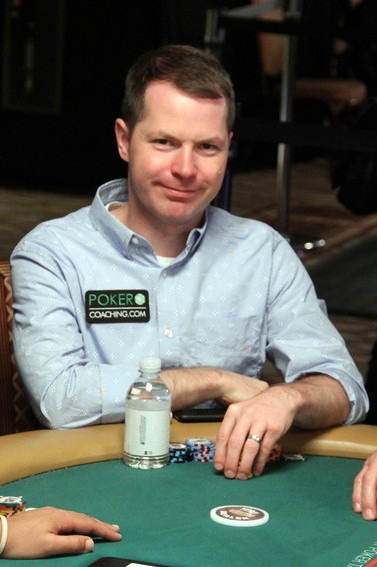 I recently had the pleasure of traveling to Jacksonville, Florida for the $5,000 buy-in World Poker Tour bestbet Bounty Scramble. This event is different from most in that some of the players in the field are bounties (myself included), so if you bust one of them, you get $2,500. This tournament is always a lot of fun and I am already excited to play again next year.
On day 1a, I got off to a nice start, increasing my 40,000 starting stack to 50,000 when I was fortunate enough to pick up K-K. At 100-200 a generally tight, aggressive player raised to 600 from UTG+1 and I three-bet from the button to 2,000.
He quickly four-bet to 7,000 out of his 27,000 starting stack. At this point, I was not loving the situation, but folding would be way too tight. I called just in case I could get off the hook on an A-x-x board.
The flop came 8 5
5 2
2 and my opponent pushed all-in for 20,000 into the 14,000 pot. I reluctantly made the call and lost to A-A. In reality, there is not much I could do to avoid this spot because if I am folding K-K, I am folding my entire range, which is usually not a good idea against a reasonable opponent who could easily have Q-Q and A-K (and perhaps even a bluff or two) in his range.
This setback left me with 20,000 chips, which I eventually lost with 9-9 against K-Q suited all-in preflop.
I re-entered on day 1b and I again got off to a nice start, turning 40,000 into 50,000. At 100-200, a good young player raised to 600 from UTG, and an older, generally straightforward player three-bet to 1,800 from middle position. Everyone folded to me on the button and I found K-K.
Both four-betting and calling are reasonable options, but in this case, I thought the three-bettor was abnormally strong and I though the UTG kid would rarely four-bet without a premium hand (because the three-bettor was obviously strong and my call should also be quite strong).
I called. The UTG kid then four-bet to 6,000, and the older player five-bet to 16,000.
A few concepts are at work here. The first is that generally straightforward players do not five-bet without a premium hand they plan to get all-in. The five-bet made it clear that he was not going to fold to an all-in, so I assumed he had at least Q-Q or A-K. Next, the UTG kid used a relatively small four-bet size that gave us reasonable implied odds to call, which indicates he has an abnormally strong hand that is not too worried about being outdrawn.
So, I am clearly against two strong ranges. While I will be against Q-Q and A-K some portion of the time, most of the time one of two opponents will have A-A. Also notice that if I six-bet jam all-in, even Q-Q and A-K may fold, meaning I only get called when I am in bad shape.
I confidently deposited my K-K into the muck after about two seconds of thought. Fortunately, UTG had A-A, so I was able to dodge bullets (just like Phil Hellmuth!) I was surprised to see the other player show up with J-J, but I suppose that makes some sense. In general, most tight, straightforward players tend to be unable to fold hands they perceive to be strong.
While I essentially never fold K-K preflop (because if you are folding K-K, you are folding everything), sometimes it makes sense. When a play makes sense, do not be afraid to make it.
Unfortunately, conserving my stack did not help me in this event. The blinds eventually got high and I found myself all-in with J-J against A-A for my 20 big blind stack. Sometimes it’s just not meant to be! ♠
 Jonathan Little is a professional poker player and best-selling poker author with over $6,900,000 in live tournament earnings. If you want to learn how to play fundamentally sound poker and increase your win rate, check out PokerCoaching.com. Click here to try PokerCoaching.com for free.