







Give us your opinion in the comments section below for your chance at winning a six-month Card Player magazine digital subscription.
Ask any group of poker players how you played your hand and they’ll come up with dozens of different opinions. That’s just the nature of the game.
Each week, Card Player will select a hand from the high-stakes, big buy-in poker world, break it down and show that there’s more than one way to get the job done.
The Scenario
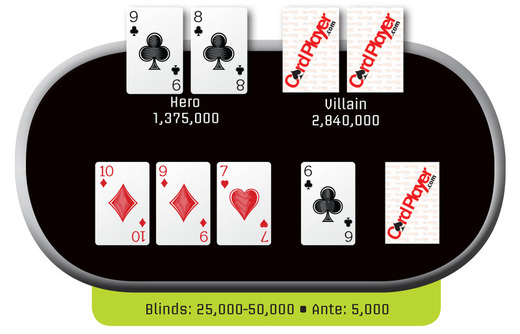
There are 11 players remaining in a major tournament and you are in eighth place with 1,375,000. With the blinds at 25,000-50,000 with a 5,000 ante, you have just over 27 big blinds.
Sitting at the six-handed table, you min-raise from the hijack to 100,000 with 9 8. The cutoff, a player stacked with 2,840,000, makes the call.
The flop comes 10 9 7
9 7 and you make a 100,000 continuation bet. Your opponent calls and the turn is the 6, giving you a straight.
The Questions
Do you check or bet? If betting, how much? Is there any risk to letting your opponent get a free card? Is there any value to betting the turn in a situation where your opponent is likely to be way behind? What kind of hand range can you put your opponent on? If your opponent calls your turn bet, which cards are you betting for value on the river and which cards are you checking?
What Actually Happened
Jason Duval opted to check behind with his turned straight on a board reading 10 9 7 6 and his opponent, Barry Kruger, checked behind.
The river was the K and Duval bet 235,000. Kruger called and then mucked when Duval revealed his 9 8 to win the pot.
Both players would eventually go on to make the televised final table of the WPT Canadian Spring Championship main event.
What would you have done and why? Let us know in the comments section below and try not to be results oriented. The best answer will receive a six-month Card Player magazine digital subscription.