







Give us your opinion in the comments section below for your chance at winning a six-month Card Player magazine digital subscription.
Ask any group of poker players how you played your hand and they’ll come up with dozens of different opinions. That’s just the nature of the game.
Each week, Card Player will select a hand from the high-stakes, big buy-in poker world, break it down and show that there’s more than one way to get the job done.
The Scenario
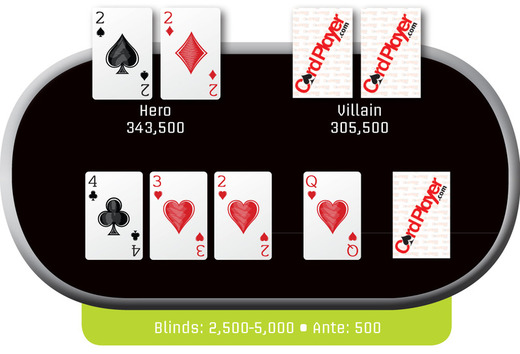
There are eight players remaining in a big buy-in six-max tournament, leaving four players at each of the final two tables. With 343,500, you are among the chip leaders in the event and are stacked with over 68 big blinds at the 2,500-5,000 with a 500 ante level.
The action folds around to the small blind, another big stack with 305,500, who raises to 13,000. You look down at 2 2
2 and make the call.
The flop comes 4 3
3 2 and your opponent continues with a bet of 15,000. You raise to 50,000 and your opponent calls. The turn is the Q and your opponent checks.
The Questions
Do you check or bet? If checking, are you looking to induce a bet on the river, or are you looking for a safe card before proceeding? If betting, how much? Are you betting to protect against the possible straight and flush draws on board or are you betting for value and/or information? Given your opponent’s willingness to call your flop raise, what types of hands are in his range? Is it possible he has turned a flush? If he’s drawing, how likely is he to call a turn bet and how much should you bet to properly price him out?
 What Actually Happened
During event no. 4 of the WSOP Asia Pacific $5,000 six-max no-limit hold’em event, Jason Gray decided to check behind on a board reading 4 3 2 Q with bottom set.
The river was the worst card in the deck, the 6. Gray’s opponent, Jan Suchanek, bet 100,000 and Gray was forced to fold. Suchanek showed him K 5, making both a straight and flush on the river.
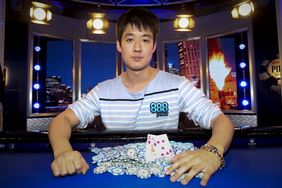
Gray limped into the unofficial final table of seven before busting, earning $27,722. Suchanek played his way to a third-place finish, banking $103,766. The event was eventually won by Australian Aaron Lim, who picked up his first gold bracelet and the $233,800 first-place prize.
*Photo courtesy of the WSOP.com
What would you have done and why? Let us know in the comments section below and try not to be results oriented. The best answer will receive a six-month Card Player magazine digital subscription.