







How to Play No Limit and Pot Limit: Learn the Key Differences and Strategies
There are three main types of poker betting formats: No Limit, Pot Limit, and Fixed Limit. This page compares and contrasts Pot Limit and No Limit poker, pointing out the rules for each and suggesting strategy tips to help you maximize your edge.
How to Play No Limit and Pot Limit Poker
No Limit and Pot Limit poker have the same rules when it comes to hand rankings and how to make bets. The key difference is how much you can bet, specifically when it comes to betting the maximum.
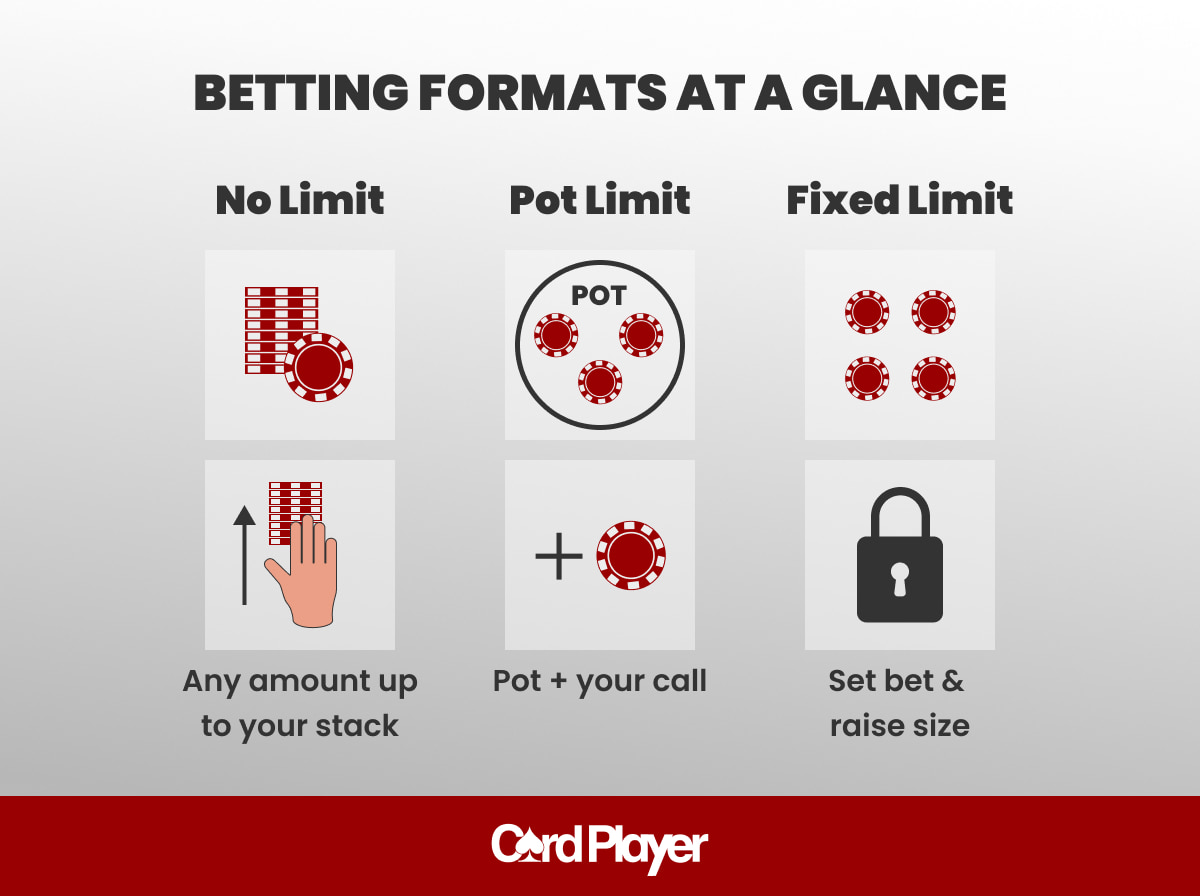
In No Limit poker, you can bet any amount up to the size of your entire stack. In Pot Limit poker, maximum bets are capped to the size of the current pot plus the amount required to call.
This changes the dynamics of gameplay. In No Limit poker, there’s an emphasis on aggression, bluffing, and moving all in. In Pot Limit poker, preflop all-ins are rare, and big pots tend to be built over the course of several betting rounds.
No Limit Texas Hold’em is a common variation and is the most popular kind of poker, both live and online. Meanwhile, Pot Limit Omaha is one of the most popular games that use Pot Limit betting rules.
No Limit Poker Rules
In No Limit poker, there is no maximum amount that players can bet beyond the size of their own stack. However, there are still poker betting rules that need to be followed.
If you are the first player to enter the pot on any street, the minimum bet you can make is one big blind. If someone has already made a bet or raise, any raise must be at least equal to the size of the previous bet or raise.
The maximum bet in No Limit poker is your entire stack. Making this bet is known as moving all in. If your opponent’s stack is shorter, the maximum bet is actually for their entire stack, a concept known as effective stacks.
Given that the only upper betting limit is the amount of chips in front of you, all-ins are possible on any round of betting. Preflop all-ins are common in games like No Limit Texas Hold’em.
Unlike Fixed Limit, No Limit and Pot Limit allow unlimited consecutive raises in a single betting round (subject only to stack or pot caps).
Pot Limit Poker Rules
In Pot Limit games such as Pot Limit Omaha, the maximum size of the bet is always capped by the amount in the current pot.
For example, if the pot is $1,000 and a player bets $1,000, the next player can raise up to the size of the pot ($2,000) plus the amount they must call ($1,000), for a maximum raise of $3,000.
Pot Limit poker betting rules slow down and stagger the action, making it difficult for players to move all in, especially during the preflop stages or on the flop. Large pots tend to be built across several rounds of betting.
Just like in No Limit poker, the minimum bet in Pot Limit games is defined by the size of the blinds. The first player to enter the pot can bet a minimum of one big blind, the next player’s raise must be at least equal to the size of the previous bet or raise, and so on.
The formula for calculating the maximum raise in Pot Limit is: current pot + opponent’s bet + your call. This determines the maximum total amount you can raise to on that betting round.
Strategic Considerations
If you learn a particular type of game, you will easily be able to apply your knowledge and skills to play with various poker betting rules. For example, if you’re proficient at No Limit Texas Hold’em, it would be relatively easy for you to adapt to Pot Limit Texas Hold’em.
Having said that, Pot Limit and No Limit betting strategy is not the same. Here’s an overview of how you can adapt to each:
No Limit Poker strategy
In No Limit poker, moving all in preflop is an option and a perfectly valid strategy when stacks are short. With deeper stacks, you can make large bets or raises with value hands to quickly inflate the pot. At the same time, bluffing is more effective because you can apply pressure with big bets.
No Limit poker betting strategy therefore rewards aggression, and that goes for value hands and bluffs alike. Mistakes are costly, both your own and your opponent’s. It’s a high-risk, high-reward game.
If a player goes all in with fewer chips than others, any additional bets form a side pot. Only players who contributed to the side pot can win it, while the all-in player is only eligible to win the main pot.
Your stack-to-pot ratio (SPR) helps determine how committed you should be to a hand. A low SPR encourages earlier commitment, while a high SPR allows more post-flop maneuvering.
Pot Limit Poker strategy
Pot Limit poker betting rules restrict the amount you can bet, which makes it difficult, sometimes impossible, to move all in preflop or during the early rounds. Instead, you’ll need to build the pot slowly and play hands over the course of multiple post-flop betting rounds.
In Pot Limit games, draws and medium-strength hands can find the pot odds needed to call on the flop, and conversely, it’s harder to push players off these hands. Bluffing is still a part of the game, but needs to be particularly well-timed to be effective.
Pot Limit Omaha and other Pot Limit games require a disciplined approach to hand selection, solid positional play, and aggression through betting on multiple streets.
No Limit and Pot Limit Poker Variations
Technically, you can play any variation of the game using any of the poker betting rules. That being said, each poker variation is typically played with a specific structure. This applies to both tournaments and cash games.
For example, while it is possible to play Pot Limit Texas Hold’em or No Limit Omaha, both of these games are very rare. Here are how No Limit and Pot Limit games are usually played:
No Limit betting rules – Commonly used for Hold’em games, such as No Limit Texas Hold’em. Increases variance while ramping up the aggression and excitement levels. The most prestigious poker tournaments in the world often use No Limit betting rules.
Pot Limit betting rules – Pot Limit Omaha is the most famous and popular game that uses these poker betting rules. A Pot Limit structure helps to balance the increased variance of playing with four hole cards.
Texas Hold’em Betting Rounds
In No Limit Texas Hold’em, players receive two down cards as their personal hand (hole cards), after which there is a round of betting. Three board cards are turned simultaneously, called the flop, and another round of betting occurs. The next two board cards are turned one at a time, with a round of betting after each card.
The board cards are community cards, and a player can use any five-card combination from the board and their personal cards. A player can even use all of the board cards and no personal cards to form a hand (known as “playing the board”).
A dealer button is used in Texas Hold’em rules. The usual structure is to use a small and big blind, but it is possible to play the game with one blind, multiple blinds, an ante, or a combination of blinds plus an ante.
Rounds of Betting
- Opening deal – Each player is dealt two cards face down, known as hole cards.
Pocket Cards

- First round of betting – Starting with the player to the left of the big blind, each player can call the big blind, raise, or fold. The big blind has the option to raise an otherwise unraised pot.
- The flop – The dealer burns a card, and then deals three community cards face up. The first three cards are referred to as the flop, while all of the community cards are collectively called the board.
Flop


- Second round of betting – Starting with the player to the left of the dealer button, each player can check or bet. Once a bet has been made, each player can raise, call, or fold.
- The turn – The dealer burns another card, and then adds a fourth card face-up to the community cards. This fourth card is known as the turn card, or fourth street.
Flop
The Turn

- Third round of betting – It follows the same format as the second round, but the size of the bets have usually doubled in limit games.
- The river – The dealer burns another card, and then adds a fifth and final card to the community cards. This fifth card is known as the river card, or fifth street.
Flop
The Turn
The River

- Final round of betting – It follows the same format as the second and third rounds.
- The showdown – Using the best five-card combination of their hole cards and the community cards, the remaining players show their hands, with the bettor or last raiser showing first. The highest five-card hand wins the pot. (In case of a tie, the pot is evenly split among the winning hands.)
Pot Limit Omaha Betting Rounds
Omaha rules are similar to Hold’em. The game uses a three-card flop on the board, a fourth board card, and then a fifth board card. However, each player is dealt four hole cards instead of two at the start.
To make a hand, a player must use precisely two hole cards with three board cards. The betting is the same as in Hold’em. At showdown, the entire four-card hand should be shown to receive the pot.
The best possible five-card poker hand, using exactly two hole cards and three community cards, wins the pot.
Betting Rounds
- The dealer deals each player four cards face down (hole cards).
Pocket Cards

- First betting round.
- The dealer burns a card, then turns over three community cards face up (the flop)
Flop
- Second betting round.
- The dealer burns another card, then turns over one more community card (the turn, fourth street)
Flop
The Turn
- Third betting round.
- The dealer burns another card, then turns over one final community card (the river, fifth street)
Flop
The Turn
The River
- Last betting round.
- Showdown. (Every remaining player shows hand. with first bettor or last raiser showing first.)
- All remaining players must use their two pocket cards and the three board cards.
Watch Out for These Common Mistakes
Here are some common mistakes that are specific to playing both No Limit poker and Pot Limit poker:
No Limit Poker
- 🚫 Overbetting: Just because you can go all in doesn’t mean you should. Sometimes, it’s better to exercise pot control or make smaller bets than to bet the pot or over, especially with medium-strength hands. Make sure to announce your intended bet amount clearly or push your chips in a single motion to avoid making a string bet, which is not allowed in live poker.
- 🚫 Bluffing badly: Bluffing is a big part of No Limit poker. If it’s done badly, though, it can cost your entire stack.
- 🚫 Missing value: One of the main ways to gain an edge in games like No Limit Texas Hold’em is simply to play your value hands effectively. Don’t trap or check strong hands too often.
- 🚫 Calling off chips: Bets can get big in No Limit games. If pot odds are unfavorable compared to your hand strength or chances of hitting a draw, you’ll need to learn when to fold or risk losing mountains of chips to poor calls.
Pot Limit Poker
- 🚫 Chasing weak draws: Because you’ll often be getting decent pot odds in Pot Limit games, it can be tempting to chase draws. The problem is that weak draws rarely win at showdown, even when your hand gets there.
- 🚫 Bluffing: It’s harder to bluff in Pot Limit poker because smaller bets generate less fold equity. If you want to bluff effectively, you’ll need to have a solid read and be prepared to fire multiple pot-sized bets.
- 🚫 Not having a plan: The majority of Pot Limit hands will be played over several streets of betting, so more than ever, you’ll need a plan for the hand to make sure you don’t over-commit or make costly mistakes.
- 🚫 Overbetting in live games: It’s common to make pot-sized bets in Pot Limit games. If you’re playing live poker, you’ll need to put the correct amount of chips in the middle. Placing too many or too few chips could cause confusion.
Playing Online vs. Live
Online poker and live poker are exactly the same in terms of the rules. If you play a No Limit Texas Hold’em game at a casino, it’s the same as playing the equivalent game online.
Live poker is played face-to-face with other people. It’s more sociable, and there’s also the potential to notice physical tells to get an idea of when someone is bluffing.
In online poker, hand reading relies purely on analyzing the situation and accurately gauging hand ranges based on betting patterns. There’s still plenty of information to go, but you won’t be able to use physical tells.
If you play live poker, you’ll also have to physically handle cards and chips, as well as remember when to post your blinds and make your bets. Newer players may struggle with this, so it can be helpful to gain some experience online to get familiar with the game.
Generally, though, you shouldn’t have a hard time transitioning between live and online poker, whether you are playing No Limit Texas Hold’em tournaments or Pot Limit Omaha cash games.
Conclusion
No Limit poker and Pot Limit are very different. Restrictions on the size of bets in Pot Limit games require a measured poker betting strategy, whereas the ability to bet big and move all in encourages aggressive value bets and bluffs.
Be sure to check the poker betting rules of each game that you play before sitting down at the tables so that you always know whether or not to shove those chips in the middle. A little practice in either No Limit or Pot Limit will allow you to learn and adapt your strategy.
FAQs
Is Omaha harder than Hold’em?
Omaha and Hold’em are both difficult games. However, Omaha is considered more challenging to master. Players start with four hole cards, which allows for more hand combinations and additional layers of complexity.
What is the best beginner strategy for No Limit Texas Hold’em?
The best strategy for beginners in No Limit Texas Hold’em is to play a tight aggressive style, playing positional poker with strong starting hands and using aggressive betting lines to win pots. Adapting to opponents is key, so no one single strategy is always best.
What is the best beginner strategy for Pot Limit Omaha?
Beginners to Pot Limit Omaha should try to play a tight aggressive strategy and focus on playing hands that can make the nuts or close to it.