







How to Play Mississippi Stud: Rules, Strategy, and Hand Rankings
Did you know that your Texas Hold’em skills can improve your chances of success in poker-style casino games, too? Despite the notable differences between poker and table games such as blackjack, there are crossover skills you can use to improve your expected value (EV).
Today, we’re here to show you how to play Mississippi Stud. This popular casino game offers plenty of scope to use your poker skills in a different setting and, with the right strategy, reduce the house edge by more than 60%.
Let’s find out how.
What is Mississippi Stud?
Mississippi Stud is a casino game, which means that, unlike Texas Hold’em, you compete against the house rather than other poker players. Experienced poker players know that casino table games favor the house, but that doesn’t mean you shouldn’t learn how to play Mississippi Stud!
Mississippi Stud rules actually give you scope to make strategic decisions. These decisions can help you reduce the house edge in certain situations. So, while this poker variant occupies a slightly different space on the gaming spectrum than Texas Hold’em and most other full-fledged poker games, that doesn’t mean you can’t play strategically.
In fact, with the right Mississippi Stud strategy, there’s a ton of potential in this game. Even better, you’ll already have a general sense of how to play Mississippi Stud and make smart decisions if you’ve tried other types of poker.
The hand rankings in Mississippi Stud are identical to Texas Hold’em, Omaha, and other high-hand variants. The concept of hitting outs is also the same. Therefore, if you’re well-versed in Hold’em, Omaha, Stud, or Draw, you’ve got a head start regarding Mississippi Stud strategy.
Side Bet
Many online casinos offer an optional 3-Card Bonus side wager on your two hole cards, plus the first community card. This is paid separately by its own bonus table.
How to Play Mississippi Stud Poker
The aim of Mississippi Stud is to make a ranked five-card hand. You combine two hole cards (i.e., your starting cards) with three community cards dealt over different streets.
You have to reach the final street to complete a hand. If that hand matches one of the standardized Mississippi Stud payouts, you win a prize that’s a multiple of your bets.
For example, if you’ve wagered $10 and your hand is worth 5x, according to Mississippi Stud payouts, you’ll receive $50 (10 x 5 = 50). That’s a basic overview of how to play Mississippi Stud poker, but we need to expand on these rules before discussing how to reduce the house edge.
Mississippi Stud Rules
Mississippi Stud rules are simple to understand; just remember that the aim is to make a five-card hand. We’ll walk you through a hand in a moment. Before that, let’s set the scene:
The Set-Up
- Mississippi Stud is played with a standard 52-card deck.
- You must place an ante bet before any cards are dealt.
- Three community cards are dealt in turn: Third Street, Fourth Street, and Fifth Street.
- You must place a bet (1x, 2x, or 3x your ante) to see the next card, but you are not obligated to do so.
- A showdown takes place after Fifth Street. If you’ve made a ranked hand, you win a prize based on standard Mississippi Stud payouts.
Step #1: The Initial Betting Round
- Pre-Flop: You place an ante bet to receive two starting cards.
Step #2: The Community Cards
You only have to decide whether to play (raise) or fold. We’ll explain how you can use a points system to determine which hands are worth playing in a moment. For now, just know that you need to play or fold.
- Fold: You can fold if your starting cards are weak. Folding costs you the ante bet and brings the round to an end.
- Play: You place a bet to play. Three betting options exist: 1x, 2x, or 3x your ante. These bets are always multiples of your ante. For example, if you tapped 2x and your initial bet (the ante) was $10, you’d be wagering $20 (2 x 10 = 20).
This fold/play dynamic is repeated three times across Third and Fourth Street as cards are revealed. You’ll always lose the money you’ve wagered if you fold before showdown. Electing to play costs another bet and releases another card from the deck.
- Third Street: The first community card is revealed.
- Fourth Street: The second community card is revealed.
- Fifth Street: The third and final community card is revealed.
Step #3: Showdown
A showdown occurs if you make three bets to reveal all of the community cards. At this point, you reach showdown, and the value of your hand is judged according to standard poker rankings. Specific pairs and better hands up to the best holding of a Royal Flush count as ranked hands and award prizes.
Mississippi Stud payouts are based on where your hand ranks on this table. One crucial difference to note between Mississippi Stud and other types of poker is that you won’t win with certain lower pairs. We’ll show you which pairs are worth something in the next section.
Mississippi Stud Payouts & Odds
Mississippi Stud payouts are prize multipliers. That means the amount you win is a multiple of the amount you’ve wagered (antes plus any raises). For example, if you wagered $50 (your ante plus bets on all three streets) in total through the hand and your hand rank at showdown was worth 5x, you’d win $250 ($50 x 5 = $250).
The table below shows the multipliers for each ranked hand, according to traditional Mississippi Stud rules:
| Hand | Payout |
| Royal Flush | 500 : 1 |
| Straight Flush | 100 : 1 |
| Four of a Kind | 40 : 1 |
| Full House | 10 : 1 |
| Flush | 6 : 1 |
| Straight | 4 : 1 |
| Three of a Kind | 3 : 1 |
| Two Pair | 2 : 1 |
| Pair of Jacks or Better | 1 : 1 |
| Pair of 6s – 10s | Push |
| All Other Hands | Loss |
Mississippi Stud Hand Rankings
The hand rankings for Mississippi Stud are taken from Texas Hold’em and other high-hand variants such as Omaha and Stud. That means a Royal Flush tops the list, and Pairs are the lowest-ranked hand.
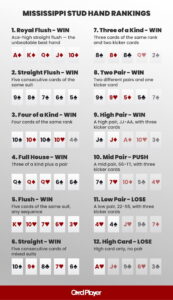
The vital caveat we mentioned earlier is that some pairs are not good enough to rank. Traditional Mississippi Stud rules state that the minimum qualifying hand is a pair of sixes. You won’t win with a pair of deuces, threes, fours, or fives.
Knowing this rule is essential when it comes to understanding Mississippi Stud strategy. These pairs may still be worth continuing cautiously with through the hand, due to their chance of making three of a kind or forming part of a full house.
What Is the Best Mississippi Stud Strategy? Top 3 Tips & Tricks
You don’t have any control over the hands you make in Mississippi Stud because the cards are dealt randomly. What you can control, however, is when and how you bet.
So, if you really want to know how to play Mississippi Stud and win, make sure you remember these three things:
1. High-Value Cards Are Helpful
This Mississippi Stud strategy works based on the logic that you’ll make pairs in Mississippi Stud more often than any other ranked hand. From this, we can look at the Mississippi Stud payouts table and conclude that high-value cards are worth playing.
I say this because any pair of Jacks or better is a 1:1 payout. Any pairs lower than Jacks are a push at best. Of course, we should be glad to push because it means we haven’t lost any money. However, we’re in the business of reducing the house edge by maximizing our potential returns.
Therefore, we should give more weight to starting hands that contain high-value cards. With advice from Michael “Wizard of Odds” Shackleford, we can formalize this Mississippi Stud strategy tip.
The veteran gambler and mathematician advocates a points system for starting hands, similar to that used by card counters in blackjack. This system looks like this:
- High Cards: Jacks, Queens, Kings, Aces = Two Points
- Medium Cards: 6, 7, 8, 9, 10 = One Point
- Low Cards: 2, 3, 4, 5 = Zero Points
The definitions of High, Medium, and Low are based on the Mississippi Stud payouts table we showed you earlier. This also confirms the idea that you should give more weight to high-value cards.
More specifically, Shackleford’s mathematically optimal strategy tells us that you should play a hand pre-flop only if it’s either two high cards, Jacks or better, or suited 65s or better, or a pocket pair. Many two-point hands should still be folded.
EXAMPLES
Hand #1
Starting Hand: 8♥ (one point) 5♠ (zero points) = one point
Decision = Fold
Hand #2
Starting Hand: 3♠ (zero points) K♥ (two points) = two points
Decision = Fold
Hand #3
Starting Hand: 9♥ (one point) K♥ (two points) = three points
Decision = Play
Suited cards (e.g., two cards with the same suit) and connected cards (cards close in numerical value) should be treated differently because they can make flushes and straights.
The points system is a good guide, but is not a strict rule. Shackleford’s complete guidance involved folding any starting hand that isn’t a pair, suited 65s or higher, or a more coordinated high-value card holding, such as QJs or KJo.
2. Taking the Points System a Step Further
Shackleford’s system can be used to make decisions at each stage of a hand, and not just before Third Street. He says, “The number of points you have must be equal to or greater than the number of cards in play to continue.”
EXAMPLE #1
- Starting Hand: K♦ (two points) J♠ (two points) = Four points
At this stage, two cards are in play, and we have four points. This is a good spot to raise 1x.
- Third Street: 8♦ (one point)
There are three cards in play, and we have five points. Again, this is a good spot to raise 1x.
- Fourth Street: 2♣ (zero points)
We can still raise 1x with four cards in play and five points.
- Fifth Street: 3♠ (zero points)
We didn’t make a ranked Mississippi Stud hand, so we lost. However, our strategy was mathematically sound. Therefore, if we always made this play, we’d maximize our chances of winning in the long run.
EXAMPLE #2
- Starting Hand: 7♠ (one point) 10♦ (one point) = Two points
- Third Street: 4♥ (zero points)
There are three cards in play, and we have two points. The mathematically correct move at this point is to fold because we have fewer total points than the number of cards in play.
This is, of course, a rule of thumb rather than a strict and binding formula. It is very useful for highlighting when your hand’s potential is in decline through a hand.
3. Know When to Raise & When to Fold
Ask anyone who knows how to play Mississippi Stud how you should handle bet sizing, and they’ll often say the following: if a hand is good enough to wager 2x the ante, it’s good enough to wager 3x.
Mississippi Stud strategy is all about pushing small edges. We already know the house has an overall edge. However, there are situations where you can reduce the edge significantly. It’s important to push these edges as hard as possible by betting the maximum.
Your betting strategy should be based on the strength of your hand and its potential to improve. Here’s a good guide for what to do across the streets:
Pre-flop
- Raise 3x if you hold any pair.
- Raise 1x with two high cards or suited connectors 65s or higher.
Fourth Street (after the first community card is revealed)
Raise 3x with:
- A made hand, if a pair of sixes or better.
- A royal flush draw.
- An open-ended straight flush draw, or a gapped straight flush draw with a high card.
- A straight flush draw with two gaps if it contains at least two high cards.
Raise 1x with:
- Three suited cards.
- Low pair (2s-5s).
- Three points or more in total.
- Straight draw without any gaps, or with one gap and two medium or better cards.
Fifth Street (after the second community card is revealed)
Raise 3x with:
- Any made hand (pair of sixes or better).
- Four cards to a flush.
- Four to a straight with at least one high card.
Raise 1x with:
- Low pair (2s-5s).
- Four to a straight with no high card.
- Four points or more in total.
- Three medium cards if we have already raised 3x previously.
How to Play Mississippi Stud Poker: Key Points
That’s how to play Mississippi Stud poker. It’s a simple poker variant that draws inspiration from games like Texas Hold’em. The sole aim is to make a ranked hand.
That means you don’t have to worry about reading tells and bluffing opponents. If you can make ranked poker hands, you’ll win.
Therefore, as long as you remember when and how to bet using the points system, you’ll give yourself the best chance of success each time you play Mississippi Stud Poker.
FAQs – How to Play Mississippi Stud
Does Mississippi Stud have good odds?
Mississippi Stud Poker is a casino game with a house edge of approximately 4.91%. However, if you learn the optimal Mississippi Stud strategy, you can get this edge down to 1.3%. That makes it comparable to low-house-edge casino games such as blackjack and baccarat.
What is the difference between Texas Hold’em and Mississippi Stud?
The difference between Texas Hold’em and Mississippi Stud is that the former is played against other people, and the latter is a solo game against the house. So, while you’re trying to outwit opponents and make strong hands in Texas Hold’em, you’re only trying to make ranked hands in Mississippi Stud. The similarity between them is that they share the same hand rankings.
Can you play Mississippi Stud online for real money?
You can indeed play Mississippi Stud online for real money at several online casinos, including BetMGM Casino, FanDuel Casino, and Videoslots. Please note that availability may vary based on your jurisdiction, and you must ensure online gambling is legal where you live before taking part.