







Advanced Poker Guide: From Preflop Ranges to River Execution
If you followed our foolproof guide on how to play poker, you’ll already be familiar with the poker rules and basics like poker hand rankings, betting rounds, and position. This advanced poker guide, focused on No Limit Texas Hold’em, will take you beyond the basics and offer a framework for preflop and postflop action, with notes on both 6-max and full-ring formats.
First, we’ll explore preflop opening ranges and common preflop scenarios. Then, we’ll take you through a street-by-street poker tutorial for betting on the flop, turn, and river. Read on to continue your journey in mastering how to play poker and to maintain and build your edge against the field.
Advanced Poker Tips for Preflop Framework: Shape Ranges with Purpose
The starting point for having an advanced poker strategy is your preflop opening range. Poker guidelines suggest open-raising preflop using a standard bet sizing that typically falls between about 2.2 and 2.7 big blinds online or slightly larger in live games, adjusting for factors like rake, position, and antes.
Raising allows you to generate folds, extract value, and build pots with strong hands. It keeps your range uncapped and sets up the scope for aggressive action postflop. The percentage of hands that you should include in your range depends on factors like position, stack sizes, and the table dynamics.
From early position, you should only be open-raising with a very tight range of premium hands like strong pairs and broadways, along with a few strong bluffs to balance your range. A typical early position opening range in full ring is around 10 percent of hands.
In late position, you can afford to open up your range considerably. A typical button opening range is around 50–55 percent of hands in most environments, with the upper end of 70 percent only workable against extremely passive tables. With only two players left to get through and guaranteed positional advantage, raising wide here allows you to steal blinds and set up easy spots to continue betting on the flop.
Of course, there’s more to preflop poker strategy than knowing which hands to open-raise. If other players act first, you’ll also have to know when to fold, call, or raise. This poker guide covers some common preflop scenarios. We aim to make this guide relevant to both online poker and live poker.
Raising Over Limpers
If players limp before you and you have a playable hand, consider raising in position to isolate weak opponents with both value hands and semi-bluffs, using an isolation raise of roughly three big blinds plus one big blind for each limper online, and a larger sizing in live games. From late position, you can also limp behind with speculative hands to see a cheap flop, when conditions are right, though open-limping is generally a losing play.
Flat Calling Bets
Flat calling bets preflop used to be seen as weak, and in rake-heavy cash games, it is often unprofitable from positions other than the blinds unless specific conditions are met. In rake-heavy cash games, cold-calling from non-blind seats is often unprofitable and should be reserved for specific situations where the call clearly outweighs the rake impact.
However, in the right circumstances, it’s now widely accepted that flatting has its purpose. Flat calling raises allows you to play a wider range of medium strength and speculative hands in position without risking too many chips. Flatting also keeps weaker hands in your opponent’s range so that you maintain decent equity postflop.
Defending the Big Blind
Whenever you’re in the big blind, the pot odds from your existing investment, and antes if present, often make defending profitable with a wide range of playable hands. This gives you great pot odds to call against a small preflop raise. That doesn’t mean you should call with very weak hands, as this can land you in trouble postflop. Instead, be prepared to defend with a range of suited hands that have at least some playability out of position.
3betting and 4betting
3betting is a powerful tool that can be used for value with strong hands or as a bluff with weaker holdings. If someone raises preflop, you can and should usually 3bet with your premium hands, such as strong pairs and AK. This allows you to build the pot with your strongest value hands.
You should also be 4betting or even 5betting with hands like kings and aces, and mixing in the odd 4bet bluff as well, of course. Your 3bet ranges should also be balanced with a few bluffs.
When 3betting, use around 3x–3.5x the original raise in position and 4x–4.5x out of position. For 4-bets, size to roughly 2.2x–3x the 3bet, adjusting by positions and opponent tendencies. For 4-bets, use around 2.2x–3x depending on positions and tendencies. Adjust these sizes to exploit opponents’ calling and folding habits. Bluff more frequently against loose late position raises that fold often to 3bets, and switch to a wider value-heavy 3bet range when they call too much.
Whenever you enter a pot preflop, think ahead and formulate a plan based on likely postflop scenarios, factoring in the stack-to-pot ratio (SPR) to gauge how committed you will be on later streets. For example, if you raise with ace-jack suited from late position, you should already be thinking about how you will respond to a 3bet and about what to do on different board textures if flatted, as to whether you will continue betting on the flop.
Poker Postflop Adaptation: Winning Lines vs. Losing Ones
You can avoid a lot of potentially tough spots postflop by folding weak hands and hands with concerning reverse implied odds. Raising preflop with correct ranges sets you up nicely for simplified postflop play, as you’ll often have both initiative and position.
As the hand plays out postflop, you’ll need to constantly assess the board texture and adapt to other players’ moves. Here’s a street-by-street postflop poker guide:
Flop Assessment in Poker
When learning to play poker, understand that everything can change on the flop. Your job is to assess the flop to see how it interacts with both your own and your opponent’s range. You can use this information, along with your opponent’s betting actions, to determine what to do next.
Continuation Betting as the Preflop Raiser
A continuation bet is a bet made by the preflop aggressor. It can be a value bet, a bluff, or a bet to protect your hand and deny your opponent their equity. You’ll be c-betting at quite a high frequency on the flop, especially when you have position.
The decision of whether or not to c-bet will depend on your hand strength and the board texture, with frequency generally dropping on more dynamic, draw-heavy boards. C-betting with smaller bets of roughly 25–35% of the pot working well on dry boards and larger bets of 55–80% of the pot on wetter boards. When barreling turns, a slightly larger size is typically applied to exert pressure and deny equity.
For example, you raise preflop from late position and your opponent calls in the big blind. The board comes A-T-2 rainbow. This is an excellent board for you. Whether you hit it or not, there are lots of top pair hands in your range. Your opponent, meanwhile, has a capped range and often has fewer strong top-pair combinations here, giving you a range advantage. Even if you missed, you can represent the ace with a bluff.
Now let’s look at the same situation, this time on a draw-heavy middling board of 8c 7c 6h. This board texture hits the big blind’s calling range pretty often. They could have one pair, two pairs, sets, straights, or all manner of draws in their range. You should be more hesitant to c-bet bluff on a board like this.
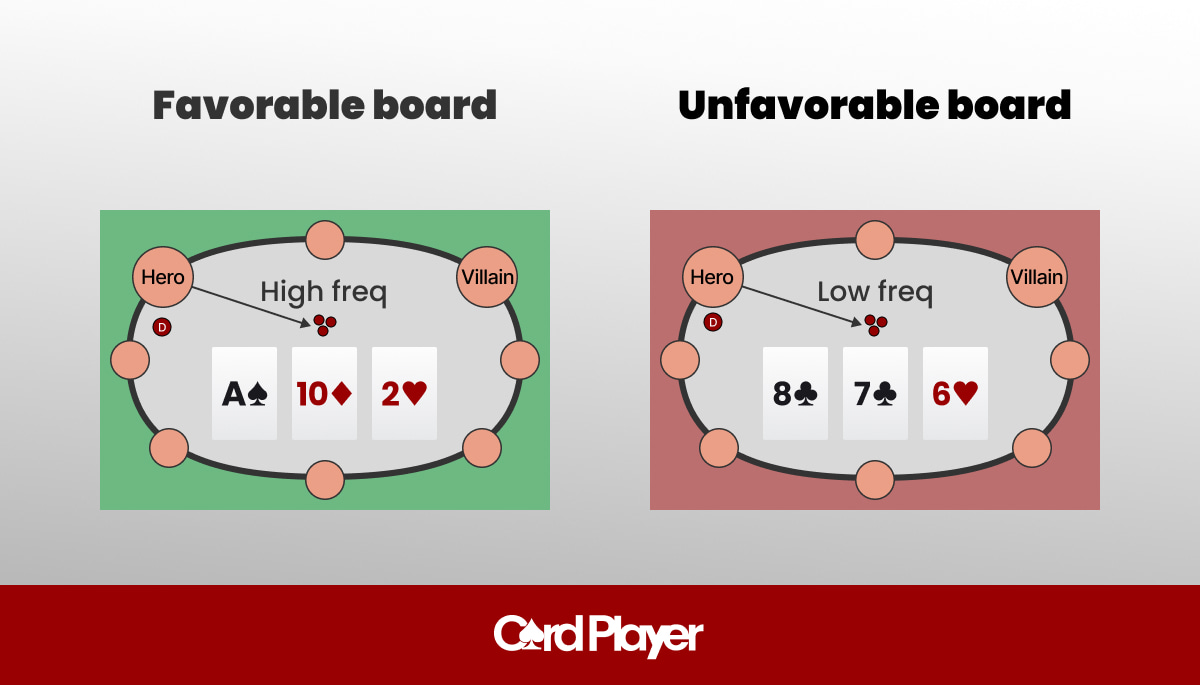
Generally, as the preflop aggressor, you should lean towards a continuation bet when one or more of the following apply:
- You want to bet for value with a made hand.
- You have a decent draw to semi-bluff.
- The flop is dry, favorable to your range and unfavorable for your opponent’s range.
- Your opponent is tight and overfolds to c-bets.
- You are in position.
You should lean towards checking when one or several of the following apply:
- Your hand has missed the board and has no equity.
- The flop is wet, unfavorable to your range, and favorable for your opponent.
- In a multiway pot, when you don’t have a very strong hand, as value thresholds rise and bluffing should be reduced significantly in these spots.
- Against loose calling stations without a very strong hand.
- You are out of position.
Calling Flop Bets
If your opponent bets first, either because you flat-called in position or defended your big blind, it’s likely you’ll be the one faced with a continuation bet.
In order to profitably call a continuation bet, you’ll need at least some equity in the hand in the form of a pair, a decent draw, or overcards with backdoor potential against opponents who continuation bet too often. Against frequent c-bettors, consider calling with overcards plus backdoor straight or flush draws. These hands can improve on later streets and put pressure back on your opponent. Weigh up your pot odds and hand strength when deciding whether to call or even raise.
Take note of your opponent’s c-betting frequency. If they tend to continuation bet on pretty much any flop and with any hand, you can call much lighter. Against players who only bet with top pair or better, you’ll need a decent hand to call. Learning poker involves adapting to your opponents’ tendencies.
Raising and Check-Raising
If you have a very strong value hand, such as a set, or you are drawing to the nuts and have lots of equity, it’s worth raising for value on the flop to build the pot. You may also mix in some strong and blocking bluff bets, especially when you block the nuts or nut draws.
Raising for value on the flop will build the pot to set up bigger bets on future streets. Before raising for value, make sure you can identify the weaker hands in your opponent’s range that will call as well as the board textures where you maintain the advantage.
You can also raise the flop as a bluff or semi-bluff in an attempt to win the pot right there and then. This is particularly effective against players who are c-betting every flop, as they will be forced to fold out a lot of their weaker hands and bluffs.
When you are out of position, check-raising is your main option for aggression. Checking entices your opponent into betting first. You can then put them to the test with a raise for value or as a bluff.
Turn Planning in Poker
The turn card can once again change the dynamics of the hand, completing draws or diminishing the value of pairs. The board can also pair, bringing the possibility of trips and full houses.
When learning how to play poker, your decisions on the turn should be based on the action so far and how the turn card connects with your own and your opponent’s range.
Value betting versus pot control
If you made a value bet on the flop, the key decision on the turn is whether or not to bet again for value. If you are still likely ahead despite the turn card, or the turn card improved your hand, another value bet will really buff up the pot, ready for the river.
Consider using pot control with your weak and medium strength hands, opting to check or flat call bets to keep the pot small. This allows you to reach showdown more often with a potentially winning hand, while negating losses when you are behind.
Firing a Second Barrel
Similarly, if you bluffed on the flop, it’s time to decide whether to follow up on the turn. Opponents will be forced to tighten up their calling range when faced with a large turn bet, allowing you to generate a decent amount of fold equity when you fire a second barrel.
If the turn is a scare card that improves your perceived range or you suspect your opponent called light on the flop, bluffing the turn can be profitable. However, a mistimed bluff is costly. If the turn card hits your opponent’s range, by completing their draws, for example, the best line could well be to give up by check-folding.
River Execution in Poker
The river is a unique moment in a poker hand. There are no more cards to come, so the equity of hands is now finalized. Draws have either made it or missed. The pot can become inflated by the river, so river bets can be substantial.
Thankfully, you’ll also have maximum information on the river. You’ll already have seen how other players acted on the previous streets, allowing you to narrow down your opponent’s range to a few possible combinations.
Betting with a Polarized Range
With your medium hands, checking or calling bets to make it to showdown makes more sense. So, when betting or raising on the river, you’ll usually be doing so with a polarized range made of very strong value hands and complete bluffs that have very little showdown value.
When betting with a polarized range, bet sizing should be large, such as a pot-sized bet or even an overbet. This puts maximum pressure on other players when you are bluffing and the maximum payoff when you have a value hand. As long as you keep your ranges balanced, it’s a tough strategy to counter.
Medium Hands
With medium strength hands, consider checking back or flat calling bets to get to showdown for cheap. This negates the risk of getting called by better hands or raised off the pot when you bet. If you are out of position, check-calling or leading with a small blocking bet can accomplish the same goal of making it to showdown. However, such bets can be exploitable by observant and adaptable opponents, and should be used selectively.
In some situations, you can bet medium strength hands for value. Effectively, you are representing a bluff to entice your opponent into calling with a bluff catcher. Betting with a merged range in this way is also useful against loose calling stations that can call with weaker hands. With a merged range, size your bets smaller to encourage wider calls.
Calling River Bets
If you are faced with a river bet or raise, ask yourself the following questions:
- Does your opponent value bet with worse hands, or do they only have hands that beat you?
- How often do they bluff the river?
The second question is crucial if you are considering calling the river with a bluff catcher. If your hand only beats bluffs, then you’ll need to assess your pot odds along with how often the villain bluffs, and consider whether you hold blockers to the opponent’s likely value hands or missed draws.
For example, let’s say that the villain bets full pot, laying you 2:1 pot odds. You’ll need 33 percent equity to break even. In other words, you need to win the pot more than once every three times to profitably call. So, if your opponent is bluffing more than one-third of the time, calling will be profitable in chip equity terms.
Advanced Poker Online: Tracking Decisions and Improving Spots
When playing online poker, you’ll have the advantage of being able to work with training tools that can take your game to the next level. You can also tag and save notes on opponents, as well as revisiting hand histories.
Here are some top poker guidelines to level up your online poker game:
- Review hand histories – Online poker platforms allow you to save and download hand histories, an option that definitely isn’t available when you play live. Many platforms allow you this, but some restrict or prohibit this feature, so always check site rules to avoid breaching any terms of service. You can use hand replayers to rewatch difficult spots, or filter hand histories by repeated situations, such as BB defense, flop c-bets, or river calls, to identify and work on major leaks.
- Analyze your game – Once you find leaks and tough spots, analyse them using solver tools or ask experienced players for advice. Study common scenarios like button versus big blind and small blind versus big blind spots, as well as specific areas that you struggle with, using our equity calculator. Then, take that new knowledge back to the tables.
- Multitabling – When playing advanced online poker, you can easily run multiple tables at once, which can give you a huge boost in terms of volume. However, make sure you don’t run on autopilot or play too many tables for your brain to handle. You still need to be able to plan through hands and adapt to opponents.
Guidelines to Advance Your Live Poker Game
Live poker is a much slower game, but this change of pace gives you a chance to really think through decisions and read table dynamics.
Here are some top advanced poker guidelines to improve your live poker game:
- Patience – Live poker requires a lot of patience. You’ll only be dealt one hand every couple of minutes, and you’ll be folding a lot of these preflop. Be sure to remain focused and involved with the game.
- Focus on hand reading – The slow pace of live poker allows you to track your opponent’s every move across multiple hands so that you can pick up on betting patterns, bet sizing tells, or even physical tells that give away the strength of other players’ hands. Keep watching even when you aren’t involved, as you’ll still gain valuable information to use when you do clash in a pot.
- Table image – Your actions will stand out more in a live poker game than they would do online, so be aware of your own table image. Other players will usually be forming their impressions based on how aggressive or tight you seem, as well as the value hands and bluffs that you have recently shown down.
Bringing It All Together: Your Next Phase as an Advanced Poker Player
Advanced play is not so mysterious. Really, it’s about precision and consistency when it comes to finding value and knowing when to bluff. Once you have developed solid preflop ranges, postflop play becomes clearer, and poker play simplified.
Poker requires a great deal of emotional control so that you can execute your strategy, stick to the plan over the course of a hand, and continue making logical decisions for hours. This takes a lot of practice. The real difference between a good and a great player lies not so much in the standard of their A game (though this is important, of course!) but in how often they can execute their A game in practice.
Once you have the basics mastered, the main way to advance your poker strategy is to track your sessions and analyse hand histories. This will help you identify and improve upon your major leaks in common spots, a process known as active study.
Learning how to play poker at an advanced level is a lifetime’s pursuit. Even elite players make mistakes. What matters is staying focused on the process of playing your A game and learning from your mistakes.
FAQs
Where can you play poker?
You can play poker online at licensed platforms, live in a casino setting, or set up your own home game to enjoy the popular card game with friends.
What are the rules of poker?
Poker rules depend on the variation and game structure. In Texas Hold’em, players are dealt two hole cards each, and five community cards are dealt across the flop, turn, and river. Players form the best five-card hand using any combination of cards and can bet and raise on each street.
How to win at poker?
To win at poker, you’ll need to master basic poker strategy and start to work with advanced poker concepts that can take your game to the next level. Solid hand reading skills, combined with having a plan for each betting round, will elevate your game. Ultimately, though, you win at poker by being better than the competition.
Is poker 100 percent a game of skill?
Poker involves both skill and an element of chance, known to experienced players as variance. The chance element determines short-term results, while the skill aspect gives better players a long-term edge over others.
Is poker hard to learn for beginners?
Poker rules are relatively straightforward, while anyone can learn basic strategy with a little effort and practice. However, mastering the game takes a lifetime.