







Under the Gun (UTG) in Poker: Definition, Position Strategy & Hand Selection
What Is Under The Gun In Poker?
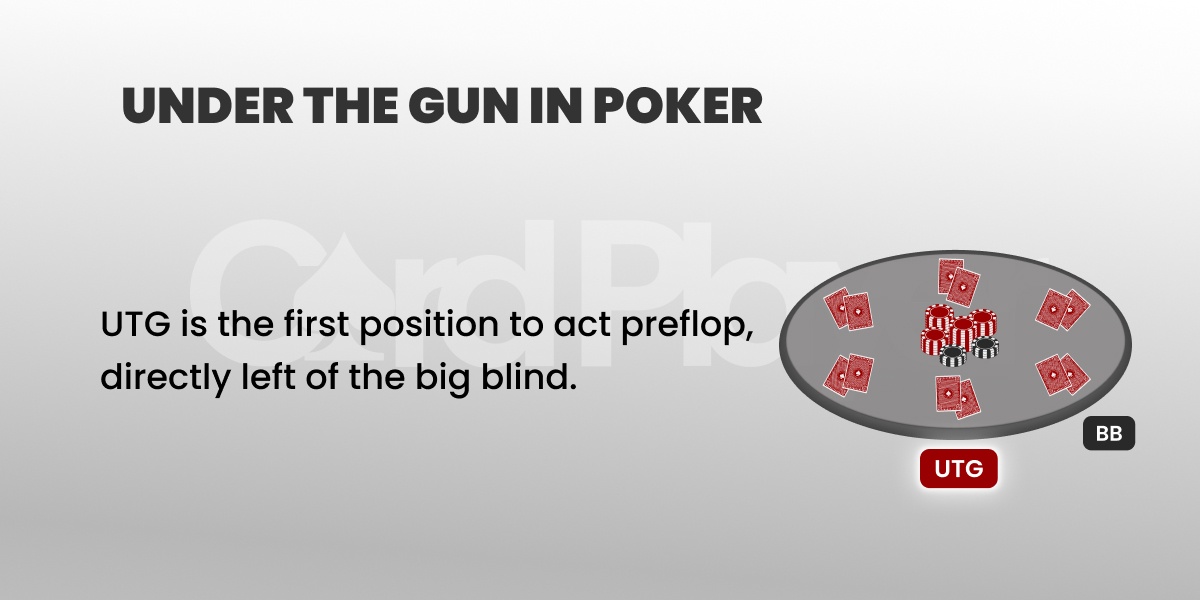
Under the Gun (UTG) is the first player to act after the hole cards have been dealt; this position is on the direct left of the big blind. There’s a big sense in which you’re guessing, and other people are reacting. That’s why it’s so high-pressure compared to almost all other positions when you have a full table.
UTG in Poker: Key Points
- When you are UTG, you act first, so you don’t have any information.
- Typically, when you are in the UTG position, you should tighten your range because the entire table is left to act after you.
- To play successfully from Under The Gun, you need to have a good understanding of table dynamics.
How UTG Position Works: Rules & Action Flow
The rules for UTG are straightforward: action begins with you preflop and continues clockwise, then resets postflop with the Small Blind acting first.
However, this simplicity masks a fundamental challenge – you must act first preflop without any information about your opponents’ hands. Since you are first to act, you are essentially playing blind. You can’t predict who is going to fold, call, or 3bet, which forces you to play a much tighter range than a player in late positions. In contrast, raising in late position gives you the luxury of knowing who has folded and who may come along. In UTG, you have no such advantage – several people behind you hold more information.
This information disadvantage creates costly traps.
A-Q, for example, is a strong hand that beginners love, but from the UTG position, you face eight or nine opponents who could wake up with A-K, Q-Q, or other premium hands. Similarly, K-J offsuit may seem playable from other positions, but it becomes problematic when two or three players raise behind you.
Early positions are expected to have strong hands, so when the board comes low, your continuation bets have less credibility.
Whether you’re playing on online poker sites or in traditional casinos, opening even slightly marginal hands from the UTG poker position can be costly. Better UTG play requires strict hand discipline and positional awareness, not just playing “good-enough” hands.
Recommended Ranges When Raising From UTG
Beginning players benefit from using a simplified UTG opening chart as a reference guide. While specific ranges vary depending on table dynamics and opponent tendencies, the core UTG range remains relatively consistent in full-ring play.
Recommended Opening Ranges From UTG
- Pocket pairs 9-9 and up.
- Premium Broadway pairs, typically Ace-King, A-Q, and occasionally A-J.
- Strong suited connectors, like 10-9 suited and better.
- A few hands like A-10 suited and K-Q suited when the table is passive.
In six-max games, the under gun poker chart opens up slightly as there are fewer people acting after you.
However, in six-max, the UTG still has the tightest range. Ranges such as Q-J offsuit, K-10 offsuit, and weak aces usually cause far more harm than good. These all seem like great hands, but they’re commonly dominated and folded to three bets. The point of keeping a tight range in UTG is precisely this: when you see a raise in front of you, you want the ability to withstand the test.
Keeping a tight range keeps you from entering big pots with hands that don’t make outs frequently enough.
Common Mistakes When Playing From Under the Gun
The biggest mistake new players make is treating the UTG position like any other.
Eager to get involved, they raise with marginal hands that don’t belong in the early position. However, a UTG raise commands respect at the table, making loose play especially costly. The other frequent error is overvaluing 8-8 or A-Jo. These hands play well in late position, where they are less frequently up against eight other hands, and don’t play well when there are eight people behind you. Suited cards with an Ace and a low card fall into this category.
While they have excellent flush draws, you’re left with a weak kicker.
Next, there’s the continuation bet problem. Some people in UTG think that after they raise preflop, they need to continuation bet (c-bet) every flop.
Adjusting UTG Play in Cash Games vs Tournaments
While UTG remains the tightest position in both formats, the strategic approach differs based on stack depth and blind structure.
In cash games, stacks are deep, and blinds don’t increase. Your UTG range stays consistently tight throughout the session since you can always wait for better spots. There’s no pressure to play marginal hands.
Poker tournaments require a different approach. Rising blinds create urgency – waiting too long burns through your stack. Your under the gun poker strategy remains disciplined, but you adjust your opening thresholds based on stack size. With 15-25 big blinds, you can open with stronger hands that can apply pressure or go all-in. This isn’t loosening your UTG play; it’s adapting to stack-to-blind ratios.
Late in tournaments, ICM considerations tighten your range even further. The cost of mistakes increases near the money, requiring heightened discipline and precision in hand selection.
Reading Opponents’ Reactions to UTG Opens
Raising under the gun normally means you have a strong range.
Paying attention to table reaction helps you get the reading on your rivals’ plans. A quick flat call from the middle positions could be a sign of a range hit-and-run min-raiser with small to medium pairs. A three-bet from the later positions could be a legitimate monster, and it could also come from a player who believes you open too wide.
Aggressive players tend to target the UTG range when they smell weakness and predictability.
The longer you watch these patterns, the clearer your play becomes in the post-flop range. Against an aggressive cutoff, you’ll either tighten your range and include some four-bets in your range, or against the passive callers, you can slightly narrow their ranges and decide your play.
These types of reads are built slowly, and they become the foundation that differentiates excellent UTG players from the rest.
Positional Awareness & Table Image from UTG
Your table image means much more in the UTG position than in almost any other position.
When you have won a few hands, your raise from UTG gets immediate respect. People think that your range is strong, but when you are playing a lot of hands, your raise will not be perceived in the same way.
Positional awareness counts, too. Pay attention to your opponents. If you have multiple aggressive players acting after you, consider playing fewer hands. If your opponents are tighter, you can widen your range.
Advanced UTG Concepts for Experienced Players
With the foundation in mind, you can then add complexity to your UTG approach.
There are some starting hands that you can add to your UTG raising range, like A-5 suited. These hands have the capability of making nut flush draws, wheel straights, and other concealed strong hands.
There’s also the matter of adapting open ranges according to the depth of the stacks.
With deeper stacks, standard opens are optimal in contributing to pots when you have the best hands. In shallower stacks, you should use a smaller sizing when raising.
In short-handed play, the definition of UTG changes slightly. With fewer players, the UTG position comes closer to the Button. The ranges expand, but still bear in mind that the rest of the table is yet to act.
FAQs
What does under the gun (UTG) mean in poker?
Refers to the first player who takes action pre-flop, seated immediately to the left of the big blind. The lack of information means that you should play only strong starting hands.
How do you play under the gun in poker?
Keep a tight, disciplined range. Play hands that can deal with raises from late positions and fold marginal hands when you hit a strong card on the flop.
Why is the UTG position considered unfavorable?
Because you make the first action preflop and don’t have any information on what the remaining players plan to do.
What are the common mistakes players make from UTG?
Opening too many hands, overrating the quality of hands that play better from late position, and continuation betting way too many flops.
How should hand selection differ when playing UTG?
Play only those hands that are resistant to re-raises, and mostly include high pairs and high broadways. Avoid those hands that appear strong initially but break when under test.
How should you adjust your UTG strategy in tournaments versus cash games?
In cash games, keep a tight UTG range throughout the session since stacks are deep and blinds don’t increase. You can always wait for better spots. In tournaments, rising blinds create urgency, so adjust your opening hands based on stack size.