










Deal in Poker: Definition, How to Deal in Poker & Tournament Deals
What Is a Deal in Poker?
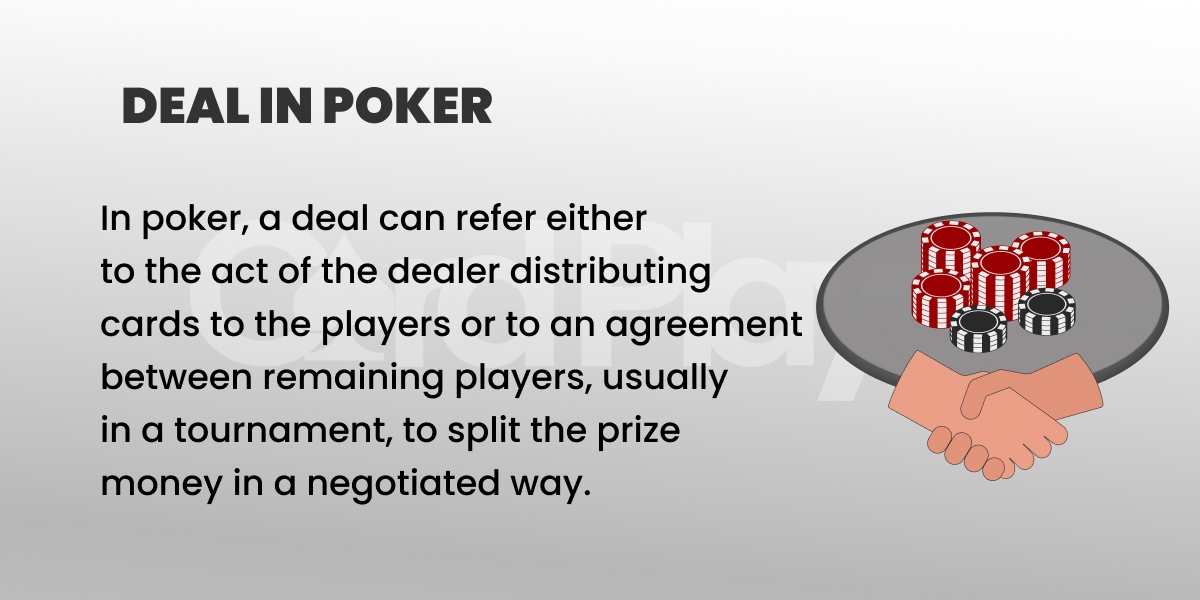
A deal in poker can mean two different things, depending on the situation.
At the start of a hand, the deal refers to the dealer passing out cards to the players. In Texas Hold’em, this means each player receives two cards face down. The dealer must follow strict rules to make sure the cards are dealt fairly and that no one sees them before they’re supposed to.
In tournaments, however, a deal in poker usually refers to an agreement between players to split the prize money. A final table deal in poker occurs when players agree to divide the payout rather than play until one winner remains.
This is often done to reduce risk and secure a guaranteed amount of money.
Deal in Poker: Key Points
- The physical deal involves a specific order of distributing cards, usually starting with the player to the left of the dealer (Small Blind).
- A tournament deal is a voluntary agreement in which players split the remaining prize pool rather than play until one player has all the chips.
- Proper dealing procedure is vital to prevent misdeals, which can invalidate a hand, ruin gameplay, and cause arguments at the table.
The Deal vs. Making a Deal
The main difference is in meaning and context:
- Deal in poker: Refers to the physical act of dealing cards at the start of a hand, following standard poker rules.
- Making a deal in poker: Refers to an agreement between players, usually in a tournament, to split the remaining prize money.
One is a gameplay procedure, while the other is a financial agreement between players.
How to Deal in Poker: Distributing the Cards
The standard poker deal procedure in live poker includes three main steps: shuffle, cut, and deal. The dealer shuffles the deck, a player cuts it, and then the cards are dealt one at a time to each player until everyone has two cards.
In online poker, shuffling and cutting are handled automatically by the software.
In Texas Hold’em, dealing always goes clockwise, starting with the player to the left of the dealer button, the small blind. Cards should be kept low to the table so no one accidentally sees them.
If a card is exposed during the deal, it’s called a misdeal, and the hand must usually be restarted.
Making a Deal: Tournament Prize Pool Split Examples
Making a deal in a poker tournament usually happens when only two or three players remain, the blinds are high, or players are fatigued. The tournament staff will pause the clock and calculate each player’s share based on chip counts.
For example, if $1,000 remains and Player A has 60% of the chips while Player B has 40%, they might agree to take $600 and $400, respectively. This allows players to lock in a guaranteed payout without risking all their chips.
Types of Tournament Deals
When discussing a tournament deal, it’s important to understand how different deal types work, because the method you choose directly affects how much money each player receives.
Chip Chop
In a chop deal in a poker tournament, players split the remaining prize pool based on their chip counts. For example, if you have half the chips, you get half the remaining money. Simple and easy to calculate.
ICM Deal in Poker
ICM deal in poker stands for “Independent Chip Model.” It is a much more advanced method that calculates your chips’ value based on the probability of finishing in each prize position (1st, 2nd, 3rd, etc.). Usually done with a computer or calculator. The idea is that the fewer chips you have, the more each chip is worth.
Chip ChopMoney is split based purely on chip count percentage.When chip stacks are very similar.
| Deal Type | How it Works | Best For… |
|---|---|---|
| ICM Deal | Complex math based on your chance of winning each rank. | Most fair for all players, especially small stacks. |
Common Dealing Mistakes (Card Distribution)
If you’re new to dealing, these mistakes are easy to make but also easy to avoid once you know what to watch for:
- Boxing a card: A card is facing the wrong way in the deck. If it appears face-up while dealing, follow proper procedure—usually it becomes the burn card.
- Dealing too fast: Rushing can cause cards to flip or send them off the table. Deal slowly and steadily.
- Forgetting to burn cards: Always burn the top card before dealing the flop, turn, and river to prevent marked cards from being seen.
A good habit for beginners is to mentally check each step of the deal before moving on, which reduces errors and keeps the game fair.
Common Poker Deal-Making Mistakes (Tournament)
Tournament deals can be confusing at first, so the key tip for beginners is to pause and double-check the numbers before agreeing to anything.
- Being too eager: Don’t show desperation when negotiating a deal; check ICM numbers first to ensure fairness.
- Ignoring the trophy/title: Some tournaments allow money splits but still require playing for the trophy or a small leftover cash portion. Always confirm final table deal rules with the tournament director.
Taking a few extra minutes to ask questions and review the deal can prevent costly mistakes and regrets later.
FAQs
What does deal mean in poker?
Deal has two meanings: the physical distribution of cards to players, and a financial agreement between tournament players to split the prize money.
How to deal in poker?
You shuffle, let someone cut the deck, burn the first card, and then deal cards one at a time in a clockwise direction, starting with the player to the left of the dealer button.
What is a final table deal in poker?
It’s when the last few players in a tournament agree to stop playing and divide the remaining prize money based on their current chip counts.
How does an ICM deal work?
An ICM deal uses a mathematical formula to decide how much each player’s chips are worth in real money, based on their chances of finishing in each remaining prize spot.
Can you be forced to make a deal in a poker tournament?
A deal must be unanimous. If even one player says “no,” the game must continue until someone wins all the chips.
What is a chip chop deal?
A chip chop is a simple way to split the prize pool, with each player receiving a percentage of the prize pool based on their share of the total chips in play.
Who deals first in poker?
To decide the first dealer, players are usually dealt one card face-up. The person with the highest card (Aces are usually high) starts with the dealer button.
Why do poker players make deals at final tables?
Players make deals to “reduce variance.” This is just a way of saying they want to avoid the bad luck of losing a big hand and missing out on a lot of money.