







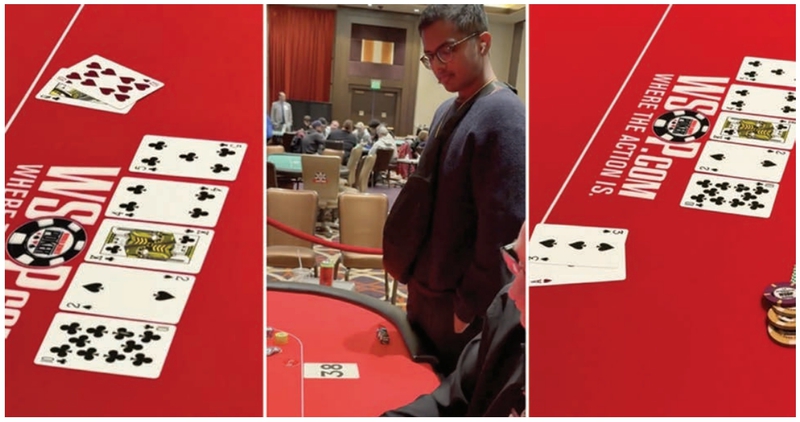
I’ll admit that I got a little hot and bothered during the debate surrounding Maurice Hawkins and his controversial WSOP Circuit win in Baltimore. Frankly, I was annoyed that there was even a debate taking place.
A player was wrongly eliminated after a dealer misread the board with just three left at the final table. Although nobody picked up on this error at the time, including the dealer, other players and cardroom staff, there was an unfortunate implication that the poker reporter on the scene noticed the mistake and chose not to speak up.
Let me be clear that this was not the case. The reporter in question was only alerted to the misread after the hand was published and after the footage was reviewed. By then, significant action had occurred, and nothing could be done but play on.
‘But what if the reporter had noticed the misread? Should they have spoken up?’
I couldn’t believe the question was even being asked, let alone that a handful of my fellow poker media colleagues were squarely on the wrong side of the answer.
Tabled cards speak, always, and game integrity is everything in the poker world. So, of course you should speak up!
Tournament Reporters
It takes a special kind of unicorn who is willing to travel and put in consecutive 12-hour days, who also has the required knowledge of all the games and players involved, and the ability to write about it coherently.
A reoccurring debate among my colleagues over the years has always split the room. Is it easier to teach a poker player how to write, or is it easier to teach a writer how to play poker? (The boring answer is it always depends on the player/writer.)
There were no concrete rules for live reporting when I first picked up the notepad and crept up to my first tournament table. It was the 2006 World Series of Poker, and I had just been hired by Card Player to work on the live updates team.
As live reporters, we were told to get as many details as possible, and to try stay out of everyone’s way. That’s it. That was the rule book.
Live updates were still a pretty new concept, nothing had been standardized. Every reporter invented their own shorthand for taking hand notes. Every reporter determined who and what was considered notable. Every reporter had their own style for interacting with players and staff.
I found out very quickly which players were approachable and who to stay away from. Which dealers were helpful in calling out all-ins and keeping the board up. Which floor understood the value of live updates, and which thought we were just a nuisance.
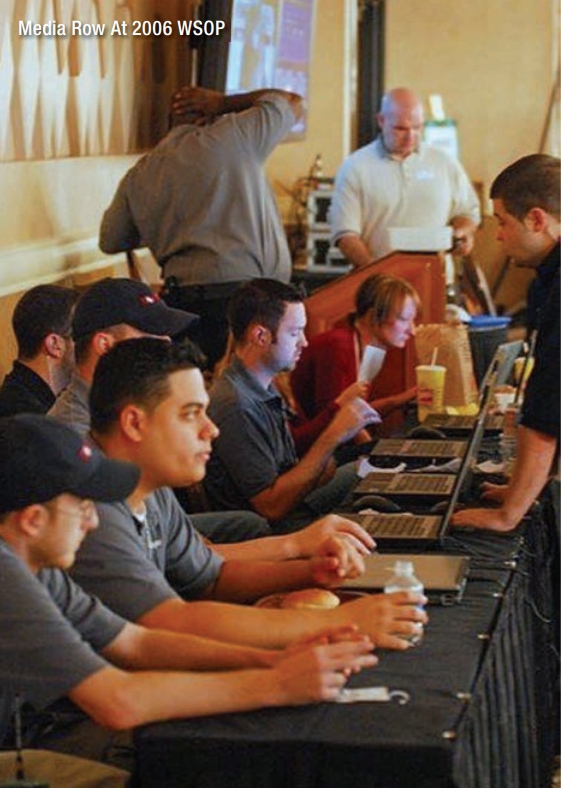 I learned how to recreate the action by quietly asking players not in the hand. If I saw a player with a big stack, I would wait until they folded and then ask them how they got it. (99% of the time, players are happy to tell you how they stacked somebody.)
The phrase I kept seeing thrown around during the debate by the say-nothing crowd was that the media should be ‘a fly on the wall.’
While I agree that poker journalists should never interrupt the action or worse, interject themselves into the story, there’s a huge gulf between being an invisible observer and speaking up to correct an obvious error. We’re not talking about changing the outcome here, we’re talking about making sure the right outcome is recognized.
I am a firm believer that we are all on Team Poker. That includes players, operators, and the media. And as members of Team Poker, it is our duty to first and foremost promote the growth of the game. Without players, the game is dead. And players don’t come back when they feel like they were treated unfairly or cheated.
Stupak And Shak
While it’s been a minute since I did the job myself, I do have a few thousand hours logged on the tournament floor. I can recall dozens of instances over the years when I spoke up to correct an error, be it a boxed/floored/railed card, dirty chip stack, pointing out who didn’t ante, or just to remind a table that the blinds went up.
And I can’t even count how many times in the early days we would help out new dealers who didn’t know how to spread mixed games or split pots at the WSOP.
There was the time I corrected the bust-out order at a big Los Angeles tournament, when the late Bob Stupak tried to use a well-timed bathroom break to make a pay jump. There was also that time in Atlantic City where I was asked to recreate the action at a divided table so the floor could determine if a raise was legal or not.
And when it comes to holding up the game, I was never afraid to tell a dealer to pause for a second before killing the board or the cards so I could get all the details. Nobody at the table ever objected or complained about the media making sure they got it right. Not once.
Of course, the key to knowing when to say something is all about knowing when NOT to say something, which is most of the time. And you must never even consider saying anything if the cards haven’t been tabled!
One of the biggest bluffs I ever got through was while reporting on a hand during a WPT event at Foxwoods in Connecticut.
There were five players who checked to the river of a board that read A-K-J-10-Q rainbow. Nick Schulman went all in for about 25x the size of the pot, and Men Nguyen called off his stack behind him. A third player who wasn’t paying attention quickly folded behind them, which prompted laughs, from most the table.
Tom Dobrilovic moved all in, and the action fell to Beth Shak, who couldn’t quite figure out what was so funny and why everyone was betting so much. She held her cards up to her face, revealing that she had turned a straight, but now wasn’t sure what to make of her hand as she looked back at the board.
The table then got really quiet. I had managed to stifle my own laughs as I stood stone-faced and motionless behind the dealer, directly in Beth’s line of sight. If she was looking for help, she wasn’t going to get it from me.
After about a minute, she folded, and the three pros turned up their garbage to chop up the tiny pot. “Every little chip helps,” said Schulman.
If you happen to be in the special unicorn club of seasoned tournament reporters, I believe that you are more than qualified enough to know if you are in a Stupak situation where you should speak up, or a Shak situation where you should stay silent.
TDA Rules
Thankfully, I wasn’t alone in my opinion that game integrity should trump journalistic integrity. (Why not both?) In addition to my associates at Card Player, there were a number of veteran reporters whom I respect who were also adamant that misreads should be called out.
A poll on Twitter by poker pro DJ MacKinnon of over 3,600 found that 70% of respondents believed media should speak up, with 30% saying they shouldn’t.
Tournament Director’s Association co-founder and WPT Executive Tour Director Matt Savage was also quick to point out and clarify TDA rule no. 12.
Declarations: Cards Speak At Showdown
Cards speak to determine the winner. Verbal declarations of hand value are not binding at showdown, but deliberately miscalling a hand may be penalized. Dealers should read and announce hand values at showdown. Any player, in the hand or not, should speak up if they think a mistake is made in reading hands or calculating and awarding the pot.
“To me, ‘anyone’ means the winning player, the losing player, another player in the tournament, a tournament director/floorpeople, spectator, poker media, live stream operator, or anyone who would speak up,” Savage wrote on Poker.org. “It could be a massage therapist, a housekeeper, or somebody just walking by the table. I don’t care. I want the pot pushed to the right person when they pay to win that pot.”
I completely agree with Matt, and I imagine the TDA rule will be amended in the future to state that ‘any one individual,’ not just ‘any player,’ should speak up if they think a mistake has been made.
This isn’t the first high-profile dealer mistake, and it won’t be the last. It’s unfortunate, but human error is always going to be some part of the game (especially after a long day at the tables). It’s on all of us at Team Poker to make sure we limit the mistakes when we can. ♠
 Julio Rodriguez is the Publisher and Editor-In-Chief for Card Player Media, having started with the company as a live tournament reporter at the 2006 WSOP. Originally from Miami, Florida, he now lives in Las Vegas with his wife and daughter.
*Screenshots from Poker.org.