







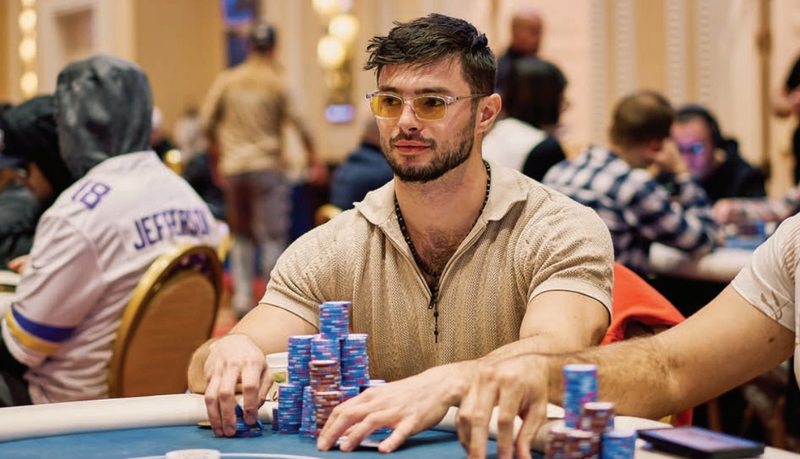
Zak Vankeuren is a holistic wellness coach, peak performance consultant, and professional poker player from New York. He considers himself a student of life who is daily exploring the mystery of existence.
Vankeuren feels his main purpose in life is supporting other people in living the life of their dreams with health, happiness, intentionality, and conscious design. He studied neuroscience, psychology, and philosophy at Duke and possesses life coaching and personal trainer certifications.
But it turns out he’s quite a poker player as well. He earned $160,000 at the Rock’n’Roll Poker Open back in 2022 and has since added numerous deep runs at the North American Poker Tour, Borgata Poker Open, and WPT Championship. This summer, he finished runner-up in a $1,000 WSOP Online event for $83,727 before breaking through for the bracelet and $219,450 just a few weeks later in the $3,200 online high roller.
Most recently, he topped a massive field of 9,670 at the Wynn Las Vegas in the WPT Prime Championship, pocketing a life-changing score of $1,162,350. Card Player caught up with the 26-year-old to break down a few key hands from his run to the title.
Event: WPT Prime $5 Million GTD
Buy-In: $1,100
Entrants: 9,670
Prize Pool: $9,379,900
First Place Prize: $1,162,350
Stacks: Zak Vankeuren – 470,000 (39 BB) Villain – 800,000 (66 BB)
Blinds: 6,000-12,000 with a 12,000 big blind ante
Players: 9
Players Remaining: 1,000
ZV: It’s early on day 2.
Vankeuren raised to 25,000 from the cutoff holding 7 7
7 . Villain called from the big blind.
ZV: My opponent was a young guy whom I’ve never played with before. He was recently caught bluffing from the big blind in a small pot, however.
Flop: J 6 5
5
Villain checked, and Vankeuren bet 35,000. Villain snap called.
Turn: 5
Villain bet 26,000.
CT: When a player donk bets in this spot, what are they usually trying to accomplish?
ZV: I think the five is a good card for the big blind to lead on because the big blind should have a stronger range with more 5-X and J-X hands when he calls my half-pot bet on the flop.
Although I will have some overpairs crushing his non-trips hands, I will also have a ton of junk hands like ten-high to ace-high that have bet the flop and now only have some overcards. Many of his hands, whether J-X, 6-X, trips, or straight draws, want to nudge the pot as both value and bluffs.
 CT: What did your raise preflop represent to the Villain?
ZV: When I raise preflop from the cutoff, I will have very few 5-X hands, other than A-5 offsuit, K-5 suited, 7-5 suited, 6-5 suited, and 5-4 suited. The big blind, in theory, should be able to lead this turn with many hands for a small (20-30 percent of pot) donk bet as he did.
I think in position on the turn, my only play is to flat call. A jack is unlikely to fold if I raise. Raising against a six for value is a bit thin, and raising allows me to potentially be three-bet on the turn versus a better made hand or draw, which would put me in a terrible spot. I’d rather call and pot control in position and always see a river to hit my potential two outer. Depending on what happens on the river, I can determine whether to call another bet, fold, raise, or check down.
Vankeuren called.
CT: Any further thoughts on the Villain’s range as you processed the donk bet?
ZV: I expect to see a decent amount of J-X, 6-X, some 5-X, straight draws like 9-8, 9-7, 8-7, and some mid pairs like 2-2 thru 8-8.
River: 8
Villain bet 85,000. Vankeuren raised to 270,000.
CT: Break down your thoughts regarding the choice to raise.
ZV: When the big blind leads here for 85,000, I feel like he has a relatively strong value hand, particularly a jack. Based on his line and bet size, I doubted he had a weak value hand, like a six or even an eight. I thought he was significantly weighted towards J-X and 5-X —his bet, though just under half pot, was a very large bet at the time in the tournament.
CT: Where was your head at this moment?
ZV: Well, at this point, I felt my 7-7 was simply a bluff-catcher and that on this river, it was hard for him to have many bluffs. I felt my only moves were to either fold or raise.
Given that this opponent was a relatively young reg who I think would take this line with some J-X hands, maybe size bigger with trips and straights, I double block 9-7 for a rivered straight, and hope that my raise would look extremely strong here, I opted to raise as a bluff. I had not shown any bluffs at this table yet, and I thought my line looked very strong, like a straight or full house.
Villain folded, and Vankeuren won the pot of 275,000.
ZV: This pot allowed me to chip up massively which helped me acquire more chips for the rest of the day.
Stacks: Zak Vankeuren – 47,000,000 (47 BB) Villain – 52,000,000 (52 BB)
Blinds: 500,000-1,000,000 with a 1,000,000 big blind ante
Players Remaining: 9
ZV: This is one of the first hands of the final table. With nine players left in a massive 9,670-player field, ICM is at an all-time high nine-handed. Ninth place gets $114k, while first gets a whopping $1,162,350.
 CT: What were your thoughts regarding ICM with two small stacks at the table?
ZV: In theory, I need to be quite careful as a middling stack because losing a lot of chips and getting knocked out would be a massive ICM disaster right now. However, with 47 big blinds and the chip leader folding UTG in this hand, and my sense that I was among the most skilled players at this final table, and with some newer players behind, I have room to see some flops and maneuver post-flop.
CT: Did you do any prep for this final table? Do some research on the players, etc.
ZV: I did a little digging on some of the players, looking into their previous tournament runs and experiences, as well as their background in either cash games, other industries, etc. Clearly, a couple of players were solid professionals, while others were much more beginners.
The majority of my preparation was mental and emotional. What I mean by this is I took time to sit with my thoughts and emotions the night before the final table. I noticed all sorts of things coming up, like: “Tomorrow is the biggest day of my poker career.” “So many of my friends and family are reaching out and will be watching.” “I hope I play my best and win.” “I don’t want to make any mistakes.” “I’m the most skilled player at this final table, I can’t get knocked out before third place at least.” None of these things are important; I just need to relax and play my best.
All sorts of conflicting thoughts and emotions were coming up, based on fear of not doing well, desire to win the most money and first place, and desire to control the situation. Even though these thoughts and emotions are natural, they are not aligned with my optimal state of mind, which is being at peace with the outside world and my inside experience.
Ironically, the only way for me to get to that ideal mental state of peace is to make peace with all my different thoughts, to remind myself that (1) Yes, I want to win first and will do everything in my power to play my best and take first place, and (2) everything I am experiencing is just as it needs to be, that regardless of the outcome, I am inherently good enough as I am, and that I am safe, loved and blessed, no matter whether I finish ninth or first.
CT: You had to be pumped to be part of the final nine at this huge WPT event.
ZV: I was. Making this massive final table and having my family and friends able to watch from back home was a rare blessing. I wanted to ensure I fully appreciated and enjoyed the moments before that brief experience ended.
I went into the final table feeling amazing with a mantra in mind: maximal positive intention to win but zero attachment to what happens.
This intention and mental preparation helped me let go of unnecessary stress, fully focus and trust myself every hand, and enjoy more moments of that special final table. I obviously ran very well, but I do not doubt that my mental and emotional preparation allowed me to feel and play my best.
Vankeuren raised to 2,100,000 from UTG+2 holding K J. Villain called from the small blind.
ZV: I had gotten some intel before the final table that this was the small blind’s first-ever poker tournament. I was told he didn’t play much poker besides the occasional cash game. Based on his play the last few days, that could very well be true. He definitely didn’t seem like a seasoned tournament pro.
Even though he is a rec player, his flatting range from the small blind should be much stronger than if he were in the big blind. I imagine his range looks something like 2-2 thru J-J, A-10 thru A-Q, K-Q offsuit, A-X suited, suited broadways, and suited connectors.
Flop: 7 7 2
Villain checked.
ZV: In this spot, I think there were merits to both betting and checking. By betting, I can clean up my outs by potentially getting some K-Q or A-J to fold immediately, and I can also start putting pressure on middle pocket pairs to get them to fold on future streets potentially.
However, there are some important reasons to consider checking. This player covers me and can stack me in a cooler situation flush over flush or full house over flush, etc. I don’t want to get in a massive cooler versus this player here. He can absolutely have some trips and getting check-raised here would be a disaster, especially since the small blind can certainly flat a bunch of As Xs hands that have me almost drawing dead.
By checking back, I allow myself to realize my equity by getting to the turn for free without isolating myself versus his strongest hands, and when I hit a flush, my opponent will likely not expect me to have one after I check back the flop. I also get to trap my opponent’s worse K-X and J-X hands like K-10 suited, K-9 suited, Q-J suited, J-10 suited, and J-9 suited that will fold when I bet the flop.
Vankeuren checked.
Turn: A
ZV: The turn was beautiful, which gave me the nut flush. The only hands I lose to are 2-2, 7-7, and A-7 suited, or A-A, if the small blind chose to flat pocket aces to trap. Overall, I’m very happy to try to get the max from the Villain’s A-X, 7-X and worse flushes.
CT: What was the best bet sizing to accomplish your goal?
ZV: That was the big question for me. There’s 6,200,000 in the middle and 45,000,000 in my stack.
If I bet too big, many of his hands will either immediately fold or call turn and fold river. With both the king and jack, not only do I have many of his hands drawing nearly dead, but I also block many of his hands that could continue.
In-game, I thought that by betting small, I would allow his value hands (A-X, trips, and flushes) and bluffs to raise my bet, or for his value hands to call the small turn bet and then call my big river bet on nearly all runouts.
Vankeuren bet 2,400,000, and Villain called.
CT: What did you make of his call there?
ZV: At this point, I expected him to have mostly A-X or one pair hands with a spade.
River: 6
ZV: The river was an irrelevant six. With the effective nuts, 11,000,000 in the middle and 42,000,000 million behind, I considered some different bet sizes. I don’t expect many raises from him here after the flat on the turn.
So, I think I need to bet big myself. An overbet might be seen as an attempt to get him to fold his A-X hands.
Vankeuren bet 10,200,000. Villain tank called and revealed A J. Vankeuren won the pot of 30,400,000.
ZV: I was propelled to second in chips at that point. And then soon thereafter, the chip lead, which I was able to maintain until I captured first.
Follow Zak on Twitter/X @ZakVankeuren. ♠