



Scheduling an interview with players from the Big Game is tougher than a 50-cent steak. I've got Phil Ivey on deck, but we're like Gavin Smith in a singles bar – unable to hook up. (Take that, Tippy-Toe Canadian!) I believe it's important to have a basic knowledge of the players to understand how some of the hands are played and how the action comes down. Therefore, I'm not through with my profiles of the players in the Big Game, but let's take a break and discuss a few interesting hands I've played lately.
I recently wrote in my column on Ted Forrest that I wish I could follow through on my reads as well as Ted can. Before that column could even make it to press, I refused to grant my own wish. This hand happened in San Jose, in the tournament before the main event.
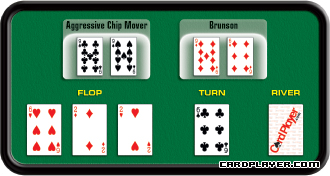
I started the hand with about $24,000. The blinds were $400-$800. I raised a little less than $3,000 from early position with the 9 6. I hadn't played a hand in a while and assumed I'd get respect with a raise from early position. Well, I was right preflop; I was smooth-called in two spots by what I perceived to be big hands. Both players had me covered. The first player was fairly tight, and I gave him two big cards, but not too big, as he didn't reraise; A-J, A-10, K-Q, K-J, or possibly A-Q.
The second player was an aggressive chip mover. He was in the blind and fumbled around with his chips, trying to make a decision. He was the tournament chip leader or close to it, and played a lot of hands. I knew he wouldn't hesitate to play a trash hand in a multiway pot, especially with the discount he was getting, being the big blind.
Knowing all of this, what was he thinking about? I knew he was pondering a reraise, so I gave him a middle pair – eights, nines, or tens, most likely. Why? Deuces through sevens are usually just calling hands against two strong players, especially if one raised from up front, as I had. Jacks or higher is usually an automatic reraising hand from an action player with chips like he had. A-Q was a possibility, but I don't think he would have studied too long with that. No, pocket eights, nines, or tens was what I thought he had to have.
What a horrible position I found myself in. If the flop comes big, I probably will get called by the first player if I try to represent a hand. If it comes small, the middle pair will pick me off. Maybe I could flop a flush, I hoped as the dealer burned and dealt the flop: 6 2 2.
2 2.
"Lovely!" I think to myself. "Now what?" The second player checks to me. I'm fairly certain I can shoot straight through the first player (the one with two big cards), which leaves just the aggressive chip leader, the second player (whom I put on a middle pair). Hmm.
Maybe I was wrong on my read. Well … I was gonna find out. I bet $10,000 and the first player went out, just as I thought he would. Unfortunately, the second player did just what I thought he was gonna do, too – raise. I had $11,000 left; now what?
The pot's laying me about 4-to-1. Sounds good? Not really; if he has what I'm afraid he does, I'm either around 8-to-1 if he has 9-9 or 10-10, or a little worse than 3-to-1 if he has 8-8 or 7-7. If he happens to have a flush draw, he probably has two overs with it, making him about even money. "That's it!" I hope to myself.
But if he has something like that, why the preflop hesitation? Q-J or 10-9 suited would be an immediate call. The more I think, the more I believe my original read was correct. I need to muck this loser and hold on to my last $11,000. I can't get the flush draw out of my mind, and I finally talk myself into making what I know is a sick call.
To my horror, he flips over pocket nines, just as I thought. I played bad and deserved to lose all of my chips and then be thrown out of the casino (and then beaten with a stick). But, as happens often enough to me, the poker gods decided to reward bad play, and off rolled a 6 on fourth street! "Do other donkeys feel this embarrassed when they draw out on me?" I wondered quietly to myself.
I wasn't done stacking this monster pot when the whole field limped in and player two from the last hand (who was understandably upset) made a huge raise. I was in the big blind and looked down to see big slick! I was sure that I had player two beat, but what about all of those limpers? Was there a trap out there set for player two?
Well, I should be out of the tourney anyway, so what have I got to lose? Besides, the illogical side of my brain is a big believer in the rush … all in! Once again, my read was right on; I had player two crushed, and sure enough, there was a trap a waitin' on me.
The player who limped in from first position had pocket kings. Oh well, the poker gods were with me for the time being, so I wasn't too concerned. Once again, my intuition was right on. I had this trapper drawing dead after the flop, which contained two aces. I went from short stack to tournament leader in two hands! (I went on to finish third.)
Only in America – or, more specifically, only in San Jose! The Shooting Star tourney is one of my favorites. The fans are unreal; they make me feel like a rock star. The whole month in Los Angeles, I signed about 100 autographs total. In San Jose, I signed 500 easy in just three days! (I better not see any of those on eBay, guys.)
Not only that, but the staff is great. Marko is an amazing owner/operator. I think it's wonderful that he hired a mentally challenged man (Matt Savage) to run the whole show.