





Editor's Note: To mark recent negotiations with Iran, McManus has prepared a pair of columns about bluffing at poker and nuclear bargaining tables. After that he'll return to the historical timeline with "Dr. Jerry Cardplayer and the Vying Games That Gave Rise to Poker."
The World Series of Poker is played nowadays in the Rio's Amazon Room. This hangar of a convention hall seats up to 2,431 players and dealers at 213 oval tables, each one lit by a white Noguchi-esque lantern and far above that by scores of spotlights hung from black scaffolding along with surveillance cameras, ad banners, and air ducts. As chips clack and clatter, many thousands of cards are shuffled and pitched, peeked under, fingered and mucked, always clockwise.
The 2006 event took place during the summer of Hezbollah v. Israel, the foiled Qaeda plot to blow up jetliners with liquid explosives, the Security Council's ultimatum to Iran to stop enriching uranium. In Las Vegas, the air above the asphalt was a breezy 130, like a hair dryer held an inch and a half from your nostrils. Yet it was brisk enough each day in the Amazon Room to shiver in heavyweight fleece. The question that kept crossing my mind was, "Where's the fuel to keep powering all these compressors gonna come from?"
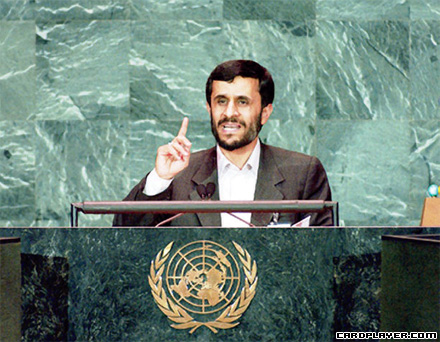
A few weeks earlier, on April 11, 2006, Iranian President Mahmoud Ahmadinejad held a pep rally in his country's holiest city, Mashhad, which means "Place of Martyrdom." Wearing traditional Persian garb, bearded young men – I won't call them dervishes – whirled about among fluttering doves, chanting "God is great!" and brandishing silvery tubes of uranium hexafluoride. No Monty Python skit, their joyous dance macabre served as the overture to Ahmadinejad's triumphant claim: "Iran has joined the club of nuclear nations."
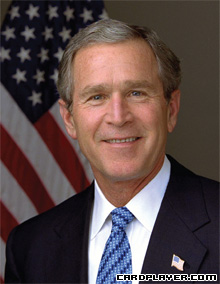 President Bush implied this claim was a bit premature. "We want to solve this issue diplomatically," he said, but refused to rule out the use of force "to prevent Iran from developing" weapons-grade fuel. "All options are on the table," he warned, presumably including a nuclear strike. In reply, Ahmadinejad rattled his scimitar, vowing to "cut off the hands of any aggressor." His boss is Iran's religious leader, Ayatollah Ali Khamenei, who calls those who seek reconciliation with America "simpletons and traitors." The two countries haven't officially spoken since 1979, when Islamist radicals – Ahmadinejad among them – seized the American embassy, took 52 hostages, and clinched the revolution that put the mullahs in power. Now Ahmadinejad says that shutting down the uranium-enrichment program "is our red line, and we will never cross it." To those who might be angry about the program: "We say, be angry at us and die of this anger."
"Ahmadinejad and the Iranian regime are bluffing," at least according to Gerald Steinberg in Toronto's Globe and Mail. "Rather than a sign of strength, the premature and exaggerated boasts appear to reflect weakness." Whereas the headline above an op-ed piece by Martin Indyk in the Los Angeles Times declared, "Iran's bluster isn't a bluff." Despite diametrically opposed views, each writer, like thousands of their fellow journalists, correctly assumed his readers understand what a bluff is – the devilishly cunning mechanism, that is, for leveraging uncertainty at the heart of America's national pastime, as well as a key tactic in our military strategy, especially since the dawn of the nuclear age.
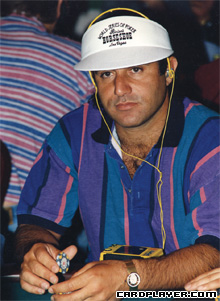 At least 250 years before our country was founded, however, Persian courtiers were playing bluff-based card games with decks of four suits: coins, goblets, polo mallets, and scimitars. In the late 18th century, their vying game As-Nas (My Beloved Ace) may have become the prototype for the 20-card French game poque. Pronounced pokuh in New Orleans, the game picked up elements of English brag (such as draws, straights, and flushes) as it evolved into 52-card poker on Mississippi steamboats in the decades after the Louisiana Purchase. Union and Confederate soldiers played the game between battles, then brought it home to every state and territory. By 1970, when the first World Series of Poker was played in Las Vegas, the variation of choice was no-limit Texas hold'em. Over the next 36 years, the number of challengers in the main event mushroomed from 7 to 8,773, including players from 56 countries. But only one besides the United States has produced more than one champion – Mansour Matloubi and Hamid Dastmalchi, both of whom hail from Iran.
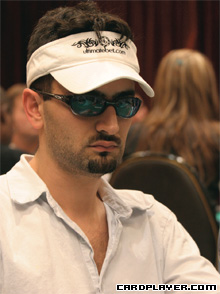 Along with Antonio Esfandiari, Amir Vahedi is considered one of the likeliest native Iranians to bring this number to three. Born in Tehran in 1961, Vahedi enlisted in the army during the war with Iraq. After he'd served for two years in that hideous bloodbath – poison gas was deployed, martyrs brigades of children, the basiji, marched across mine fields – Vahedi's mother begged him to desert his unit and leave the country. Despite his determination to serve with honor, he decided to obey his mother's desperate plea. He was imprisoned in Afghanistan, but upon his release managed to obtain a forged passport, make his way to East Berlin, slip into West Berlin, and eventually arrive in Los Angeles. There, he drove limos and learned to play tournament poker, achieving enough success in the latter – his lifetime earnings exceed $2.5 million – to be immortalized with a cigar-chomping bobblehead. Affable and gregarious away from the tables, Vahedi is almost recklessly aggressive while playing hold'em. "To live in a no-limit tournament," he has famously observed, "you have to be willing to die."
Ahmadinejad seems to have adapted this as his rallying cry. He was a basij recruiter during the war with Iraq and has lately been extravagant in his praise for suicide bombers. In his inauguration speech, he asked, "Is there any art more beautiful, more divine, and more eternal than the art of the martyr's death? A nation with martyrdom knows no captivity." And if, as he believes, the Twelfth Imam is about to return to destroy the infidels, why should he compromise, especially when a reported 9 million basij formed a 5,400-mile human chain to support his nuclear program?
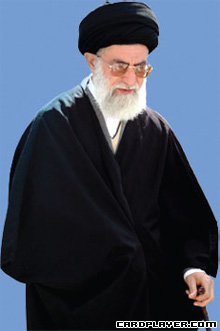 But is Ahmadinejad really a martyr himself, or does he just play one on TV? More crucially, can the West accept nuclear weapons in the hands of a demagogue obsessed with self-slaughter? Even though his regime probably has no warheads yet, it counts on belligerent pronouncements toward Israel – which "must be wiped off the map" – and America to rattle world energy markets, raising fuel prices while enriching Iranian coffers at the rate of $2 billion a week. This in turn enables it to fund Hezbollah and Shiite jihadis more lavishly, to pay hefty sums to import nuclear expertise, and makes it less vulnerable to economic sanctions. In this sense it has us almost literally over a barrel. Much, much worse, Iran's nuclear program keeps edging closer to yielding the 15 or 20 kilograms of U-235 necessary for a warhead or suitcase bomb. Ahmadinejad and the atomic ayatollahs may have banned gambling card games, but they have signaled a willingness to risk millions of lives – Muslim, Christian, and Jewish – in the ultimate no-limit staredown.
Parallels between poker and nuclear showdowns are seldom neat or one-to-one, yet no game resembles high-stakes diplomatic and military maneuvers more closely. Bluffs, counterbluffs, and the ability to deduce opponents' intentions and strength from contradictory signals had long been at the heart of most countries' defense tactics. (The German word bluffen means to bluster or frighten. The English version, apparently combining both meanings, first appeared around 1665.) Beginning in the early 19th century, the importance of bluffing in military and other affairs spurred poker's development and popularity. No other pastime so perfectly captured the essence of this deceitful yet often lifesaving tactic – of making someone believe you will fight to the death, for example, without having to actually shed any blood, let alone evaporate cities.
By the middle of the 20th century, with the nuclear arms race neck and neck, two brilliant Princeton professors helped the United States pull ahead of the Soviet Union. Economist Oskar Morgenstern served as an advisor to President Dwight Eisenhower. All-around math whiz John von Neumann had already made vital contributions to the Manhattan Project, and was now working on information theory and computer technology.
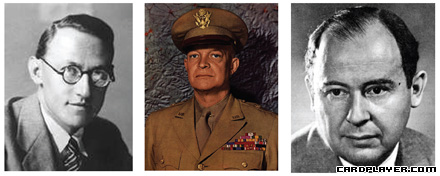
As Morgenstern wrote in 1961 in the New York Times Magazine: "The Cold War is sometimes compared to a giant chess game. The analogy, however, is quite false, for while chess is a formidable game of almost unbelievable complexity, it lacks salient features of the political and military struggles with which it is compared." Since chess is a game of complete information, it provides no opportunities to bluff, leaving it "far removed from political reality … where the threatening nation has to weigh the cost not only to its enemies, but to itself, where deceit is certainly not unheard of, and where chance intervenes." Chance, deceit and cost-effectiveness are basic to poker, a vying game in which, as Morgenstern used capital letters to emphasize, "THE BEST HAND NEED NOT WIN." Why not? Because strong players with weak hands can deploy "artful deception through bluffing" to steal pots from weak players with strong hands. It is the bluff that makes poker the most useful model for "countries with opposing aims and ideals [who] watch each other's moves with unveiled suspicion."
Ours was naturally suspicious 40 years later, when we learned that Iran had sought warhead designs from Pakistan while developing long-range missiles capable of delivering those warheads. According to Raymond Tanter, a former member of the National Security Council, Iran had used reverse engineering of hardware secretly purchased from Ukraine to move "a screwdriver's turn away from having a nuclear-capable cruise missile system."
A successful bluff involves dozens of interconnected factors – an artful blend of nerve, mathematics, timing, psychology, pattern recognition, and what might be called recumbent method acting. (At the most basic Stanislavskian level: If second-place money makes a CPA happy, he's gonna look happy to be called.) It also requires a coherent storyline; it may mislead the opponent but shouldn't confuse him. Otherwise, he might call just to satisfy his puzzled curiosity.
The most artful bluffs require a rational, smart, even ingenious bluffee. Facing a donkey or a foe bent on martyrdom, it's better to wait till you have a real hand. Your opponent must fear losing his chips and be able to imagine you having the hand your body language and bets represent. The story you sell him must be not only coherent, but credible. As you lie to his face, after all, you're counting on him to believe you. And the more often you're caught bluffing, the harder it becomes to pull off the next one. Lake Meads of ink have been spilled on the subject of bluffing, but two recent books are especially useful: Matt Lessinger's The Book of Bluffs and former FBI agent Joe Navarro's Read 'Em and Reap.)
In Part II, we'll take a closer look at how American and Iranian diplomats may or may not be using this tactic. 
Editor's Note: This article was adapted from McManus' article "Bluff," which originally appeared in the Nov. 5, 2006, Los Angeles Times Magazine.