







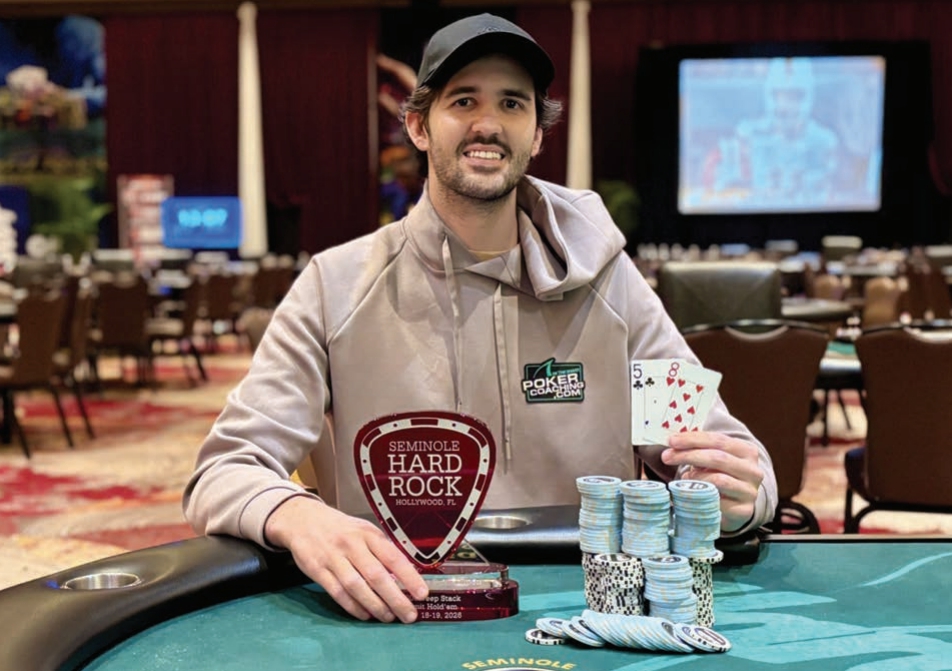
Justin Saliba graduated from the University of Dayton with a degree in chemical engineering, but the former college soccer player had already fallen in love with poker and decided to pursue his dream in Las Vegas.
The 31-year-old has been on an incredible run over the last few years, going from a relatively anonymous online grinder to a feared competitor in some of the biggest tournaments around.
His run started in 2021 when he took down the $5,000 no-limit hold’em event at the WSOP Online series for $253,800 and his first bracelet. Saliba added his second bracelet at the 2022 WSOP Online series, winning the $10,000 high roller event for $154,752.
Saliba had a third-place finish at the Rock N Roll Poker Open $25,000 event for $402,634, and a fifth-place showing at The Return $5,000 event at Borgata for $304,629. He then won the PokerGO Cup $10,000 event in January of 2023 for $195,000, and days later took second at the Lucky Hearts Poker Open $25,000 event for another $353,175.
In the summer, he banked $690,000 in a $60,000 Triton London high roller, and in 2023, he finished third in the WPT Championship $25,000 high roller for another $525,087. His biggest score came in 2024, when he finished runner-up in a $50,000 Triton Montenegro high roller for $1,188,000. Later that year, he picked up $512,465 and $499,097 after two big final tables at the World Series of Poker.
Last September, Saliba won the $15,000 event at the Poker Masters for $301,000 and his second PGT trophy. Most recently, he found the winner’s circle again in south Florida, banking $236,925 in a $10,000 Lucky Hearts Poker Open side event. He now has career earnings of $11 million.
Event: Lucky Hearts Poker Open NLH
Buy-In: $10,000
Entrants: 72
Prize Pool: $684,000
First-Place Prize: $236,925
Craig Tapscott: Set this event up for us, Justin. I read that you weren’t planning on entering this tournament.
JS: I had a rough start to the Florida series. I bubbled the $25,000 event after firing a couple of shells. And then busted the main event as we were nearing the money in disappointing fashion.
After I busted, I didn’t register the $10,000 right away. I left the property, had lunch, and considered skipping the event and just playing an online Sunday session. But after eating, I turned the car back around and was ready for more live poker action.
CT: Was there a tipping point that changed your mind that day?
JS: My good friend Brock Wilson told me I was being soft, that it was a good tournament, and I could play online any other Sunday I wanted. (laughs) That fired me up a bit. I was ready to get back to the casino and hop in, ready to play my best and run deep.
Luckily, I played a fun hand in the first level, which gave me some nice momentum.
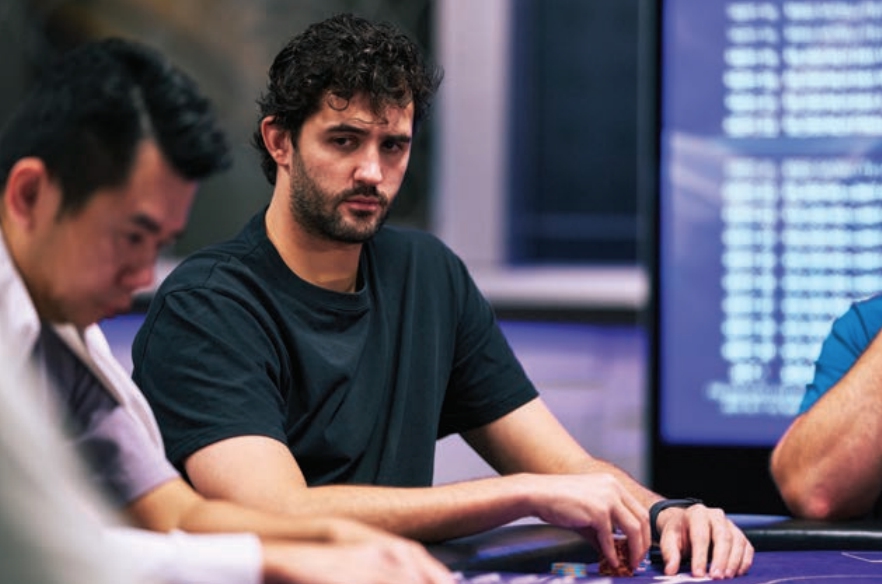
Hand No. 1
Stacks: Justin Saliba – 40,000 (80 BB) Villain 1 – 40,000 (80 BB) Villain 2 – 40,000 (80 BB)
Blinds: 300-500 with a 500 big blind ante
Players: 9
Saliba raised from the lojack to 1,100 holding 5♣5♦. Villain 1 called from the cutoff. Villain 2 called from the big blind.
JS: Both of the villains are strong players. Preflop, this is a standard raise with 5-5 from the lojack. Pairs play pretty well at deep stacks, especially when they make sets.
FLOP: K♠8♠5♠
Villain 2 in the big blind checked.
JS: Luckily, I made the set that I was looking for, but unfortunately, it’s a monotone flop.
CT: What’s the plan to proceed?
JS: I need to be a bit careful because the cutoff and the big blind both have a ton of potential flushes. With that said, I really want to push equity here. Letting the action just check through on the flop would allow both to realize their equity for free.
I went for a small c-bet.
Saliba bet 1,100, and Villain 1 called. Villain 2 reraised to 6,000.
JS: The cutoff called, which is great. But once the big blind went for a large raise, I was immediately concerned that I was behind and needed to get lucky.
I called, looking to boat up on the turn, but I ended up getting lucky in a different way.
Saliba called, and Villain 1 folded.
TURN: 4♠
Villain 2 bet 4,000.
CT: Please explain how you got lucky here.
JS: Because the 4♠ is a very interesting card. When Villain 2 raised this large on the flop, I could somewhat discount nut flushes. I felt like he was weighted more towards weaker flushes that wanted a bit more protection, or the nut blocker that had equity but was looking for more folds.
Once the 4s came and I faced a small bet, I thought that it was pretty likely that the opponent had a jack- or queen-high flush. After I called the flop, I could have so many As-X combos in my range. My perceived range could have A♠ 9x, A♠ 10x, A♠ Jx, A♠ Qx, and A♠ Ax.
So, when he went small, I thought that I could represent the nut flush nicely and decided to turn my hand into a bluff.
Saliba raised to 15,000.
CT: I’m catching on now.
JS: Typically, when you are bluffing, you want to have equity against your opponent’s continuing range, but it’s really hard to do that on four-flush boards. Luckily, my hand unblocks all of the potential weak flushes, and if he called my raise, I still have 10 outs to improve to a boat.
More importantly, though, I felt like a raise puts his range of hands in an awful spot, and my story was believable.
Villain 2 folded. Saliba won the pot of 36,200.
JS: Luckily, he thought for a bit and folded, showing the J♠2♠ combo, and I was able to pick up a nice early pot to build some momentum in the tournament.
CT: How did the rest of the day go?
JS: I had very smooth sailing on day 1. I bagged over 5x starting stacks and would come into day 2 as the chip leader.
With many people busting out of the WPT main late on day 2, the late reg line was very long the next day. It ended up getting over 70 entries, with everyone’s eyes on the top prize of $237,000.
Day 2 started quite well, busting a few of the short stacks and continuing to climb. Once we reached the final 10 players, it became clear what my strategy needed to be.
CT: Don’t hold back on me now. Please share.
JS: With a first-place prize of $237,000 and a pool of $684,000, the tournament was extremely top-heavy. So, my strategy nearing the bubble and ITM was to play hyper-aggressively.
Luckily, the hyper-aggressive plays worked out. I was able to use the chip lead to my advantage and put a lot of pressure on other players. It helped that I was running hot in the all-ins when I needed to have a really smooth day 2.
CT: Did heads-up go as easily as the rest of the tournament?
JS: It was quite tough, actually. And although I began with a chip lead, we swung to even stacks quite quickly.
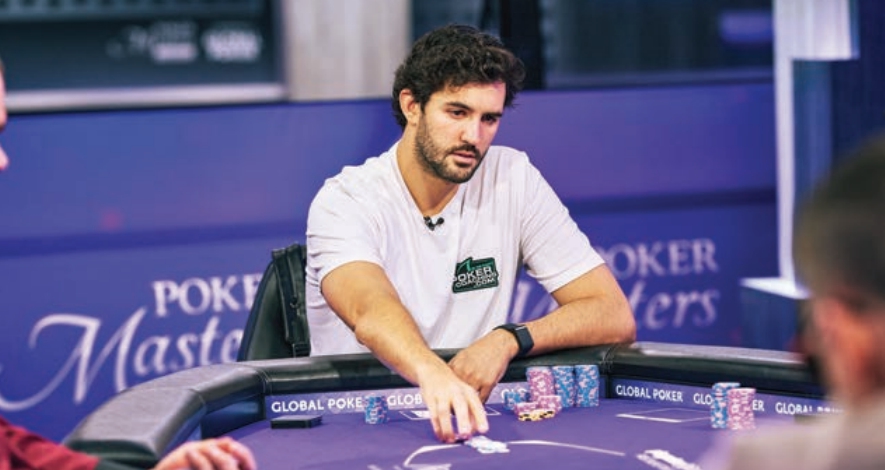
Hand No. 2
Stacks: Justin Saliba – 6,000,000 (40 BB) Villain – 5,700,000 (38 BB)
Blinds: 75,000-150,000 with a 150,000 big blind ante
Players: 2
CT: Did you adjust your strategy plan when you got down to heads-up?
JS: No. I was sticking to my aggressive strategy. Heads-up in live poker leads you to play 100 percent of hands on the button, because you’re really fighting for pots when there is a full big blind ante in there.
You’ve already posted half a big blind, so if you’re not willing to play aggressively, you may get run over.
Saliba raised to 450,000 from the button holding 8♦5♠.
JS: 8-5 offsuit is a very bad Texas hold’em hand, but I felt like the larger raise size to three big blinds, and raising often was working well.
CT: What kind of response do you expect from your opponent here to that raise sizing?
JS: Against the raise, he needs to three-bet often and call a ton of very weak hands to properly defend his big blind. I think people have a hard time doing both of those things. Unfortunately, on this hand, he did three-bet.
Villain reraised to 900,000.
JS: He gave me a great price, three-betting to six big blinds. This means that I need to call three big blinds to win a total pot of 13 big blinds. And 8-5 offsuit has more than 23 percent equity against everything other than pocket eights through pocket aces.
So, even though I wasn’t thrilled to play a bloated pot with an awful hand, I decided to call because I felt like I was going to be able to realize more than the required equity playing in position.
Saliba called.
FLOP: Q♦9♥5♣
Villain bet 750,000.
JS: He quickly bet five big blinds. I took my time and…
Saliba called.
CT: What now? Besides hope and a prayer?
JS: I tried to figure out what his range looked like and how I would proceed across different turns.
In reality, the only cards I was going to be happy to see were an eight or five, but I was hoping after he three-bet and continuation bet, and I called twice, that perhaps we could play check-check on the turn a decent amount and try to get to showdown.
TURN: 8♥
JS: We nailed the key card, and within a couple of seconds, my opponent overbet jammed for about 4,000,000 chips. My hand was incredibly strong, and I could beat a ton of potential value hands that he could have, like K-K, A-A, A-Q, K-Q, etc.
Although I do lose to some straights, I had a very easy call.
Saliba called, and Villain revealed K♦10♣.
JS: I had to fade the jack to take home the trophy.
RIVER: 2♦
JS: Luckily, it bricked out, and after we counted the chip stacks to see that I covered him by a small margin, I was able to get my first win of the new year. I’m very glad that I drove back to the casino to play that one.
CT: I am sure you are. Can you share how you maintain a positive mindset and cope with the variance of tournament poker?
JS: Having a great support system is the biggest thing. If it’s just yourself, grinding for money, I think that motivation dies quickly. But having a great group of friends and loved ones that you can lean on when things aren’t going your way can help you stay resilient.
The variance can seem large in the short term, but constantly zooming out and just trying to play your best and improve each day makes the journey more fun and allows you to focus more on long-term goals.
Find Saliba on Twitter/X @Justin_Saliba and learn from him at PokerCoaching.com and PeakGTO.com. Get a FREE strategy bundle at PokerCoaching.com/CardPlayer.