The World Series of Poker has long been known as a battlefield in which unknown players can battle established stars in search of a gold bracelet. On Saturday, May 30, Jesse Lonis and Brian Yoon each stood to add to their respective legacies and accomplished tournament players. And yet, when the final hand of the $1,500 stud and $5,000 pot-limit Omaha events were dealt at the 2026 WSOP, both players found themselves settling for second place.
Lonis, the defending Card Player Player of the Year winner, carried a massive chip lead into the final day of the $5,000 PLO event. The two-time bracelet winner had 3.5 times as many chips as the second-place player in the chip counts with seven players left overnight. But Yang Wang, one of two short stacks to begin the final day of action, came back to win his first gold bracelet. It came a year-and-a-half after Wang fell tantalizingly close to a bracelet at WSOP Paradise in 2024, finishing second to Stephen Chidwick in a $50,000 buy-in PLO event.
Yoon, a five-time bracelet winner and the champion of the 2023 WSOP $10,000 stud championship, also settled for a runner-up finish. James Cheung earned the biggest win of his career and his first bracelet in the $1,500 buy-in stud event.
In the early action at the 2026 WSOP, both Wang and Cheung established themselves as serious players. Here’s how a wild day of action from Horseshoe Las Vegas played out on Saturday.
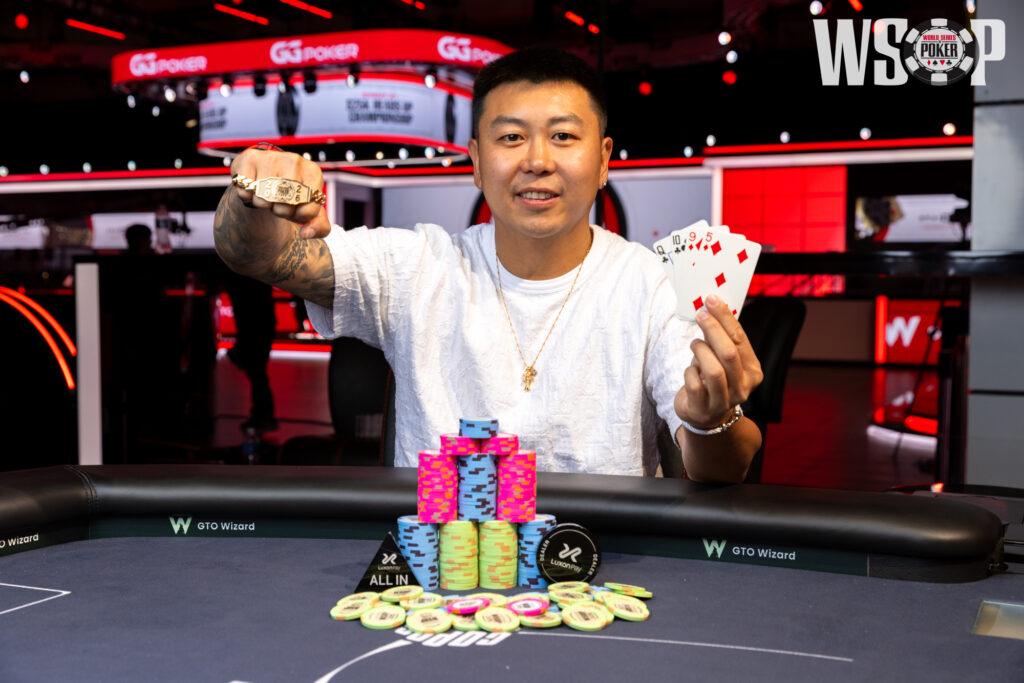
Yang Wang Wins $5,000 PLO Bracelet
After two days of action in a $5,000 buy-in PLO event in the early stages of the 2026 WSOP, it appeared as though Jesse Lonis was destined to add to his incredible run over the last few years. The Little Falls, New York native had 17.6 million in chips, while the closest of six other remaining challengers had 4.98 million.
Lonis has accumulated over $27.8 million in tournament results since the start of 2023. That includes two WSOP bracelet wins, four Triton Super High Roller titles, and numerous other victories of note. He was in a position to further bolster that incredibly impressive resume, but it simply would not be Lonis’ day to shine. Instead, Yang Wang, a Chinese high roller, surged from one of the shortest stacks to start the day to claim the WSOP gold bracelet and the $595,388 first-place prize.
In total, 716 entrants took their shot at what would ultimately become Wang’s permanent possession. There were 120 players who advanced to day 2, and then just seven remaining in contention heading into the third and final day.
From the very start of the day, Wang seemed to be on an upward trajectory. Within the first 15 minutes of play on day 3, Wang flopped top set against Evan Krentzman to double up, and Wang would double through Krentzman again later on at the final table.
Lonis wasn’t the only bracelet winner to reach the final day of play. 2013 PLO eight-or-better WSOP champion Jarred Graham finished in seventh place ($77,815), and high roller regular Dylan Weisman went out in sixth place ($104,359). Weisman ceded most of his chips to Wang without a showdown, and then fell at Krentzman’s hands.
A Charge To Victory
Justin Scott won his WSOP bracelet all the way back in 2006, when he took down a $2,000 buy-in no-limit hold’em event. His chance at a second gold bracelet, 20 years later, ended in fourth place in a clash that saw Lonis got a big chunk of his stack back. Lonis’ A♠Q♥J♠7♦ was technically behind Scott’s K♣K♠8♠6♦, but he had a fair number of outs to hit to improve. He did so on a 7♥ turn, and then finished with a flourish as the 7♣ river gave Lonis a full house. to bust Scott in fourth place ($197,139).
Wang took over the chip lead early on in three-handed play and did not cede it from there. Three-handed play carried through a dinner break and more than 5 hours in real time, before Krentzman finally fell. The chips went in on a 9♦7♦4♥ flop, and Wang turned over an open-ended straight flush draw with 10♦8♦6♣5♦. Krentzman was technically ahead with a pair of sevens, but the J♦ turn gave Wang the jack-high straight flush to clinch the hand. Krentzman, at his second major WSOP PLO final table in as many years, settled for third place ($277,537).
Lonis was left to try to battle back from a major chip deficit, and it wouldn’t take long for Wang to close it out. On the final hand, Wang hit runner-runner tens to beat Lonis’ flopped top pair and nut flush draw to secure the victory.
Wang’s win earned him 1,824 Card Player Player of the Year points. His first qualifying cash of 2026 immediately shot him up to 85th place in the overall standings presented by CoinPoker. Lonis’ second-place finish for $396,892 earned him 1,520 POY points and pushed him up to 11th place on the leaderboard as he chases back-to-back POY titles.
Final Table Results
| Place | Player | Payout | Points |
| 1 | Yang Wang | $595,388 | 1,824 |
| 2 | Jesse Lonis | $396,892 | 1,520 |
| 3 | Evan Krentzman | $277,537 | 1,216 |
| 4 | Justin Scott | $197,139 | 912 |
| 5 | Stephen Hubbard | $142,279 | 760 |
| 6 | Dylan Weisman | $104,359 | 608 |
| 7 | Jarred Graham | $77,815 | 456 |
| 8 | Zackary Estes | $59,001 | 304 |
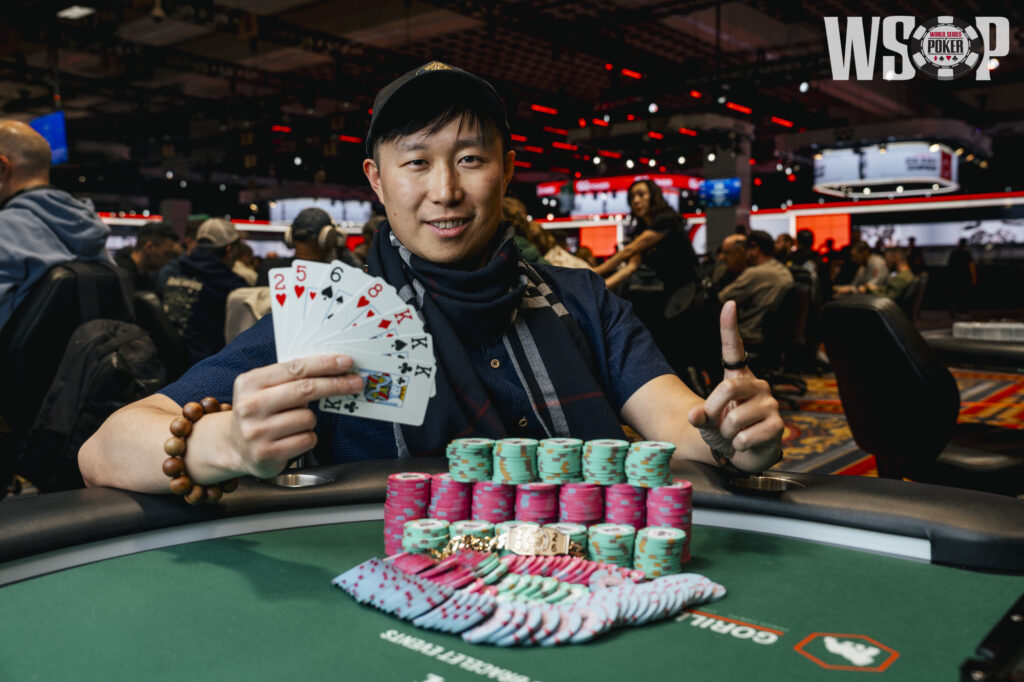
James Cheung Bests Five-Time Bracelet Winner To Take Home First Gold In $1,500 Stud
The WSOP has long been an unmatched showcase for all of the non-hold’em events. Though three of Brian Yoon’s five career bracelet wins have come in no-limit hold’em tournaments, Yoon’s resume also includes extensive mixed-game experience. Yoon has two non-hold’em bracelets and final tables in stud, deuce-to-seven single draw, deuce-to-seven triple draw, razz, H.O.R.S.E., and mixed triple draw lowball.
Yoon held the chip lead for long stretches of day 2 in the $1,500 buy-in stud event this year, but Scottish player James Cheung came back from a short stack to secure his first-ever WSOP bracelet victory and a $103,185 first-place prize.
This event drew 359 entrants, ending with 62 players after day 1 and just six hopefuls to start the third and final day of action.
American Thomas Savitsky was the overnight chip leader, joined by 2021 bracelet winner Bradley Jansen, a short stack, with Yoon and James Cheung among those in the middle pack.
There were big moves early in the day, and Jonathan Glendinning was the first to fall in day 3 action. The last of his chips went in on fifth street, and though Glendinning had the best of it with a pair of tens, Savitsky made a pair of jacks on seventh street to knock Glendinning out in sixth place ($16,017).
Five-handed play saw the dynamic change dramatically, with multiple double-ups and big pots changing the pecking order. By the time Cheung made a club flush and eliminated Jansen in fifth place ($22,141), he had taken over a sizable chip lead.
Cheung’s Path To Victory
Yoon made his most significant move towards the top when he eliminated Savitsky in fourth place ($31,380). By sixth street, Yoon had Savitsky drawing dead, with a spade flush against Savitsky’s unpaired board.
Cheung and Gregory Josephson traded the chip lead several times at the final table, and during three-handed play in particular. But as the limits grew larger, a couple of significant pots for Cheung shifted the balance for good.
Josephson fought for a long stretch, but ultimately missed with his pair of aces and heart flush draw against Cheung’s aces and queens. With that, Josephson hit the rail in third place ($45,570).
Cheung and Yoon took a short break, and the tournament didn’t last long after play resumed. Yoon was soon all in on sixth street and drawing dead against trip kings for Cheung. Yoon was awarded $67,771 as the runner-up.
Along with his first-ever six-figure live result, Cheung earned 600 Card Player POY points, in his first qualifying result of 2026.
Final Table Results
| Place | Player | Payout | Points |
| 1 | James Cheung | $103,185 | 600 |
| 2 | Brian Yoon | $67,771 | 500 |
| 3 | Gregory Josephson | $45,570 | 400 |
| 4 | Thomas Savitsky | $31,380 | 300 |
| 5 | Bradley Jansen | $22,141 | 250 |
| 6 | Jonathan Glendinning | $16,017 | 200 |
| 7 | Korey Simeone | $11,888 | 150 |
| 8 | Karle Wilson | $9,058 | 100 |
Photo credits: WSOP / Monique Marestein, Lennart Hennig.