







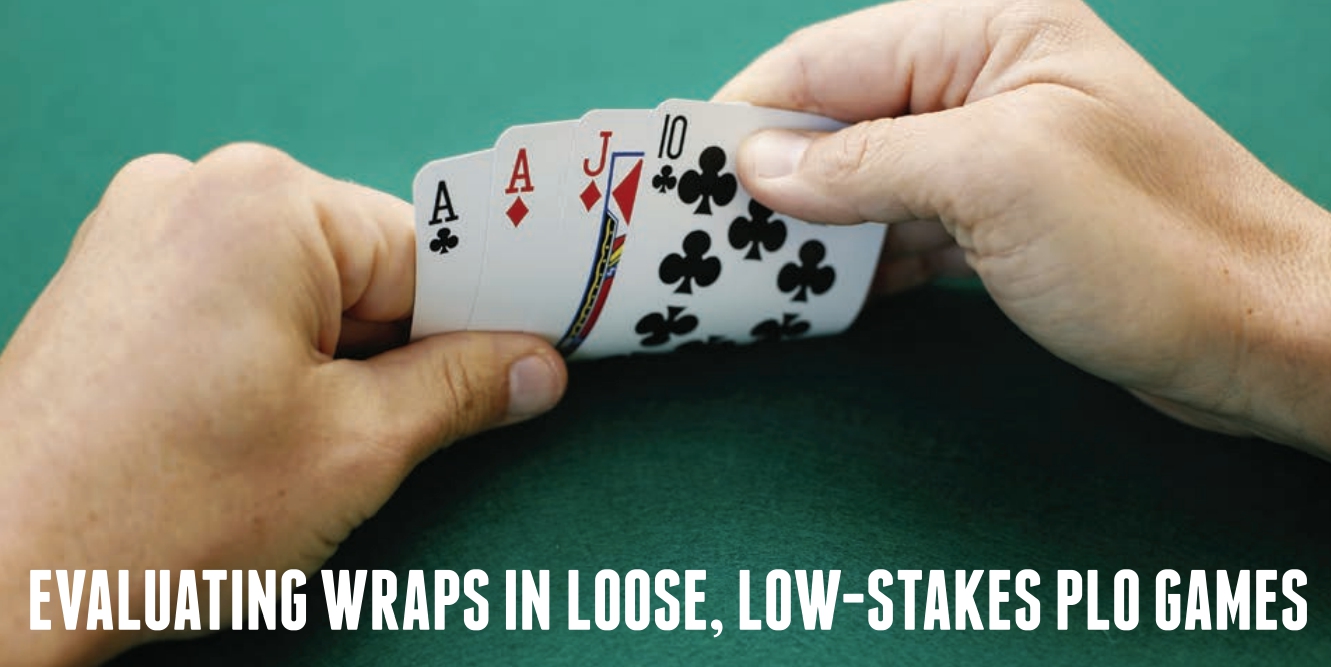
Over the years the migration of players going from Texas hold’em to pot-limit Omaha has been slow but steady. One of the largest adjustments newer players face when now getting dealt four cards is identifying and properly valuing the big straight draws called wraps, defined as those having nine or more outs.
For example, if you hold Q♦J♦10♠7♥ and the flop is K♦9♥2♣ you have what is referred to as an ‘Inside Wrap’ and it can make a king-high straight by pairing one of the nine remaining queens (3), jacks (3), and tens (3).
Or you could have A♠J♥10♦7♠ on a 9♣8♠3♥ board where you have 17 outs; the queens (4), jacks (3), tens (3), sevens (3), sixes (4) but only 11 of them, the queens (4), sevens (3), and sixes (4) make the nuts.
When learning PLO, it can be helpful to name the most common forms of wraps and visualize the corresponding total and nut outs. This particular form is what I refer to as the Two Ahead, One Behind Wrap (17 outs/11 nuts). And this specific hand would be an exact 50/50 proposition against A♦K♥9♦9♠ that flopped top set.
As you gain experience you will become more adept at calculating outs on the fly and recognize how important it is to hold cards that are ahead of the flop which increases your nut potential.
While it’s exciting to potentially flop draws that have so many nut outs, middling rundown holdings (i.e. four cards nine and lower) tend to be slightly overrated, especially in multi-way pots. The first problem is duplication, referring to the times that an opponent either shares the same outs with you or currently has the same hand along with redraws (or higher quality redraws) to a better holding.
Consider the following situation:
Board: 10♦7♣6♥
Hero: 9♠8♠6♣5♦ Redraws: Backdoor Full House
Villian: Q♦J♣9♣8♥ Redraws: Nines (2) and Eights (2), Backdoor Club Draw
Results: Split pot (72%), Villain wins (26%), Hero wins (2%)
Even though this will often be a chopped pot, this is a bad situation because when it isn’t split your opponent is 13 more times likely to scoop, and that’s assuming Hero gets to the river. After all, one of the paths towards making the full house is pairing either the nine or the eight, which gives Villain the jack-high straight. If stacks are deep and lacking a consequential redraw, Hero is forced to play cautiously when facing a pot-sized bet even when no immediate flush draw is present.
If you happen to be in Villain’s shoes, having a redraw to a higher straight and a backdoor flush is typically enough of a freeroll to raise as it’s even a favorite over 10♣9♠8♠7♥, a holding that flopped the nut straight along with top two pair. In fact, it’s almost 1.3 times more likely to scoop, which is a more important metric to consider than the 53% equity it has.
And having the ability to raise is important for the times your opponent instead holds a set or two pair, where it’s either reaping value or forcing your opponent to relinquish their equity.
Another reason why middling rundowns may be overvalued is that a medium straight is often not the nuts by the river. While the board pairing or making a flush or higher straight possible doesn’t always give you a second-best hand, it can impede your ability to seek value or protect your holding against draws that haven’t yet gotten there. Or you could end up getting bluffed off the best hand.
Due to the implications of duplication, and the board frequently changing the nuts, we usually desire 13 nut outs to feel good about our draw. A powerful draw to remember is the Broadway Wrap (13 outs/13 nuts), which occurs whenever you have an ace accompanied with two Broadway cards and flop the other Broadways e.g. A♦Q♥10♦5♠ where the flop comes K♥J♠3♣. Here you have 13 nut outs; any of your nine pairing aces (3), queens (3), or tens (3) will make an ace-high straight, and the nines (4) will give you a king-high straight along with a redraw.
Another somewhat common 13 nut out draw is the Three Ahead Wrap (13 outs/13 nuts) such as when your hand contains Q-J-10 on a 9-8-2 rainbow board. Again, you’ll make the nuts by pairing, but really desire to turn a seven to possibly freeroll someone holding just the J-10 combination.
Having a 13 or more nut outs isn’t required to call small bets or possibly pick up a pot as a semi-bluff. It’s more of a conservative guideline when facing big wagers in multi-way pots or versus a single opponent pegged for having a strong hand such as a set or top two pair that probably won’t be folding to further aggression.
With 13 nut outs you often have the correct odds to call on the turn, assuming that the board didn’t pair. Consider the following hands where Hero has a Broadway wrap draw against an opponent holding top set:
Hero: A♣J♣10♠5♦
Villain: K♣K♦10♦8♥
Board 1: K♥Q♠3♦2♣ (Hero has 40% equity)
Board 2: K♥Q♠3♦2♦ (Hero has 30% equity)
If Villain bets the pot on the turn, you are getting 2:1 on your money where you require around 33% equity. In the first case you have more than that immediately even though your opponent has one of the cards you need.
When he picks up a flush draw as shown on board 2, the odds are still adequate enough since you can often win a little money on the river when making the nut straight. And he doesn’t always have the flush draw.
When the flop contains a flush draw, any wrap is severely devalued as it decreases your nut outs. However, always be aware of backdoor flush potential, especially if it’s to the ace, e.g. A♣J♣10♠5♦ on a K♥Q♣3♥ flop. This possibility is worth around two outs and offers more implied odds than a front-door flush completing as an opponent will be less convinced that you have it.
We can conclude with a few final thoughts, a hand such as 8♠7♠5♣4♦ looks decent enough, but things have to almost go perfectly in order to play a big multi-way pot with it and have your opponent(s) in a dominated position. The smaller the cards are, the more perfect your rundown needs to be, and this holding has a middle gap and is only single-suited.
Meanwhile dry big pairs (e.g. K♠K♥7♠3♦) have gotten a bit of a bad rap (pun intended) since not all of the combinations are working together. While not a premium holding, it’s probably better than a middling rundown since the times you flop top set you have often both the best hand and the best draw.
In loose, low-stakes games, the nuts (or near nuts) are often lurking and the type of hands that can build them and get paid off often contain large pairs, suited aces, and Broadway cards.
 Kevin Haney is a former actuary but left the corporate job to focus on his passions for poker and fitness. The certified personal trainer owned a gym in New Jersey, but has since moved to Las Vegas. He started playing the game back in 2003, and particularly enjoys taking new players interested in mixed games under his wing and quickly making them proficient in all variants. Learn more or just say hello with an email to haneyk612@gmail.com.