







Long before the explosion of ChatGPT in November 2022, a different kind of artificial intelligence was honing its skills in the world of high-stakes gambling. While the public is only now beginning to grapple with AI’s implications, the gambling industry has been quietly developing and simultaneously battling against intelligent systems for decades.
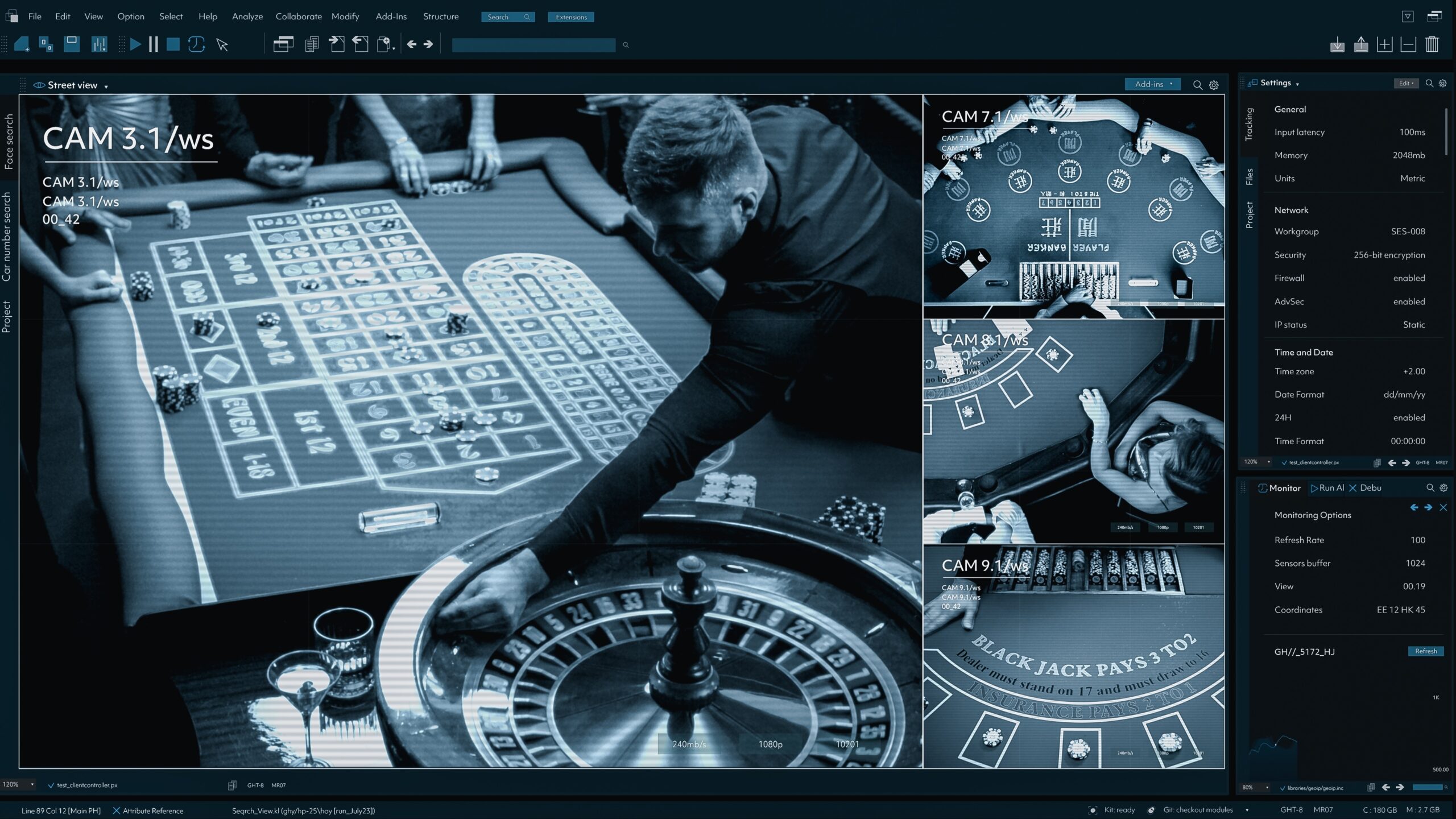
Step into any major Las Vegas casino in the early ’90s, and the pit boss wasn’t the only one watching you. From the moment you parked your car, unseen digital eyes were tracking your every move — analyzing your spending habits, how long you stayed at each table, and the path you took across the casino floor. This was an early form of artificial intelligence using algorithmic surveillance — primitive by today’s standards, but powerful for its time.
On the surface, its purpose seemed straightforward. It quickly flagged known card counters or other advantage players, allowing security to discreetly escort them off the premises. Additionally, the ‘eye in the sky’ was used to identify players in case of disputes at the table.
However, the real gold was in the data. By understanding intricate patterns of guest behavior, casinos could architect their entire environment, guiding multimillion-dollar remodels, marketing strategies, and future investments. They were using AI to design a more efficient money-making labyrinth.
But the house wasn’t the only one getting in on the AI action. Players were starting to arm themselves, too.
For decades, poker represented a monumental challenge for artificial intelligence. Unlike chess, a “perfect information” game where all pieces are visible, poker is a labyrinth of unknowns. Researchers attempting to solve poker with AI were forced to grapple with bluffing, incomplete information, and human psychology, a challenge many believed was impossible.
The first real signs of AI entering the poker world came in 2005 during the “World Series of Poker Robots,” hosted by the online poker room Golden Palace. During the event, poker pro Phil Laak narrowly defeated a bot named Poki-X in a heads-up Limit Hold’em match. Despite his victory, Laak admitted the match was “tough” and predicted that machines would eventually surpass the best humans. He was right.
The team behind that bot, from the University of Alberta, was relentless. By 2008, their next program, Polaris, was already beating human specialists in heads-up limit hold’em. Seven years later, they unveiled Cepheus. This program was so advanced it had effectively “solved” the game, playing a strategy so close to perfect that it could never be beaten over the long run.
However, limit hold’em, with its fixed-betting structure, is a far simpler beast than poker’s most popular and complex variant. No-limit hold’em became the next great challenge, taken up by a competing group of researchers at Carnegie Mellon University.
Their first major attempt, Claudico, faced four top professionals — including Doug Polk — in 2015, playing over 80,000 hands. While the humans finished ahead by more than $700,000, the result was deemed a statistical tie given the staggering $170 million wagered.
There was no ambiguity two years later. In 2017, Claudico’s successor, Libratus, left no doubt. In a high-profile showdown, it crushed a team of elite pros, winning over $1.7 million (in virtual chips) across 120,000 hands.
The winning streak didn’t end there. In 2019, the same CMU research team unveiled Pluribus, an AI capable of playing six-handed no-limit hold’em — exponentially more complex than heads-up play. Facing five elite professionals, including Seth Davies, Linus “LLinusLLove” Loeliger, and 2012 WSOP main event champion Greg Merson, Pluribus didn’t just win, it dominated. The era of man versus machine at the poker table was over, and the machines had won.
But while these victories were a theoretical showcase, the practical impact of AI on poker was only just beginning.
For modern poker players, AI is no longer an abstract academic concept. It is both a companion and a formidable threat. This paradox is embodied by the rise of poker “solvers” — sophisticated training tools that allow players to analyze virtually any situation and see the Game Theory Optimal (GTO) solution.
Early solvers were limited to pre-solved scenarios, but new AI-driven tools like GTO Wizard AI, released in mid-2023, allow players to customize everything from ranges to stack sizes. This unlocked a level of strategic depth that once required hours of computation. But this power came with a dark side, creating a new threat to the integrity of the game: Real-Time Assistance (RTA).
Online poker players have known for years that RTA is a growing threat. In recent years, several high-profile professionals have been banned from major sites for using these tools to gain an unfair edge. Modern platforms now log solver queries and compare them against hand histories to determine whether a player was using RTA in real time or reviewing hands after the fact.
But cheating in the digital age goes beyond humans using AI tools. The most insidious threat isn’t even human at all.
Let’s talk poker bots.
The sophisticated AIs developed in university labs didn’t stay there for long. Their commercial, black-market descendants found their way to the online felt. These are no longer research experiments—they are automated systems designed for one purpose: relentlessly extracting profit from human players.
For the average, everyday online grinder, bots feel like a digital plague. Ask anyone who plays online poker, and they’ll have plenty to say. Some avoid certain sites entirely, while others quit online poker altogether, convinced the games have become unbeatable.
That paranoia gained terrifying validation in January 2026, when a video resurfaced on Twitter/X showing a so-called “bot farm” from a few years ago. The footage appeared to show more than 20 computers in a single house, each running accounts on major poker sites. These bots weren’t just playing near-perfect GTO poker — they were colluding, sharing hole-card information to operate as a hive mind. That’s an advantage that makes them virtually unbeatable.
As poker pro Charlie Carrel explained in a viral YouTube video, the scale of the problem is staggering and threatens the foundation of online poker itself. Yet in this technological arms race, the very tools causing the problem may also be the solution.
To combat the infestation, major online poker sites are deploying their own AI, fighting fire with fire. These companies train machine-learning systems to act as digital bloodhounds, sniffing out bots across massive datasets of confirmed cheaters and legitimate players.
These systems analyze volumes of data no human ever could: impossibly consistent bet sizing, inhuman reaction times, and decision patterns that are just a little too perfect. With a bird’s-eye view of the entire ecosystem, security AIs can also detect collusion rings and chip-dumping schemes in real time.
It’s a constant, evolving battle. As cheating AI grows more sophisticated, so too must the AI designed to hunt it down.
The casino floor was once watched by cameras in the ceiling. Now it is watched by algorithms in the cloud. The players may have changed, but the game — man versus machine — is just getting started.
 Luke Geel is an artificial intelligence expert with a master’s degree from Johns Hopkins University. A Boston native, he works as an engineer for the U.S. Air Force and on an AI-driven real estate startup. In his free time, he can be found at the poker tables at Encore Boston Harbor or The Nash.