







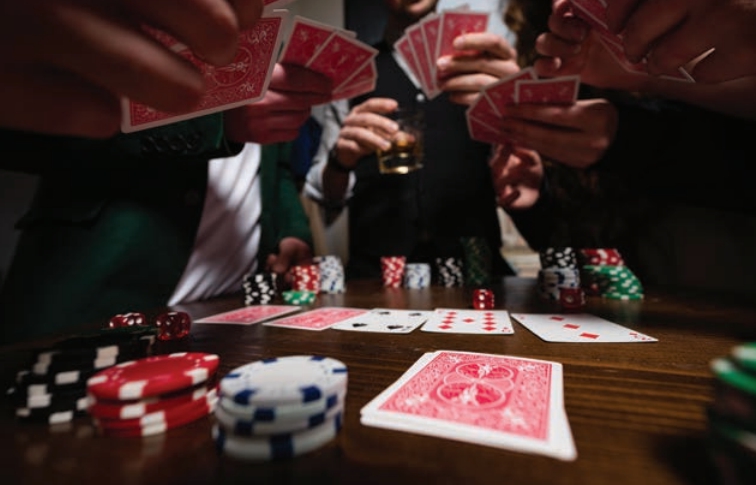
 Most mixed game players prefer limit poker due to the faster pace of play and more congenial atmosphere as decisions are less complicated and one bad cooler hand won’t wreck your entire evening. Many also enjoy buying in for a large amount and building huge chip castles when having a good session.
Sometimes a regular home game is comprised of those who also enjoy big bet games. Or to expand your player pool, it may be beneficial to entice some potential fun players by adding some to the rotation. Common ground can often be found by adding a few no-limit or pot-limit variants, while instituting a cap on the amount that could be lost on any one hand.
Five-card pot-limit Omaha eight-or-better (i.e. Big O) is a very popular form of poker with big-bet enthusiasts. It’s also a game that is usually acceptable to the limit crowd. The cap is often 10 times the limit big bet, so if you are playing $20-$40 stakes in the limit games it would be $400. Posted blinds are usually half what they would be for the limit games, so in this case they would be $5-$10 instead of $10-$20.
Some might object to that ratio, stating that they don’t often lose $400 in a limit hand. This is certainly true, and there are a few options if this poses a problem for your group. The cap could be set to a lower amount such as $300, or the blinds can be lowered (e.g. $5-$5), or a combination of both. Where allowable and agreed upon, running big pots twice can also smooth variance.
Pot-Limit Omaha Double Board Bomb Pot is a game that is now the rage in many cardrooms, often being played after a dealer change even in no-limit hold’em games. In bomb pots there is a rotating button, but no posting of blinds or preflop action. Everyone instead antes and play commences after the dealer spreads two flops. The final pot is split between the winners of the two boards or all to one lucky individual if they scoop. With a $400 cap the ante can range from $2-$5, depending how deep or shallow everyone wants to play.
The main benefit of bomb pots is that they drag every player to the two flops and automatically insert them into potentially tricky situations. This can result in sizeable sums changing hands which may liven up the entire mix.
Another option is Pot-Limit Ultimate Bomb Pot, sometimes also referred to as “Best Best.” This is a split-pot game where the holder of the superior high chops with the best low over both boards. One potential drawback is that what wins can be slightly confusing, and novices can get burned quickly. Consider the following hand where player 2 scoops.
Player 1: A♠2♠K♦Q♥J♦ Player 2: 5♣6♥7♠9♣Q♣
Top Board: 6♠7♥10♠J♠8♦ Bottom Board: 4♣6♣9♥K♣A♣
Player 2’s Flush: A♣K♣Q♣9♣6♣ > Player 1’s Flush: A♠J♠10♠6♠2♠ Player 2’s Low A-4-5-6-7 > Player 1’s Low: A-2-6-7-8
Player 1 might end up with an unpleasant surprise, the A-2 combination won’t always make the nut low as there are two boards in which it can get counterfeited. And in a similar way an ace-high flush can also lose when a player with a lower flush overtakes it with a key river card. In this scenario Player 2 holds the nut high and can bet and raise with impunity.
Mixed game players are often open to playing No-Limit Deuce-to-Seven Single Draw as it can be exciting and not a game frequently spread. However, there are only two streets of betting, so that must be considered when determining both the cap and posting of blinds. There’s also the matter of whether to employ a common rule for cash games that outlaws limping, forcing players to come in for a raise.
It’s also in the spirit of the game to allow the ability to make very large river bets. Suppose you are playing with $5-$10 blinds and a $400 cap. There’s a raise to $30, the small blind calls, and the big blind three-bets to $120. If both players call the pot will be $360 but there’s only $280 left in the cap to bet after the draw.
While that’s a hefty wager, it’s not the size of the pot and ideally it should be played a little deeper. One option is to structure the game with $5-$5 blinds and a mandatory open of at least $20. This would ensure that the average pot is of a decent size but leaves the door open for aggressive leveraged play after the draw.
If your home game is in the mood for something entirely different you can try Captain, a unique variant of deuce-to-seven dramaha. If the stakes are $20-$40 it could be structured with blinds of $10 and $20. The button (the captain) puts in $100. All players are dealt five cards except for the captain, who receives six.
Starting with the under-the-gun player, everyone decides whether they want to match the $100 or fold. That’s the only money to be wagered for the remainder of the hand.
The dealer puts down a flop and any player contesting the pot has one option to draw to improve their deuce-to-seven low and Omaha holdings. However, the captain must discard at least one as they need to finish the hand with five cards. The turn and river are then dealt, and the pot is chopped between the best low, and Omaha high holding.
The main challenge is taking on the captain whose sixth card strengthens their range considerably even though they will only end up with five. If you crunch the numbers, you will probably find that the captain is around three times more likely to be dealt a good low or a premium draw. Then when entering from early position, you also must worry about the other players as well.
This can be played with all dramaha variants, and others have given funny names for them such as Lieutenant for dramaha high or General for dramaha low dugi. Spice up your home game and think of something clever.
More From This Series
Introduction
Old School Dramaha
Super Sized Stud Hi-Lo
Badugi Dramahas
Simultaneous Omaha And Hold’em
Point-Based Dramaha Variants
Archie And It’s Variants
Badeucey And Badacey
Passing Pips And Red/Black Split
Stud Lowball Variants
 Kevin Haney is a former actuary but left the corporate job to focus on his passions for poker and fitness. The certified personal trainer owned a gym in New Jersey, but has since moved to Las Vegas. He started playing the game back in 2003, and particularly enjoys taking new players interested in mixed games under his wing and quickly making them proficient in all variants. Learn more or just say hello with an email to haneyk612@gmail.com.