







How to Play Poker Cash Games: Rules, Tips & Bankroll Management
Playing poker cash games is a raw, exciting experience and gives you the chance to play poker hands for real money in action-packed, deep-stacked pots. Cash game poker differs significantly from tournament poker, and although there is some overlap, the two require distinctly different approaches to study and strategy for optimal success.
This is an introduction to No Limit Texas Hold’em cash games poker strategy and the advanced concepts that come into play with those much deeper stacks.
Poker Cash Games vs. Tournaments
There are two main categories of poker games: cash games and tournaments. Although poker cash game rules are the same as tournaments, the structure and gameplay are very different. If you want to be successful at cash games, you’ll need to adapt your strategy accordingly.
Here’s a rundown of the main differences between poker cash games vs tournaments:
Structure and Blinds
In tournaments, players pay a set entry fee and are given the same starting stack as all other players. The aim is to outlast other players, with the biggest prizes heavily weighted towards the top three finishers, and generally towards those who reach the final table. A core part of the strategy is adapting to the ever-increasing blind levels and battling it out to a deep finish.
What is a cash game in poker all about? In cash games, players buy in for any amount they wish, between the given minimum and maximum, which is usually 40-100 big blinds online or up to 100 big blinds in live games. Blinds stay the same throughout, and each pot is played for real money. The focus is on making consistent decisions and grinding out small profits, rather than chasing a big score.
Time and Flexibility
Tournaments are run at a scheduled time and typically last for several hours. You’ll need to commit an entire day or night to play from start to finish, as well as having the focus to see it through.
You can jump in or out of a cash game whenever you choose, which is a huge advantage for anyone who is short on time or struggles to focus for 10 hours straight! However, with no set start or finish time, you’ll have to be disciplined when it comes to both putting in the volume and knowing when to stop.
Poker Strategy
When it comes to poker cash games vs tournament strategy, you’ll be thankful to know that the two are not entirely different. It’s relatively straightforward to transfer your skills between tournaments and cash games, although they do say that tournament players find it easier to transfer to cash than vice versa.
Despite sharing basic rules and hand rankings, there are significant differences in how you should approach cash games vs. tournaments in poker. In particular, stacks tend to be much deeper in cash, which makes concepts like implied odds and pot control even more critical.
Learn and practice basic poker strategies such as position, hand selection, pot odds, and so on so that you can bring that knowledge to the cash game tables. Then, follow the rest of this guide for poker strategy tips that apply specifically to cash games.
With regard to bet sizing, for pre-flop play, standard opening raises are around 2.5 to 3 times the big blind, with an extra big blind added per limper. 3-bet sizings are typically around 3x the open raise size in position or 4x out of position. These sizings are a broad guide for cash game poker, with sizing often much smaller as the stacks get short in tournament play. The CardPlayer strategy archive is full of much more in-depth guidance on this and numerous other facets of play.
Thinking in Big Stacks
When playing cash games, you’ll usually be able to buy in for a maximum of 100 big blinds, an option that many players will take. For the most part, then, your cash games poker strategy will revolve around playing 100bb+ poker, though many games allow short-stack play down to 20-50bb.
With deep stacks, you can widen your preflop opening ranges and find creative betting lines post flop. Generally, you’ll have all options available to you with a stack depth of 100 big blinds. As long as your aggression is calculated, you can make lots of different moves.
Certain hands play well with deeper stacks, while others become less valuable. The core concepts related to thinking across multiple streets of betting, which are often needed with deeper stacks, are known as implied odds and reverse implied odds.
Implied Odds
In basic terms, implied odds are concerned with the amount that you stand to gain on future betting streets when your hand hits and your opponent pays you off.
Speculative starting hands, such as low pocket pairs and suited connectors, have great implied odds when stacks are deep. You won’t make a set or flush very often, but when it happens, you can get paid off big time by weaker hands. Stacks are deep enough to allow this equation to make sense.
With shallow stacks, you can rarely afford to play speculative hands. Doing so would be too costly, and even when you hit, you won’t gain a large number of chips. With deep stacks, you’re risking less of your stack to set mine or chase a draw, and when you do hit a monster, you can gain mountains of chips.
Calculating implied odds can be challenging since we must consider several factors, including our chances of getting our opponent to pay up across the board. Andy Bloch gives a nice breakdown on this precise element in cash games poker strategy in this Cardplayer Implied Odds video.
Reverse Implied Odds
Reverse implied odds are the amount you stand to lose when you hit your hand, but your opponent has an even better hand. It’s the opposite of implied odds and makes some hands very risky.
Reverse implied odds are the reason why weak kickers are problematic at any stack depth. These risks increase even more in multiway pots, where more opponents can have stronger hands when you connect with the board. If you hit top pair and your kicker is weak, an opponent could have a higher kicker and take all of your chips when you make your hand.
With deep stacks, this concept is amplified. One pair hands, especially with weak kickers, go down in relative value, and stacking off with top pair for 100 big blinds is very often simply too risky. The solutions to reverse implied odds are hand selection and pot control.
A couple of poker cash game tips, then: know when to inflate the pot and when to slow down. Don’t be afraid to check back or flat call one or two streets to make it to showdown with medium-strength hands. This is known as pot control.
The perils of Reverse Implied Odds have a good deal of nuance, as many elements in poker, so take your time exploring this more advanced concept. For now, the introduction above should serve you well.
Stack-to-Pot Ratio (SPR) Simplified
Stack-to-pot ratio refers to the amount in your stack divided by the amount in the pot. It’s a measure of how committed you are to the hand and/or how easy it will be to stack off. You can use stack-to-pot ratio (SPR) to navigate the various stack depths and pot sizes that you’ll encounter in cash games.
SPR = Stack size / Pot size
Low SPR (1–3) – With a low SPR, you are fairly committed to the pot and can play top pair hands for stacks. One or two rounds of betting should be all it takes to get all your chips in the middle.
Medium SPR (4–6) – With a medium SPR, you’ll need to be more cautious and consider using pot control with one pair hands. You’ll need stronger hands and may need to raise or bet multiple streets to stack off.
High SPR (7+) – Stacks are very deep, so implied odds and reverse implied odds are amplified. Play cautiously with one pair hands and only look to stack off with stronger hands. Speculative hands, such as draws, can be played more readily with a high SPR.

As the above image indicates, there are different guiding strategies concerning how to play different stack-to–pot ratios. The guidelines in the image are of course just a starting point, and there is much more to this nuanced poker strategy topic.
Expected Value and Equity Realization
In poker, including poker cash games, you’ll want to make decisions that have a positive expected value (+EV). In other words, decisions that will lead to profit in the long term.
The more you force your opponents into making costly mistakes, and the fewer mistakes you make yourself, the higher your overall expected value.
In very competitive high-stakes cash games, professional players will often take spots with small edges (marginal EV). In weaker, low-stakes games, you’ll be able to get away with giving up marginal spots and capturing equity with huge pots during deep stack play.
Your expected value is a long-term measure of how profitable a particular decision is, but in the short term, anything can happen. It can take thousands, even hundreds of thousands of poker hands, to see a true win rate and realize your equity.
Thankfully, there’s less variance in cash games than in tournaments, so you’ll realize your equity much quicker when playing according to poker cash game rules.
Bet Sizing and Line Planning
Because cash games are usually played with deep stacks and a high SPR, it’s less likely that you’ll be moving all in preflop or taking pots down with a shove on the flop, as might happen regularly in tournament poker. Instead, cash game hands are often played over the course of several betting rounds, or streets.
This requires effective planning so that you don’t end up overcommitting to the pot or failing to get maximum value. When continuation betting, consider the board texture: dry boards often warrant smaller bets (25–35% of the pot), while wet boards call for larger sizing (55–80%) to deny equity. These are simply initial guidelines, and of course, there may be additional reasons to size even higher or in the mid-pot region in certain situations. Consider which betting lines have the highest expected value, as well as anticipating possible outcomes for the following street. The following image can be a useful reminder of the general principle.
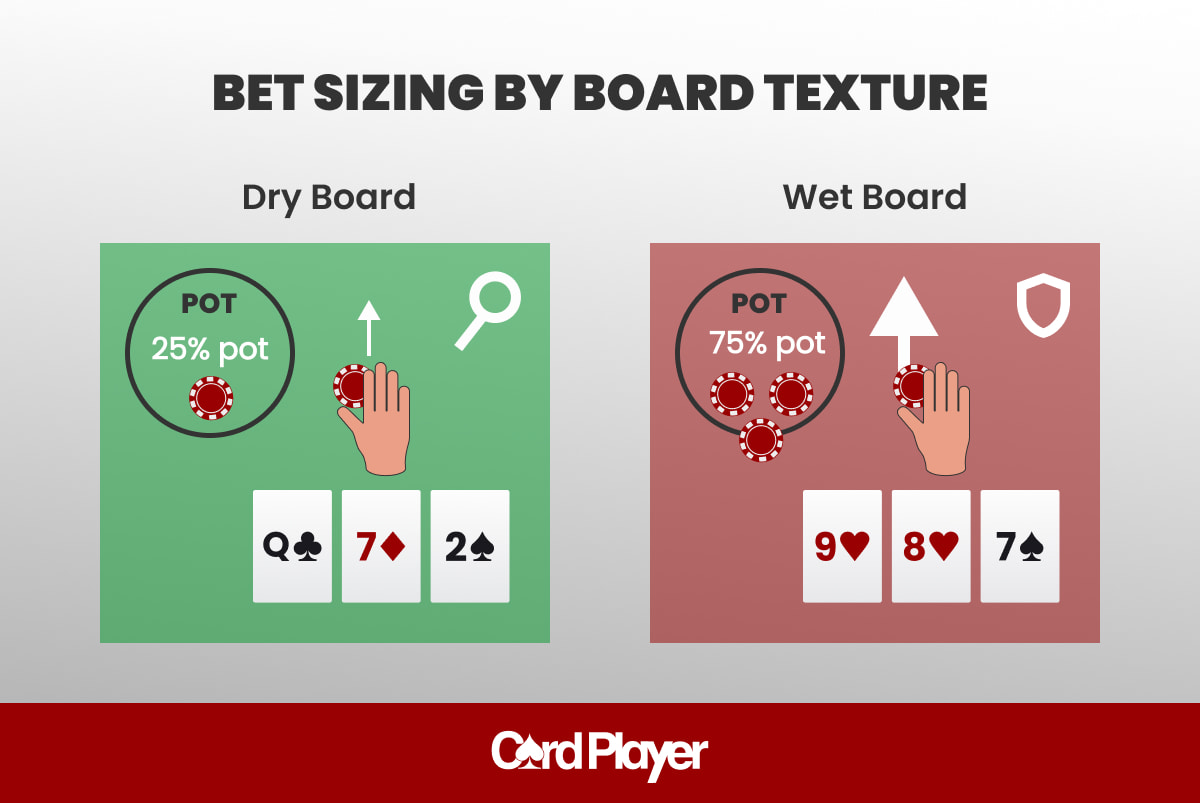
For example, if the SPR is very high on the flop and you’re looking to move all in on the turn, use a large bet or raise to set up a pot-size shove. Conversely, if you have a medium-strength hand, such as top pair, consider how you can control the size of the pot while also finding value.
Bluffing also requires a multi-street approach in cash games, as it’s less likely opponents will fold to a single bet. Always consider what you will do if they call, and consider your options when it comes to firing again on the next street.
Polarized ranges (strong hands and bluffs) typically use larger bet sizing, while depolarized ranges (medium-strength value hands) usually employ a smaller sizing to extract value more often.
Practical Bankroll and Rake Management
Bankroll management is an essential skill for any poker player. It encourages you to set aside funds that are used exclusively for poker and to play games that you can comfortably afford. The idea is to give yourself a cushion against bad beats and downswings.
As mentioned, cash games have less variance than tournaments, but you still need a bankroll management strategy in place if you’re taking poker seriously. This will lessen the risk of going broke and give you the best chance to realize your equity. High rake and caps affect your long-term expected value. Be aware that even a small change in rake structure can shift your break-even point substantially.
A typical bankroll management for cash games poker strategy is to have 40+ full buy-ins at the stakes you want to play. So, if you’re playing $0.10/$0.20 cash games and buying in for 100 big blinds, that’s a $20 buy-in per game, which requires a bankroll of around $800. This amount will increase if you are playing multiple tables simultaneously.
Of course, this is just a guideline. Your cash game bankroll management strategy should be tailored to you, based on your poker goals, risk aversion, win rate, and other factors. Keep in mind that you need to beat the rake in a cash game to make real profit, which is typically five percent of the pot, often with a cap of $3–$5 online or $5–$10 live.
Smart Table Selection
As you become more proficient at learning how to play poker with real money, you’ll notice that cash games give you the chance to select your table and seat. This is more than just a novelty. Experienced players use this as an opportunity to play against weaker opponents.
You want to find a table with several recreational players, preferably those with deep stacks, who are likely to call you off. Some live games allow optional straddles (usually 2× the big blind), which shift position and increase pot sizes preflop. Look for the right kind of action; if you don’t find it, be prepared to move on to other tables.
You can also choose your seat in a poker cash game. Try to sit down with looser players on your left so that you have position over them.
Adapting to Opponents on the Fly
In cash games, perhaps more than any other format, you’ll notice huge differences in the way people play. One of the most essential poker cash game tips to take on board is to adapt to your opponents.
It’s not unusual for there to be at least a couple of whales in a cash game, players who are more than willing to splash chips around for fun, making loose calls and nonsensical bluffs. On the other end of the spectrum, some players will be sitting tight and waiting for their moment to get their chips in the middle with a strong hand.
Spotting these player types will allow you to make exploitative plays when it comes to your betting lines and bet sizing. For example, you can play for value against the whales while stealing pots and bluffing against the tight players.
Of course, your opponent’s tendencies are more nuanced than that. The longer you sit and play, the more information you can discern that can inform your decisions, especially in a live cash environment.
Live vs. Online Poker Cash Games: Key Differences
Live and online poker cash games share the same rules, but there are some key strategic differences between the two. In live cash games, for example, you can use physical tells to make reads. Online games, meanwhile, are much faster and more convenient.
Here are some of the key differences between live and online cash games:
| Feature | Online cash games | Live cash games |
| Speed | Faster (60-100 hands/hr) | Slower (25-40 hands/hr) |
| Multitabling | Yes | No |
| Table selection | Easy | Depends |
| Tells | Betting patterns, timing, statistics | Physical tells, table talk |
| Rake | Lower | Higher |
| Convenience | Home or mobile | Casino or card room |
| Game toughness | Tougher | Softer |
| Software and tracking tools | Yes | No |
| Social experience | No | Yes |
That’s a great start to studying the differences between live vs. online poker cash games. Of course, there is no replacement for experience in terms of knowing this difference inside-out!
A note on multitabling: When playing multiple tables online, start small and gradually increase the table count as you build confidence.
Hand Rankings Refresher
Poker cash game rules follow the same hand rankings as tournaments, starting with royal flush as the highest hand, down to one pair and high card hands. The full hand rankings are always worth reviewing for a refresher.
Next Steps: Tools and Practice Resources
If you want to become a cash game beast, it’s going to take a lot of learning and practice, especially as you move up in stakes and face tougher competition. You’ll need to dedicate time and resources to making improvements by using any of the following:
- Use solvers to review your cash game sessions and plug leaks
- Consider a training course run by a cash game professional
- Surround yourself with other cash game players who are willing to share knowledge
- Play cash games at home with friends or start at the micro stakes online to gain experience
- Use tracking software, such as PokerTracker or Hold’em Manager, to review statistics and track win rates in online games.
Maintain discipline with session lengths and monitor your emotional game to avoid tilt and burnout.
Conclusion
Cash games are a rewarding format to play and can provide the opportunity for a steady, consistent win rate for those who are willing to grind it out. Adapting to cash games requires a knowledge of deep-stacked play, integrating concepts like SPR and implied odds into your overall cash game poker strategy.
It’s recommended that you start your journey into poker cash games by playing the micro stakes with a healthy bankroll while continuing to learn and improve.
FAQs
How to play poker online for money?
There are lots of regulated, fully licensed online poker sites available on the web. Sign up for a reputable site and make your first deposit to access real money cash games and poker tournaments. Make sure you meet the legal age requirement in your region.
How is a poker cash game different from a tournament?
In a tournament, you pay a set entry fee in exchange for tournament chips. The blinds steadily increase, and players are paid out based on their finishing positions. In cash games, players buy in with cash chips and can leave the table at any time.
How to win at cash game poker?
To win at cash game poker, you need to have a good understanding of playing with deep stacks and be able to adapt your strategy to different players at the table.
Are poker cash games real money?
Yes, poker cash games are played for real money. Each pot is played for chips that can instantly be exchanged for the same cash value. Cash game stakes start very low, known as the micro stakes, and run up to very high, known as the nosebleeds.
What is the best poker strategy to play cash games?
The best poker strategy at cash game tables involves utilizing fundamental poker concepts, such as position and hand reading, in conjunction with a flexible approach that adapts to opponents.