






How to Play HORSE Poker: Rules, Strategy & Complete Guide
Curious what HORSE poker is and how it works? Put that saddle away, because there’s nothing equine involved. HORSE is the most popular mixed games poker format in the world, and this guide explains the rules and everything you need to get started.
So, keep reading to learn exactly how to play HORSE poker. Yeehaw!
HORSE Poker: Key Points
- The acronym HORSE stands for Hold’em, Omaha Hi-Lo, Razz, Seven Card Stud, and Eight or Better (Stud Hi-Lo).
- HORSE offers a diverse challenge that attracts elite players looking to prove their all-around poker skills.
- The format uses a consistent Fixed Limit betting structure across all five games.
- Playing HORSE poker games sharpens various poker skills used across multiple variants and mixed game formats.
What is HORSE Poker?
Before we get into the HORSE poker rules, we need to talk about the game’s unusual name.
When you realise that it’s an acronym, everything starts to make sense. HORSE is a mixed-games format, so each letter corresponds to a specific type of poker. It has nothing to do with horses, betting on horses, or cowboys, unless you get dealt pocket kings, of course!
Most poker tournaments stick to one single game throughout, only increasing the size of the blinds and antes as time passes. But a HORSE poker tournament also changes the game at the end of each level.
Of course, HORSE poker games also exist in cash game format, where they typically play a fixed number of rounds of each game type before rotating.
Author’s Tip:
It’s worth keeping in mind that stud games represent 60% of HORSE, but are also known to be strategically the most complex, so many weaknesses will show up there. Keeping track of those in your opponents will go a long way, as will reducing your own leaks.
What Games are in HORSE Poker?
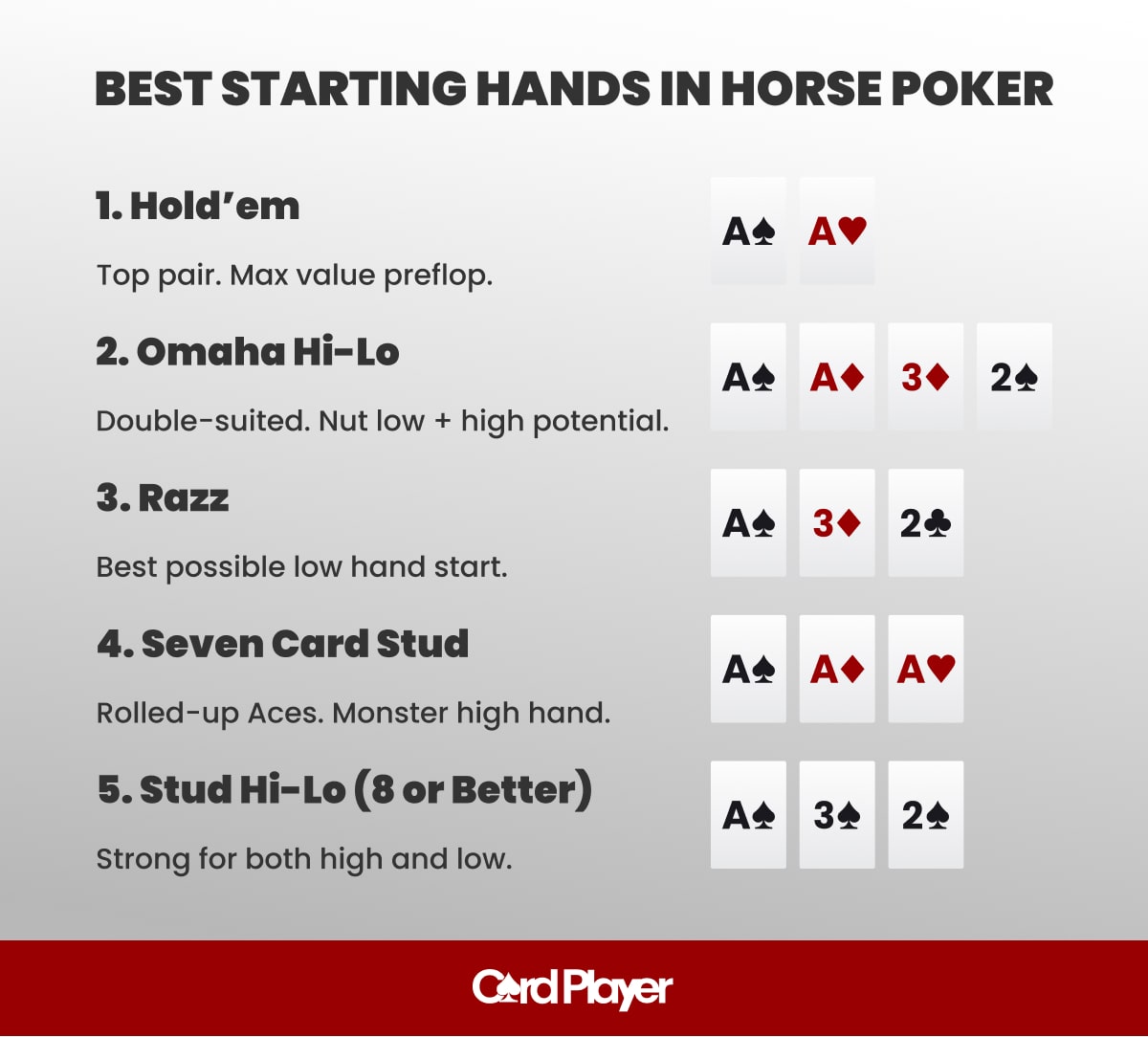
HORSE poker games always rotate in the same order: Hold’em → Omaha Hi-Lo → Razz → Seven Card Stud → Seven Card Stud Hi-Lo.
Here are the five games that make up the word HORSE in poker:
- Texas Hold’em: A flop-based game where each player receives two private hole cards. Forced bets, known as blinds, must be posted by two players.
- Omaha Hi-Lo: A variant of Hold’em in which players start with four cards and must use exactly two. Two pots are contested – one for the high hand and one for the best low (8-or-better) hand.
- Razz Poker: A lowball form of Seven Card Stud, where the best possible hand is 5-high. As a stud game, there are no forced blinds.
- Seven Card Stud: The classic seven-card variant of stud poker. Players receive two cards face down and one turned up, then receive three more upcards and a final downcard, with a betting round after each.
- Seven Card Stud Hi-Lo 8-or-Better: Often called Eight or Better, this is a split-pot version of Seven Card Stud that uses an 8-or-better qualifier for the low hand.
HORSE Poker Origins
People have always played mixed poker games in one form or another. The concept of Dealer’s Choice, for instance, has been around for as long as poker itself.
By the early 2000s, elite-level competitors were keen to find a way of demonstrating who was the best all-round player. After all, just because someone crushes at Hold’em, it doesn’t necessarily follow that they’re good at every other form of poker.
Several mixed game formats were tried, but HORSE emerged as the winner, as it offers the best blend.
HORSE & The World Series of Poker
When HORSE debuted at the 2002 World Series of Poker, the game’s credibility was given a significant boost; a healthy 156 players turned out for the $2,000 buy-in event, with John Hennigan eventually lifting the trophy.
Within just a few years, the game’s popularity exploded.
By 2007, the WSOP calendar featured three different HORSE poker tournaments. It grew to four for the first time in 2021. 2006 was an especially notable year for HORSE, as the WSOP Championship buy-in was raised from $10,000 to $50,000. That gave birth to what we now call the Poker Players Championship.
In 2010, the format was expanded to an 8-game mix, then to 10 games in 2015, before settling into a 9-game rotation by 2021.
Top Players Love HORSE Poker
HORSE always attracts elite professionals, particularly at the WSOP.
Such players can’t resist the urge to prove how multi-talented and well-rounded they are, at the highest stakes and on the biggest stage. The likes of Phil Ivey (2010), Scotty Nguyen (2008), and Doyle Brunson (2003) are just a few of the poker legends to have claimed HORSE bracelets.
Often considered the best ever all-round poker player, Chip Reese fittingly won the inaugural $50,000 HORSE Championship at the 2006 WSOP, staking his claim to that title more securely than ever.
Other notable winners include David Bach, who won HORSE bracelets at both the 2009 and 2017 WSOP, and John Hennigan. The latter is also a dual winner, adding a second title in 2018 after claiming the first-ever WSOP HORSE poker tournament in 2002.
How to Play HORSE Poker
To master HORSE poker rules, you simply need to understand how to play each of the five games involved.
After all, the game changes periodically – at the end of each level in tournaments, or after a predetermined number of cash game hands, typically 8 to 10 hands per game. Because the five games are all so different, HORSE usually adopts a Fixed Limit betting structure.
This helps to keep things consistent and less chaotic. No Limit Hold’em certainly works as a concept. But No Limit Razz has no place in a $10,000 WSOP championship, or at a high-stakes cash game.
The entire structure of a HORSE game changes between Omaha Hi-Lo and Razz.
Hold’em and Omaha Hi-Lo feature forced bets called blinds. Stud games don’t use community cards or blinds. Instead, each hand starts with antes and a bring-in, and betting begins after third street is dealt.
Antes are used instead, with the player showing the worst door card forced to pay a “bring-in”, usually equal to the small bet of the fixed-limit structure. If it’s a tournament, antes are also likely to appear in the latter Hold’em and Omaha Hi-Lo rounds, alongside the blinds.
If you’re hungry as a horse for HORSE poker strategy, you’ll want to check out the gameplay and strategy of legends of the felt, such as Chip Reese. There’s a ton to learn in HORSE, and he knew most of it!
How to Play Each Game in HORSE Poker
Each variant in HORSE has its own unique rules and strategy, so let’s break down the fundamentals of all five games.
H = Texas Hold’em (Limit)
Limit Texas Hold’em is rarely found outside of HORSE, but the mechanics are very similar to the more popular No Limit Hold’em. The best five-card hand wins at showdown, and any five of the two hole cards and five community cards may be used to make your hand.
There are four betting streets – preflop, flop (3 community cards), turn, and river.
Limit betting rounds are predetermined, there is a small bet on preflop and flop, and a big bet (usually double the small bet) on turn and river. A bet and up to three raises are permitted per betting round.
O = Omaha Hi-Lo (Eight or Better)
Omaha Hi-Lo is a split pot game, which means that half of the pot is won by the high hand and the other half by the low hand.
Aces count as both high and low, making the wheel (ace to five) the lowest hand.
Players get dealt four cards each and must use two to make the best high hand, and two for the low hand (it can be the same or different two cards from your hand). 8 or better means that the low hand must consist of 5 unpaired cards lower than 8 to qualify. If no such hand is made, the entire pot goes to the best high hand.
This is a bit more complicated than Hold’em, but you will get the hang of it in a couple of orbits.
The main mistakes beginners make in Omaha 8 or Better:
- Misreading that there are low hands when there cannot be one (e.g., on 349Q3).
- Overplaying low draws or made lows.
- Pairing low cards and/or not seeing how new cards change the best low.
- Trying to make the best high or low hand with just one hole card.
R = Razz Poker
Razz is a lowball stud variant where the lowest (unpaired) hand wins. Aces count as low, and straights and flushes are allowed, making A2345 the best possible hand.
Like in every modern stud poker variant, each player is dealt three cards to begin the hand, with two being private (downcards) and one visible upcard. The bring-in (forced bet to start the action) must be put in by the player with the worst (highest) upcard.
S = Seven Card Stud
Seven Card Stud has the same mechanics as Razz:
- Players start with three cards, two downcards and one upcard (called third street).
- The game starts with a forced bring-in by the worst (lowest) visible card.
- There are 5 streets and betting rounds (for each new card dealt from 3rd to 7th street), with 3rd to 6th streets being upcards.
- There are no community cards – each player has their own hand.
- Any upcard can flip the odds and hand strength, so reading the board is a key skill.
Discovering how to play HORSE poker will be a crash course in stud poker – three of the five games are stud variants!
E = Seven Card Stud Eight or Better
The third stud variant in HORSE is the split pot version.
Like in Omaha 8 or Better, half the pot goes to the low hand (if at least one player qualifies with 5 unpaired cards 8 or lower). Aces count as both high and low.
The key to strategy is to aim for a scoop – play hands that can make both straights or flushes as well as a low aggressively – these are the hands that have the most value as they have two ways to win and have great odds against hands that are only going for either the low or the high.
The bring-in is the lowest card, which makes bring-in hands a bit stronger than in other forms of Stud.
What is a HORSE Poker Tournament?
Like any poker tournament, the stakes are raised at the end of each level. This forces players to act rather than simply sit on their chips and wait for a big hand.
Levels are usually timed, though the exact length varies depending on the type of event.
A turbo tournament will have much shorter levels, with steeper increases in the blinds and antes than a deepstack event. Some HORSE poker games count the number of hands per level, instead of using a countdown timer. Although this is more common in cash games, it’s not impossible in smaller tournaments.
Because stud games progress more slowly than Hold’em and Omaha Hi-Lo, players often complete fewer hands during stud rounds.
Buy-Ins
HORSE poker tournaments are popular with the world’s best players as they showcase a wide range of skills. They’re the perfect way to prove who is the “best”.
As a result, they tend to carry higher buy-ins than average.
That said, the World Series of Poker offers a really nice spread of HORSE events. The 2025 schedule, for example, boasted three different events, with buy-ins to suit all bankrolls:
| Event | Buy-In | Entrants | Winner | 1st Prize | Runner-Up |
|---|---|---|---|---|---|
| 39 | $1,500 | 867 | Andrey Zhigalov | $197,923 | Thomas Taylor |
| 55 | $10,000 | 207 | Kristopher Tong | $452,689 | Maximilian Schindler |
| 98 | $25,000 | 150 | Chad Eveslage | $883,841 | Brian Rast |
HORSE Poker Tips
Understandably, there’s a lot to think about with a HORSE poker tournament. Here’s some expert advice to help you out if you’re new to the format:
- Be aware of the game: It sounds obvious, but you must pay attention to which game is currently active. You’re not likely to confuse Hold’em and Omaha Hi-Lo, but the switch from Razz to Seven Stud and then to Stud Hi-Lo often catches people out.
- Understand the structure: Some mixed-game tournaments also change the betting structure, including Pot-Limit or No-Limit rounds. Make sure you don’t accidentally buy into such an event if you’re not comfortable with that setup.
- Play to your strengths: If you’re considerably weaker in one particular game, stick to an ABC strategy and try to avoid big pots during those levels. You’ll have plenty of opportunity in later rounds to capitalize on your strengths.
- Target weakness: Similarly, your opponents might also have a game in which they’re less competent. Keep your eyes open and, if you find a weakness, make sure you target those players during the relevant levels.
- Look to scoop: Two of the games featured in HORSE are split-pot games. That means half the chips are reserved for the best low hand, with the remaining chips awarded to the strongest holding. In these games, it’s important to play hands that give you a chance of winning both pots.
- Be aggressive: Because HORSE is almost always played as a Fixed-Limit game, you don’t need to be as concerned about losing your entire stack. There’s rarely any reason to slowplay, and strong hands should be pushed aggressively.
HORSE Poker Rules
This form of poker is certainly quirky. Here are some unusual but important poker HORSE rules to remember.
Button Movement
In HORSE poker tournaments, the dealer button moves clockwise during Hold’em and Omaha Hi-Lo rounds, just like in standard flop games. However, during the stud-based rounds, Razz, Seven Card Stud, and Stud Hi-Lo, the button is typically removed or frozen, as these games do not use a dealer button.
Once the game rotation returns to Hold’em, the button resumes its regular movement to ensure fairness in blind placement.
Hand Rankings
Four of the five poker games in HORSE use the standard hand rankings at least in part, where a royal flush is the best. However, Razz is a lowball game, so the aim is to make the best possible low hand.
How are low hands determined? Razz, along with the low portion of Omaha Hi-Lo and Stud Hi-Lo, uses Ace-to-Five lowball rankings. Razz is a low-only game, while the other two are split-pot formats in which a player can win both the high and low pots. That means straights and flushes are discounted when forming a low hand.
Under these rules, the best possible low hand is 5-4-3-2-A. This plays as 5-high, instead of as a straight.
No Sitting Out Game Rounds
In mixed game tournaments, it’s common for players to have one game that’s weaker than the others.
It’s tempting, then, to simply sit that blind level out, rather than making bad decisions and putting your tournament life at risk. However, HORSE poker tournament organizers are prepared for this.
You can leave the table for a short time to answer a call of nature or whatever you have to do. But if you’re disappearing for an entire level at a time, you may be penalized at the discretion of the tournament director, especially if you miss mandatory bets such as blinds or bring-ins.
Conclusion
HORSE poker represents the ultimate test of poker versatility, blending five distinct variants into one challenging format.
While mastering Hold’em, Omaha Hi-Lo, Razz, Seven Card Stud, and Stud Eight or Better takes dedication, the journey will make you a more well-rounded player.
Focus on learning the stud variants where most players show weakness, stay aggressive with strong hands, and look for scooping opportunities in split-pot games. Whether you’re playing online poker or chasing a WSOP bracelet, HORSE offers an engaging challenge that separates specialists from true masters of the game.
FAQs
How do you play HORSE poker step by step?
The game of HORSE is really a combination of five poker games, as covered in our article. You can read any of our excellent guides to the games in question, such as Texas Hold’em and Omaha, by following the links above.
What online poker sites spread HORSE?
Larger online poker sites are the most likely places to find a game of HORSE, whether as a cash game or a tournament.
What is the best beginner strategy in HORSE poker games?
Study each individual game among the five types of poker in HORSE to become a true beast at the tables when it comes to HORSE.
What does each letter in HORSE poker mean?
H is for Hold’em, O for Omaha 8 or Better, R for Razz, S for Stud, and E for Stud 8 or Better.
What is the best hand for Razz poker?
The best hand is the wheel (ace, 2, 3, 4, 5).
How many cards do you get in the HORSE game?
It depends on the game in the rotation that is being played – for Hold’em, you get two; for Omaha, four; and in all three stud poker variants, you start with 3 cards, two hidden and one upcard.
How do you switch games in HORSE poker?
Switching usually happens either every orbit or after a predetermined number of hands. This is tracked by the dealer with designated plaques showing the game and the remaining number of hands. Usually, the blinds go up on every switch. In HORSE poker tournaments, games are sometimes played for a timed interval (blind level) instead.