







How to Play Zoom Poker Cash Games: Focus, Discipline & Smart Adjustments
Zoom Poker cash games are a fast-fold variation in which you’ll automatically move to a new table and be dealt a fresh starting hand whenever you fold. In a normal cash game, you can expect to see around 75-100 hands per hour in six-max (60-80 in full ring). In Zoom Poker, you’ll typically see around 200-250, which is about two and a half to three times as many hands.
It’s clear to see the appeal of Zoom. No more waiting around. You’ll always have cards, and you’ll be able to put in loads of volume per table. But what about Zoom Poker strategy? How does the fast-fold format alter gameplay, and how can you take a smart, disciplined approach to increase your win rate?
This page shows you how to beat Zoom Poker cash games, taking you through every step of the format’s gameplay, from preflop ranges to postflop Zoom cash game strategy and bankroll adjustments. We’ll assume you already know basic poker strategy and focus on advice that is specific to Zoom Poker.
What Makes Zoom Poker Unique & Why Many Players Have Leaks
In Zoom Poker, you don’t join a table and take a seat like you do in an ordinary poker cash game. Instead, you’ll join a pool of players who are all playing at the same stakes. From this pool, tables are formed for each hand with software that balances positions so players aren’t seated unfavorably too often.
Whenever you fold, you’ll be transported to a different table and immediately be dealt a new hand. If you click the fast-fold button, you won’t even have to wait for your turn. You’ll move right away and be automatically folded when the action reaches you.
The fast-fold feature significantly speeds up the game and eliminates the need to wait for hands. This is a huge appeal for players, especially recs who just want to get involved with big hands. It’s also one of the main reasons why Zoom players have plenty of leaks.
Fast-folding encourages a lazy, shallow approach to the game. Players tend to avoid marginal or tough spots, instead moving on to the next hand. Many will fall into rigid patterns, such as overfolding to aggression, fast-folding their blinds, or continuation betting every flop.
You don’t want to be one of the players who falls for this trap. Instead, your Zoom cash game strategy will be based on a baseline of playing solid, unexploitable ranges, as well as making smart deviations to exploit the lazy tendencies of Zoom player pools, ideally undetected!
Player History and Exploitable Plays in Zoom Poker
Before we jump into preflop Zoom Poker strategy, it’s worth taking a minute to think about how the Zoom format impacts our reads on other players.
In a normal cash game, you can sit with the same group of people for hours and form solid reads on how they approach the game. This isn’t possible in Zoom Poker, which to some extent eliminates the use of player histories and makes individual reads rare. In turn, this reduces your ability to make exploitable plays. At micro stakes, the player pool is so large that you may only see the same opponent once every 50–80 hands. This means HUD data builds slowly, and a meaningful sample takes time to develop.
Instead, you’ll need to make general adjustments based on the “population” of players. These are assumptions and observations based on how the pool as a whole is behaving. Player pools will differ depending on factors like stakes, but in general, Zoom players are likely to have the following tendencies compared to standard cash game fields:
- Usually tighter preflop
- Raise the button often to attempt to steal
- Will c-bet often on the flop
- Underbluff turn and river
- Tend to give up easily on the turn or the river
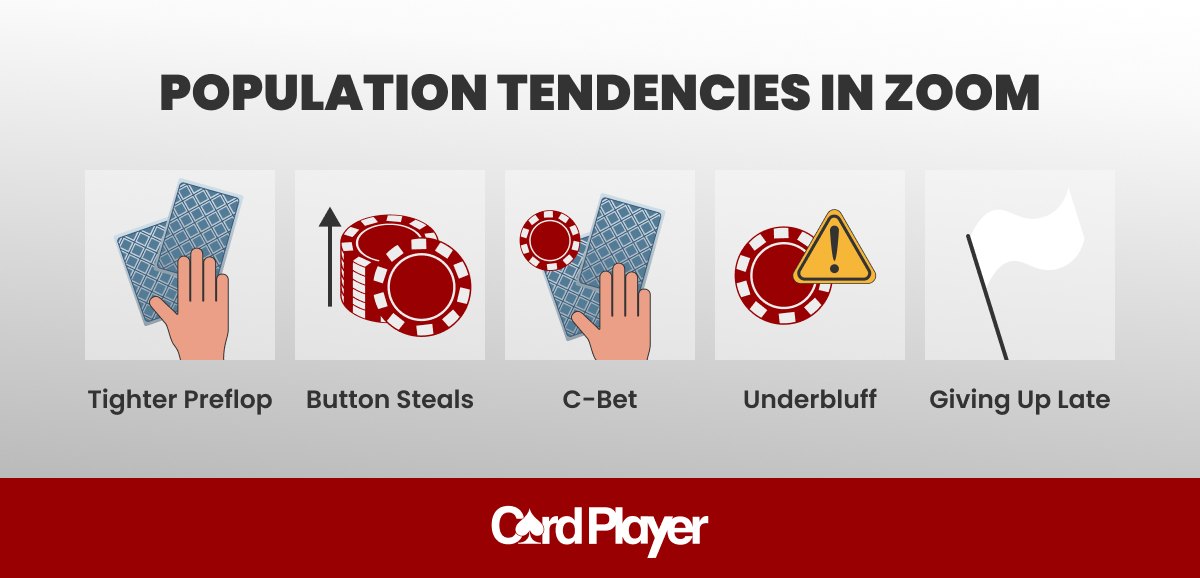
Although these general statements about populations will serve as a guide when it comes to preflop and postflop Zoom Poker strategy, they are not as reliable as individual reads and will only slightly alter your ranges and betting lines.
When it comes to gaining individual reads, you can still use the traditional method of note-taking in Zoom Poker. Every time you get to showdown, you should quickly take a note of how your opponent played the hand. Over time, you can build up a database of helpful notes to exploit other players.
However, given that you won’t sit with the same players for long, you may want to consider using a HUD for Zoom Poker. Over time, you’ll be able to gain data on the pool as a whole and, with a large enough sample, make use of individual players’ stats like VPIP, preflop raise, fold to c-bet, and so on. This data can then be used to make exploitative plays.
Building a Purposeful Preflop Zoom Strategy
Given that you won’t usually have individual reads, your preflop Zoom Poker strategy will be based around constructing clear opening ranges from each position. You can use standard poker starting hand charts to build your ranges, as you won’t be deviating too far from those.
The main preflop adjustment to make in Zoom Poker is to raise a little wider than usual from late position. This is because the population is more likely to autopilot or fold quickly in search of strong hands. Overfolding is inherent to the format, so you should look to exploit this by stealing blinds or raising with medium strength hands in position.
Keep your ranges tight from early position, while opening up from late position, especially from the button. Include suited connectors and other speculative hands in your late position raises, as well as more bluffs. You can also raise a little wider than usual from the small blind, as there’s always a chance the big blind has auto-folded.
A lot of Zoom players playing online poker have wisened up to the fact that they can raise lighter from late position, so three-betting from positions like the big blind becomes a little stronger, and three-bets against button raises are more likely to get through. However, widening your three-bet ranges is risky. It’s better if you have a read that the population is raising wide, or better still, an individual read on the opponent.
Preflop decision-making is always the starting point for a winning strategy, and Zoom Poker is no different. If in doubt, stick to constructed ranges. We recommend running regular study routines to improve your preflop gameplay by using tracker software to:
- Tag any hands in which you encountered a tricky preflop situation, such as a three-bet or four-bet all-in, or even a simple call or raise that you were unsure about.
- Filter your hands by position and action to check your ranges from different positions and make sure your stats for raising, three-betting, and folding to three-bets are on point.
- Look for leaks in your game, such as opening too wide from early position or folding too often to three-bets from the button.
- Track a large volume of hands in blocks and see how closely your actual ranges follow your theoretical ranges and how often they deviate. Look for habitual mistakes.
Postflop Awareness in Zoom
If you have position as the preflop raiser, your postflop Zoom cash game strategy should be based on exploiting the tendencies of Zoom players. A small continuation bet is often enough to take down the pot if your opponent has missed completely. If they have hit, they are likely to call quite wide with hands like middle or top pair.
However, general populations in Zoom Poker tend to give up easily on the turn or river. If you are bluffing, consider firing again to encourage them to fold. On the other hand, consider slowplaying very strong hands or delaying your bet on the turn with thin value hands to gain value against aggressive players on later streets.
One of the main exploits you can use postflop as part of your Zoom Poker strategy is countering c-bets. Opponents who have initiative often follow very routine betting lines, c-betting nearly every flop and then giving up on later streets. Consider check-raising as a bluff or semi-bluff with draws, floating the flop in position, and then betting the turn, or calling down c-bets when the board is in your favour.
Here are some quick postflop tips for Zoom cash games:
- Bet thin for value on the flop
- Don’t c-bet every flop, consider board texture first
- Bluff the turn and river more often
- Consider slowplaying strong hands on the flop or turn
- Play back at c-bets by floating or check-raising
As with preflop Zoom Poker strategy, we recommend that you regularly complete postflop discipline drills to make sure your play is consistent. Tag hands you are unsure about, and review them later using tracking software and poker hand calculators.
When and How to Adjust Mid‑Session
Without individual reads, your preflop and postflop Zoom Poker strategy should be based on making profitable plays with fairly standardized raises, making only minor adjustments based on assumptions about the overall Zoom player pool.
Over time, either following hours of continuous play or when you have played many sessions at your stakes, you’ll start to build up a solid idea of how your pool plays. You may even notice player tendencies shift at different times of the day, such as an even more passive period or a sudden uptick in aggression.
Even better, constant note-taking, combined with your recorded HUD stats, may finally reveal a clearer picture.
When you notice pool tendencies or have individual player reads, you can switch back to a more exploitative style of play. Here are some examples of how to respond to various changes in opponent behaviour:
- If the player pool or individuals are overfolding even more than usual, increase your aggression from late and even middle position.
- If the pool is three-betting light against late raises, tighten up your open-raising range or be prepared to four-bet.
- If the pool is continuation betting less than usual, consider bluffing the turn if they check and calling less when they do c-bet.
- If the pool is calling the turn more than usual, use thin value bets while bluffing less often, or consider checking the turn for pot control.
Even though it is possible to adapt your Zoom cash game strategy mid-game in this way, it’s worth emphasising here that you should remain disciplined. You still won’t have the quality of information on players that you would in a normal cash game, so you should avoid levelling yourself into spewing.
Session Structuring & Focus Training
Although Zoom Poker reduces the boredom of waiting for hands, it can also encourage autopiloting. It’s easy to fall into the habit of fast-folding without waiting to see what the action brings or taking the same betting line without thinking about factors like position and board texture.
You must stick to the fundamentals of poker while playing Zoom cash games. Not doing so will quickly reduce what is already a small edge. To prevent autopiloting, structure your sessions around long-term focus and regularly review them to stay on track.
Playing multiple Zoom tables increases hand volume but can reduce decision quality and win rate. Any guide on how to win at Zoom cash games should balance the benefits of volume with the costs of reduced focus.
Here’s a recommended guide to structuring your session to give yourself the best chance of beating Zoom Poker cash games. You can adapt this outline to your own needs:
- Warm up – Start by logging in to your chosen poker app and warming up with a single Zoom table. During your first ten minutes of play, minimize all distractions by closing down any tabs and muting notifications. Get in your zone. Calibrate your decision-making process so that you are ready for additional tables. Start to take notes of any tricky spots you encounter.
- Play blocks of hands – To avoid going on autopilot, play short blocks of hands. In Zoom Poker, a block of around 400-500 hands takes around two hours if playing one table. If you are playing two tables, it only takes one hour. Feel free to set your own parameters, but always make sure you can remain fully focused for the duration of the block. Keep tagging hands that need reviewing as you play.
- Review your block – Review your hand histories using tracker software and table viewers to run back through your block of hands. Take a deep dive into your overall stats, such as how often you raise from each position and how frequently you c-bet the flop, to make sure you are not deviating too far from your ranges. Review tagged hands to learn more about how you should have played tough spots.
- Take a break – After playing and reviewing your block, take a break from the tables to replenish your energy. Rest, eat, drink water, and take care of any little tasks that could distract you during future blocks. Treat yourself to an enjoyable activity, such as going for a walk.
- Repeat – Decide whether to play another block of Zoom cash games or call it a day. If you want to play another block, start again from the warming-up stage, play another block, then review your block.
Zoom Poker is ideal for short, high-volume sessions and rapid play, while regular cash games are better for building reads and exploiting opponents. Choosing the right format depends on whether your goal is volume or deeper strategic adjustments. Zoom can also accelerate learning because the higher hand count allows you to practice and review more situations in less time. This makes it a useful tool for players working to sharpen fundamentals.
Bankroll & Emotional Resilience in Zoom
Bankroll management is even more crucial in Zoom cash games than in traditional cash games. This is because edges are typically smaller in Zoom. Although you’re up against a lot of recreational players, your ability to exploit maniacs effectively is reduced due to the lack of reads and the fast-fold option.
With smaller edges comes a lower win rate, which in turn increases variance. Swings tend to arrive faster in Zoom due to the sheer hand volume, even if the variance per hand is not higher. Not as wild and dramatic as tournaments, but still quite tough on your emotions and bankroll.
If you go on tilt or lose this small edge in some way, the situation can quickly spiral. A winning player will immediately become a losing player if they are tilting. Emotional control is essential when playing Zoom, both for win rate and bankroll.
In a regular cash game, it’s recommended that you have at least 40 full buy-ins in your bankroll for the games that you want to play. In Zoom cash games, many players use 40 buy-ins as a guideline, while 50 buy-ins is a more cautious buffer for bankroll management.
Always remember, for all its skill elements, poker is still a form of gambling and as such, you should always aim to ensure you are playing within your means, not playing to excess, and gambling responsibly.
Rake and Rakeback in Zoom
Because Zoom Poker cash games generate a much higher hand volume, players also pay more rake overall. A strong Zoom cash game strategy should therefore include awareness of rakeback or loyalty rewards, which can make a big difference to long-term profitability.
FAQs
What is Zoom Poker?
Zoom Poker is a fast-fold variation of the game in which players are taken to a new table and dealt a fresh hand as soon as they fold. This increases the number of hands played per minute.
Is Zoom Poker profitable?
Zoom Poker can be profitable if you combine a winning poker strategy with adjustments to the fast-format. However, edges tend to be smaller in Zoom Poker, largely due to the lack of opportunity for exploitable plays.
Why is Zoom Poker harder to beat than regular cash games?
Zoom Poker is not technically a harder game. However, win rates tend to be lower because of the format, which in turn increases variance. Because you play many more hands per hour, your hourly rate can still be strong even with a smaller win rate. Beating Zoom Poker cash games is about grinding small edges efficiently.
What preflop strategy works best in Zoom Poker?
You should play fairly standardised preflop ranges in Zoom Poker, opening tight from early position and loosening your ranges from late position. In general, you can be aggressive from late position because the population of players is likely to be overfolding.
What post-flop tactics should Zoom players use?
Postflop Zoom Poker strategy involves adapting to the overuse of continuation bets and flop overcalls, while also bluffing more on the turn and river to take down pots.