










Bad Beat in Poker: Definition, Odds & Strategy Insights
What Is a Bad Beat in Poker?
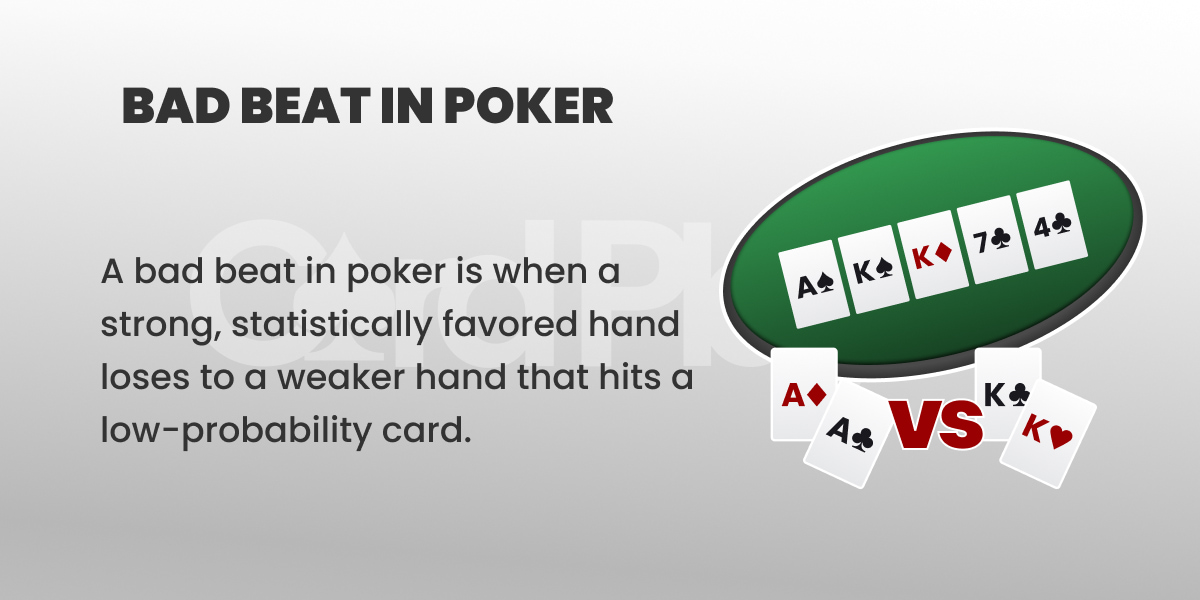
A bad beat in poker is when you have an obviously better hand and a lot of equity, but your opponent catches an improbable card, and you lose.
Unfortunately, it’s more common than you may think.
Bad Beat in Poker: Key Points
- When you play enough hands, even small percentages gradually pile up, which is why what seems like a statistically impossible event still happens from time to time.
- The emotional pain is worse than the math suggests because players tend to remember losses more vividly than wins.
- In poker venues that use bad beat jackpot rules, a loss that meets the requirements can turn out to be the most profitable event of the session.
What Qualifies as a Bad Beat In Poker?
To understand what qualifies as a bad beat, it helps to think in terms of equity.
If you are a 70% favorite, losing is unpleasant, but it doesn’t qualify as a bad beat. If you are an 85% favorite or higher, the loss feels even more like a genuine statistical shock. Many players set the bar somewhere around 80 to 90% equity for a bad beat.
The difference between bad beats and coolers becomes clearer when you compare examples.
- Normal loss: This can occur when you make a routine call on the river, and your opponent has a better hand, or when you lose a hand by folding
- Cooler: A cooler is something like flopping a set of queens against a set of Kings. Both players had strong pre-flop holdings, both hit the board hard, and neither one could reasonably fold.
- Bad beat: A true bad beat is more specific. Imagine getting all the chips in on the turn with top set against an open-ended straight draw that only has eight outs. If the river hits one of those outs, the underdog wins despite holding around 18% equity.
Bad Beat Examples in Poker
To make things more concrete, consider a few examples of bad beats in poker that come up often enough to be recognizable.
A-A fails to Win
In the first example, you have A-A and get all the chips in before the flop against J-J. Pocket Aces hold roughly 80% equity. When the flop comes J-x-x and the Jacks make a set, your Aces were just crushed by a classic bad beat.
Straight vs Straight
Another common scenario happens when you flop a straight, and your opponent holds a higher straight draw with only a handful of outs. You might be a 90% favorite, but if the turn or river completes their one specific higher card combination, the hand becomes a textbook bad beat.
Made Hand Becomes Dead Hand
A third example is when you have strong made hands on the turn. Imagine that you turn the nut flush and your opponent has two pairs with one card to come. They might have a 4% chance of filling up. If the river matches the board, your winning hand loses in a way that is clearly in line with any reasonable definition.
These situations definitely feel brutal, but they are all part of the game.
Bad Beat Jackpot Rules Explained
Many card rooms and online casinos offer special promotions called bad beat jackpots, which completely alter the way some pots are played.
These payouts come from small drops taken from qualifying cash game pots. Once there is enough money in the pot, the room sets rules for when a bad beat jackpot can be won. The person who loses a hand usually gets the biggest piece of the jackpot pool. The player who knocks out the other player receives a smaller share, and the remaining money may be divided among the players at the table, depending on the rules.
Bad beat jackpot rules are very clear because a lot of money is usually at stake.
One rule is that a player must use both of his hole cards. This rules out a player winning or losing a game using only one of them. On the other hand, each room sets a certain minimum hand required to qualify. The straight flush that beats quad eights is normally the limit. Based on the value of the jackpot, a room may require a much better hand than this.
Winning a bad beat poker jackpot can turn a significant loss into one of the most memorable experiences a person has had at a table.
Bad Beat Odds & Probability
Bad beats feel common, but mathematically they’re not.
A hand where you hold 90% equity will still lose one time out of ten. Therefore, if you play thousands of hands per week online, that one-in-ten outcome shows up often enough to feel normal. That doesn’t take the sting away from the bad beat, but negativity bias explains a lot. Players tend to remember painful losses more vividly than routine wins.
Sample size matters as well.
One night of cards means almost nothing from a statistical perspective. Variance is the engine behind all of this. It is also the reason poker remains beatable. If weaker hands never sucked out, they would never call, and the game would collapse.
Worst Bad Beats in Poker History
Bad beats happen at every level and to every player, regardless of skill. The following two examples from the 2025 WSOP serve as brutal reminders of this and show how common bad beats are in poker tournaments.
Hellmuth Out With A-K
This Main Event hand begins with Phil Helmuth holding A-K and moving all-in for a little over 30 big blinds. It’s a standard shove in tournament play, and he’s almost always getting called by strong pairs. His opponent, Mike Zulker, has pocket Queens, which sets up a classic race: Queens slightly ahead pre-flop but vulnerable to any Ace or King.
The flop arrives J-4-3, which keeps the Queens in front. Helmuth spikes a King on the turn, leaving his opponent seeking a Queen.
The Queen arrives on the river. Helmuth goes from almost tripling his stack to being eliminated on the single worst card in the deck. A true two-outer bad beat.
Nines vs Pair + Backdoor Draw
In a later round, Matthew Franklin gets all-in with 9♣️7♣️ against Nicholas Rigby, who holds 6♦️3♦️plus a backdoor flush draw.
It’s a comfortable situation for Franklin because he’s roughly a 3-to-1 favorite and expects to double up most of the time. The 6 ♥️J♦️9♥️ flop doesn’t bring much danger, as Franklin scored top pair and only needs to fade a handful of outs.
He moves all-in, with Rigby calling behind.
The A ♠️ on the turn helps no one, but the 3♥️ on the river gives Rigby two pair. This sends Franklin from a near-lock to the rail, another example of a big underdog hitting one of just a few winning cards.
The Psychology of Bad Beats: Why They Hurt
It helps to understand why bad beats feel uniquely painful.
Loss aversion refers to the phenomenon where humans experience negative outcomes more intensely than positive ones. Outcome bias leads us to judge the result of a hand rather than the quality of the decision that led to it.
The best players separate process from outcome.
A correct laydown or a mathematically sound call remains correct even when the card that beats you hits. The long-term expected value of the decision is what matters, not the single instance.
How to Handle Bad Beats in Poker
It takes practice to learn how to deal with bad beats, but once you do, you’ll be able to use the skills for the rest of your playing career.
The first thing you need to do after a bad beat is look at your hand and see if you made the right move. If you made a smart decision, that means you didn’t play poorly; it’s just the math at work.
Additionally, it is helpful to maintain a broader perspective. One hand, or rather one session, means absolutely little when weighed against the number of hands you are likely to play in the long run. Variance is inherent in poker, and paradoxically, variance makes the game lucrative for players who put money in the pot with odds in their favor.
So, when you feel irritation creeping in, that in itself means it’s time to take a step back.
Tilt can easily lead to a snowball effect, and stepping back can help prevent you from ending up in places you would definitely not go if you had remained even-tempered. Later, when the emotional cooling process has completed, return to that hand and re-examine it. Equity calculators can help you in figuring out whether your decision was correct in order to distinguish between bad luck and bad play.
Additionally, at this stage, bankroll management plays a crucial role.
Bad Beats and Bankroll Management
Bankroll management protects players from the natural swings in poker.
Cash game players often use a 20 to 30 buy-in guideline, while tournament players rely on 50 to 100 buy-ins due to higher variance. When someone plays too high for their bankroll, a bad beat can create serious emotional and financial stress.
A bad beat in poker may feel like the world is turning against you, but in reality, it’s just probability doing its job. If you were ahead when the chips went in, you were playing the game correctly.
The key is to trust the math, stay composed, and keep your focus on long-term results.
Bad Beats in Online Poker vs Live Poker
Players often claim bad beats happen more frequently online. The truth is that the faster pace of online games simply exposes you to far more hands. A typical live player sees around 30 hands per hour. Online, especially when multi-tabling, that number can exceed 100 hands per table per hour.
With that much volume, you witness 1-in-10 and 1-in-20 outcomes more often.
Random number generators used by reputable sites are tested and certified. The increased frequency of bad beats is a perception issue rooted in exposure, not illegitimacy.
Common Mistakes After a Bad Beat
Many players begin making mistakes immediately after suffering a painful loss:
- The most common is tilt betting, where someone bets with raw emotion, trying to recover chips quickly, and chooses hands or bet sizes that make no strategic sense.
- Another mistake is results-oriented thinking, which confuses a poor outcome with a poor decision. Some players convince themselves they are due for a win and overplay marginal spots, which is a direct example of the gambler’s fallacy.
- Others keep playing even when emotionally compromised, and that single choice often costs more money than the original bad beat.
FAQs
What is a bad beat in poker?
A loss where your strong, statistically favored hand gets cracked by an unlikely card.
What is an example of a bad beat?
Pocket Aces losing all-in pre-flop to pocket jacks that spike a set.
What qualifies for a bad beat jackpot?
Usually, a very strong hand, such as quad eights or better, losing to an even stronger hand with both hole cards playing.
What are the odds of a bad beat happening?
A typical 90% favorite still loses 1 out of 10 times.
What’s the difference between a bad beat and a cooler?
A bad beat involves dominant equity losing. A cooler involves two huge hands that were always going to clash.
Should you complain about bad beats?
No, it affects your focus and does nothing to improve your results.
How do you get over a bad beat quickly?
Take a short break, breathe, re-center, and remind yourself you made the correct decision.
Do bad beats happen more often in online poker?
Volume creates the perception. More hands per hour means more exposure to rare outcomes.
What is the biggest bad beat jackpot ever won?
Several rooms have awarded multi-million-dollar jackpots, with exact totals varying by casino and location. However, the largest was at the Playground in Quebec, Canada, in 2023, when a player won $1.9 million.