







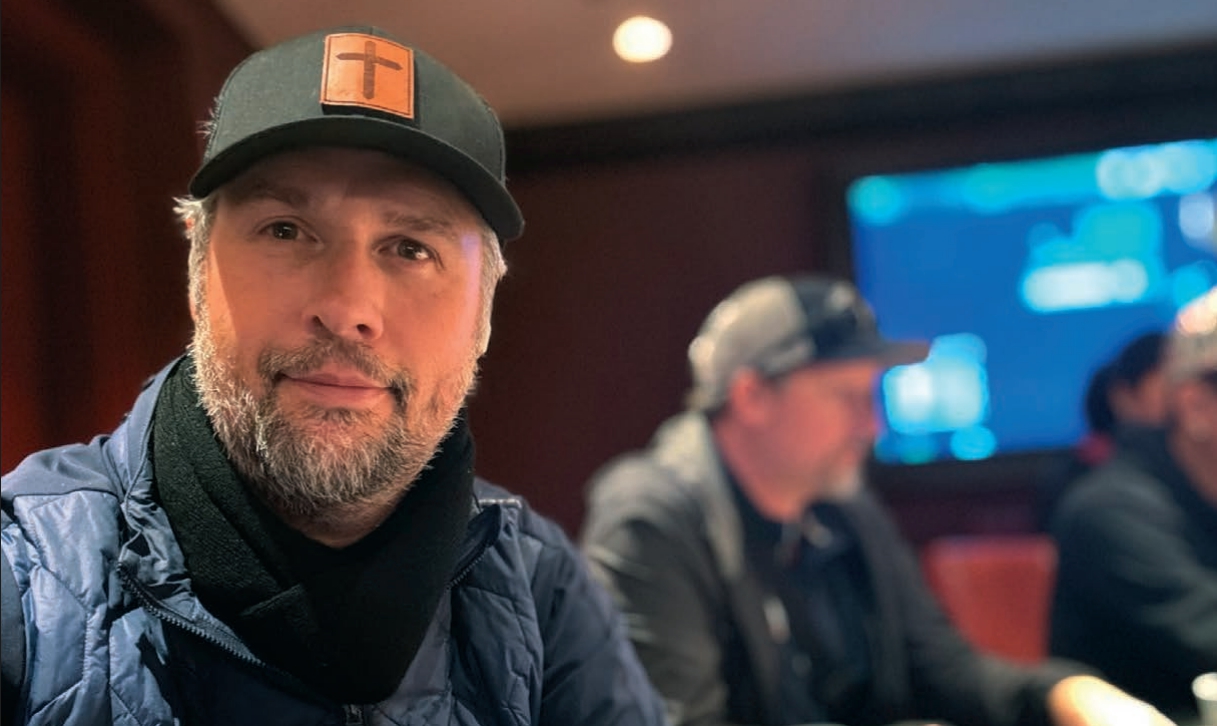
Legendary bluffs in high-stakes cash games, living at the Bellagio to take on all comers, and a month-long disappearance that transitioned into a two-year retreat in the Oregon woods. It would be quite an understatement to say that poker pro Brad Booth has had a unique life, and these were just some of the stories he shared in a recent appearance on the Table 1 podcast.
Booth grew up in the town of Whitehorse in the Yukon territory of Canada, earning him the nickname ‘Yukon’ at the poker tables. He had a number of high-profile tournament finishes during the height of the poker boom, most notably when he finished third in the World Poker Tour Mandalay Bay Poker Championship for $319,180. But Booth is most remembered for his fearless and hyper-aggressive play on televised poker shows like High Stakes Poker and Poker After Dark.
One particular hand he played against Phil Ivey is still regarded as one of the best televised bluffs of all time. The 49-year-old discussed that viral hand as well as his time at the top of the poker world, and why he decided to walk away from the game entirely.
Keep reading for highlights of the interview below. You can also watch or listen to the entire episode below or on YouTube, Spotify, Apple, or any podcast app.
Booth addressed the reasons why he has an occasional habit of withdrawing from society, which included a well-publicized disappearance in 2020.
Brad Booth: [The first time] I was just a young kid and my mother had passed away. I’ve run away a couple times in my life, actually, but that was probably the first time. Just an escape to get away.
It’s funny now that 30 years later, talking about it can still get me teared up. I just didn’t want to be around friends to see me cry and things like that, so I went up to the Yukon territory. I knew one person and just stayed there. It was just one of those things. I went up north as a lost kid and just tried to find myself.
Justin Young: Were you still finding poker when you went up there?
Brad Booth: I was. One of the first things that I did was ask a cab driver where the card game was, and the first five cab drivers had no idea. By the time I got to the sixth one he said, ‘Yeah, I’ll take you there.’ I was like, ‘Okay, let’s go.’
I had no idea where I was going or anything. He took me to a place called the Airline Inn, and it was in room 101. We used to play between $2 and $25 bets. There was no check-raise, there was no hold’em, and [we ate] smoke-infested bologna sandwiches. It was a wonderful place to play. I did quite well and built up a bankroll, or survival funds back in those days.
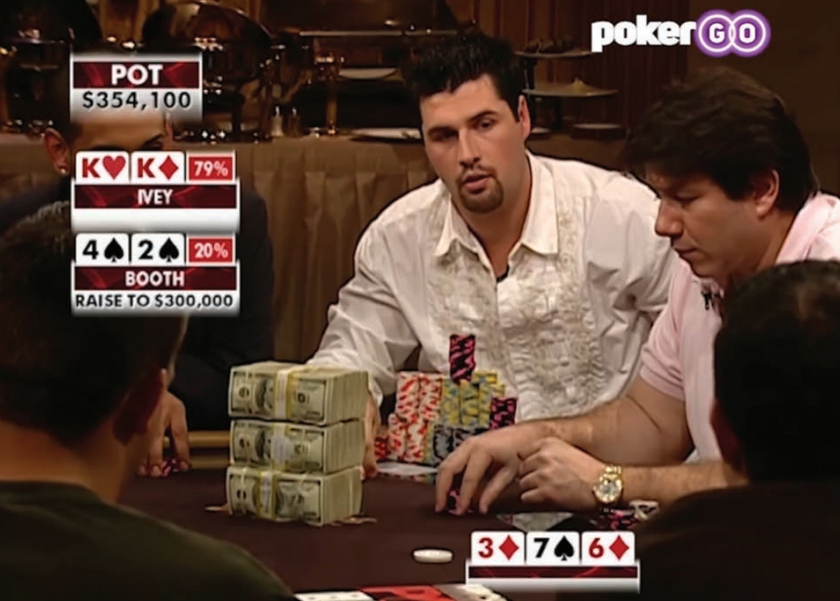
Booth also started winning online and moved to Las Vegas to play higher stakes, even living for a time at the Bellagio so he could be closer to the action. The discussion later touched on his infamous bluff against Phil Ivey on High Stakes Poker.
The 11-time WSOP bracelet winner notoriously folded pocket kings to Booth’s 4s 2s on a flop of 7s 6d 3d. Ivey bet $23,000 into a pot of $31,000, only for Booth to move all in over the top for another $260,000 effective.
Justin Young: Let’s talk about that hand.
Brad Booth: It was just one of those hands where I was smart enough to be able to put Ivey on the hand. Then I was smart enough to realize what I would do if I was Ivey in that situation.
It was kind of before overbets were a thing. Now, you see it all the time. Ivey being one of, if not the best poker players… it’s sort of just one of those things where he just has to find a better spot, right? Most players are going to fold in that spot and just find a better spot to pick off later.
Justin Young: You never have queens there. If you make it smaller, you could have queens or jacks.
Brad Booth: That was my only thought, that I wanted to make sure he didn’t think I had queens.
Justin Young: Do you remember how long the tank was for? On TV, it felt like forever, but live it had to fill infinitely longer.
Brad Booth: It did feel infinitely longer. It was that moment where I was really the deer in headlights, and was really thinking, ‘Please fold.’ I do remember he was grabbing some chips and he dropped one and I was like, ‘Okay, he’s going to fold now,’ because I saw him really processing his thoughts on what to do. Then he kind of just took his mind off it for a sec and I thought, ‘Okay, I’m going to get away with this.
After revealing some of the ups and downs of his time at the tables, Booth reflected on his disappearance in 2020 and what led him to walk away from the game.
Art Parmann: You had your mistakes. You basically kind of fell off the map for eight years or so, 2012 to 2020. Then I think every poker player remembers the middle of the summer. All of a sudden it was like, ‘Hey, we haven’t heard from Brad Booth, he disappeared.’ What happened?
Brad Booth: I’m here to be honest. I’m not running away from that. I would say it was just not taking accountability, all those types of things. Life catches up to you. Your mistakes and your errors. They catch up to you, and you have to finally hit a point where you realize your heart and your actions just aren’t matching. You have to take a timeout. This is going to sound so selfish, but I had to save myself.
Justin Young: Where did you go?
Brad Booth: I ended up in the woods in Oregon.
Justin Young: I read that you basically told your roommate, ‘I’m just going to go camping,’ and you just left. Then the roommate said you only had enough camping gear for one or two days.
Brad Booth: Yeah, it’s true. I had next to nothing, and then I just kept going and going and going. I never had a set destination. I was just hoping to hang in there. I went up out of northern Nevada into Oregon, and then just found a place there.
I became MIA. That’s why I was literally a missing person. No cell phone. Off. Done. Didn’t say goodbye to a family member, a friend, nobody. Just irresponsible as can be.
When I first got there, I stayed at a hotel and then was trying to figure out what I was going to do. Then I realized I didn’t have a whole bunch of money there to bankroll the situation. I ended up staying in a tent outside, just really facing all the stuff that I had to face. It was rough, and it was tough, and it was cold, and unique, and humbling.
Justin Young: How did you get pulled back?
Brad Booth: I knew I just couldn’t be there with my thoughts. I had to go do something.
There was some noise being made up the road from construction equipment. So, I just walked up there and said, ‘Hey, I’d love to give you guys some help. You don’t have to pay me, just looking for something new.’ They said okay.
I didn’t do a whole lot of ‘manly work’ as a kid or anything like that. After the first day they were just like, ‘Thank goodness this kid didn’t ask for any damn money.’ I didn’t know how to run a chainsaw. I didn’t know how to do anything.
By the end of it, I could cut down a tree, limit and buck it, and stack it. All that kind of stuff. Then I learned how to drive a skid steer and lawnmower. I really bonded with some people and they gave me that humanization, [reminding me] that I could be trusted.
Justin Young: Yeah, that’s invaluable. That’s something you can’t will, and you can’t buy, that’s for sure.
Art Parmann: Whenever I’ve had a really bad stretch or I self-sabotage or do something to myself, the only thing that ever really brings me back to level is just completing something where I had full control over the process.
I spent a month building a greenhouse during COVID and it was the shittiest looking greenhouse you’ve ever seen. I probably spent $2,500 on building this thing that I could have bought out of the box for $800. But it just brought me back and I was like, ‘Alright, it’s done and I can plant some stuff and it’ll grow.’
Even if you make the right choice in poker, you could lose, and you get that negative dopamine. Doing something completely different really makes a difference.
Brad Booth: It really does. The family and friends up there really just gave me a chance. It wasn’t handed to me at the beginning. It was a slow trust thing. They let me use their vehicle. And then, rather than stay outside, I was staying inside. It was just really nice. It was beautiful.
I was reading a couple of things online once I did have access to the Internet, and people were saying, ‘Brad Booth would never get a job.’ That’s still not true. I would totally get a job. I started helping out at this lodge with just little jobs outside and then inside, and then parking boats and stuff like that.
Then there was this other resort down the road that needed some help, so I’d just go there and help out. They wanted me there [one day] but I couldn’t come. ‘Well, the Reno police are looking for you anyways,’ she said. At that moment, I didn’t want to be found yet. I was not ready.
 The first two years were really rough in the sense of living conditions, but really strong in brothership. After that, I slowly started re-emerging, but still going through a massive identity crisis. I started having access to a vehicle, and then went out to some bars to play pool and stuff like that because I was really craving some competition. All those nights in the woods without playing cards and stuff was really tough for me.
Justin Young: Let’s talk about the comeback. What’s been the story since the woods?
Brad Booth: I still live in Oregon. I live as close to Vancouver, Washington, as you can be on the Oregon side. I play a few nights a week up there. There’s a place called The Game, there’s a place called Final Table, and there’s a place called Portland Meadows. Fantastic players, well-managed, all that kind of stuff. All those places are great places to play.
Then there’s also the smaller towns [with games] like Bend, Oregon, and down in Medford. So I’m just slowly accumulating some rounds, trying to keep the engine oiled, as far as no-limit hold’em goes and lower limit hold’em goes – with no ego.
Justin Young: Do you get recognized in those low-stakes games to the point of embarrassment? Not that I was ever as much of a rising star as you or anything, but I get that embarrassing feeling when I’m grinding lower.
Brad Booth: The embarrassment feeling came many years ago after playing $4,000-$8,000 [limit] in Bobby’s Room or $200-$400 [no-limit]. I think as I went down from yellow chip-white chip, to green chip-black chip-red chip, to blue chip-red chip-occasional green chip.
I had that ego check quite some time ago. But the ego is something that I now just check at the door. It’s more than poker for me moving forward. I’m very thankful and filled with gratitude to be where I am today, mentally, emotionally, and now we’re going to work on it financially.
About The Table 1 Podcast
Hosted by high-stakes poker pros Art Parmann and Justin Young, the Table 1 Podcast is on a mission to make poker fun again. Tune in to see world-class pros talk poker, gambling, and all manner of life experiences on and off the felt. Visit the website for the podcast, newsletter, or even to get in the game. ♠
- Photos – Brad Booth, PokerGO