










ICM in Poker: Definition, Concepts & Tournament Applications
What Is ICM in Poker?
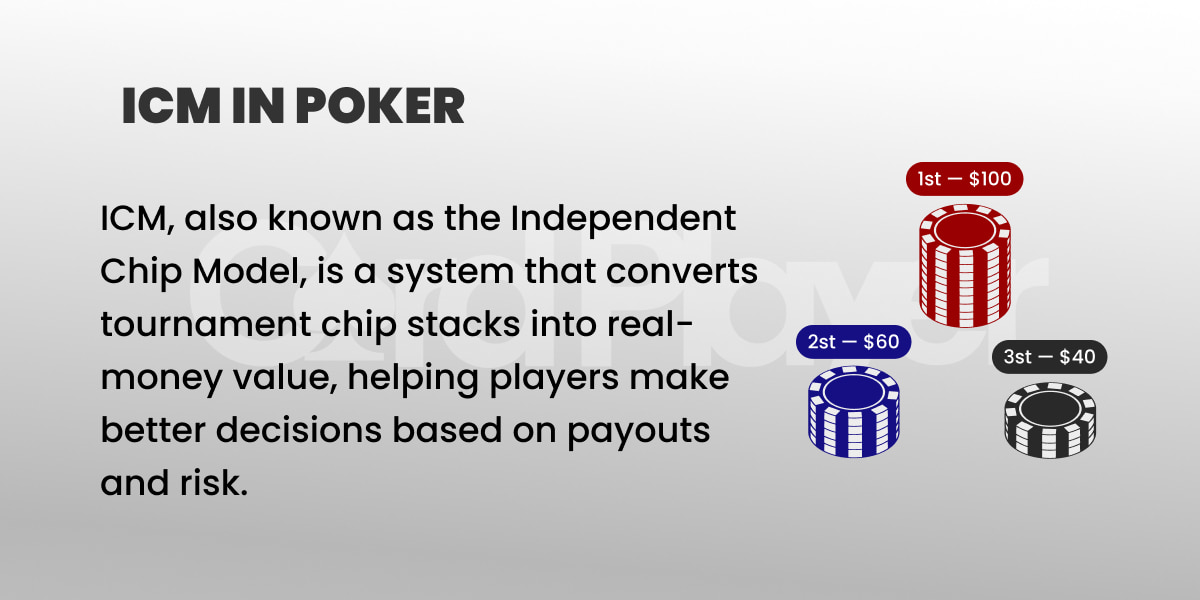
ICM in poker is a valuable concept that can help players quickly determine whether there’s value in staying in the hand. Its goal is to determine the actual monetary value of each player’s stack by adjusting for the payout structure stated in a tournament.
The ICM assigns an amount to each stack only based on stack sizes and the remaining prize pool. It does not account for player skill, table play, and any future strategic adjustments. Following ICM poker in tournaments matters because a player’s chips do not equal dollars on a one-to-one ratio.
A double-up may increase one’s probability of moving up the prize structure when there is a multiple table payout system, but this move does not necessarily double one’s value within a tournament. That’s why understanding poker ICM can help a player avoid making decisions that could literally cost them much more than they may initially realize.
In contrast, players in cash games never have to worry about this problem. The value of a stack is equivalent to having real dollars at any time in a cash game, which is not the case in tournaments. This is what makes ICM poker strategy necessary in an MTT but not necessary in a ring game.
ICM in Poker: Key Points
- The ICM assigns a value to each stack according to the prize pool, rather than just considering the chip counts.
- A short stack, a medium stack, and a large stack are each distinct because a loss is more detrimental to one’s equity compared to when one gains chips.
- ICM in MTT games is relevant whenever payouts are involved, such as during bubbling, and when there is a pay jump, as seen during satellite qualifying tournaments.
How the Independent Chip Model Works
The Independent Chip Model estimates each player’s probability of making each remaining payout position. It translates those probabilities into a weighted average, which is the value that is actually being realized by that stack.
The key is this: The Independent Chip Model assigns a dollar value to each player’s chip stacks by simulating how each one finishes, assuming each player is equally capable.
Basic Concept
If you have 20% of the chips in play, you will presumably have a similar chance to win, which is approximately 20%. Then, the probability of placing second or third is influenced by how probable other stacks are to last longer than each other.
This, in turn, explains what the ICM poker meaning is: The model is not predicting what you are likely to win, but what your chips are worth right now to you in terms of expected monetary value.
Simple Example Calculation
Imagine a three-player payout structure:
- 1st: 500.
- 2nd: 300.
- 3rd: 200.
Total prize pool: 1000.
Stacks:
- Player A: 50% of chips.
- Player B: 30% of chips.
- Player C: 20% of chips.
The Independent Chip Model estimates:
- Player A wins first place 50% of the time.
- When Player A does not win first, the remaining stack distribution determines second and third probabilities.
- The same logic applies to Player B and Player C.
Although the exact calculation is lengthy, the resulting equities might look like:
- Player A equity: 420.
- Player B equity: 330.
- Player C equity: 250.
It’s important to note that while Player A’s chips are 50% of the total stack, they are about 42% of the prize money. This is one crucial thing that rookies need to remember about making ICM poker errors, because they often place too much value on building up their stacks to increase payouts.
Factors Affecting ICM
Chip stacks, payout structure, table position, and comparison to table stack depth affect this model. Players with shorter stacks experience more ICM stress because they are on the bubble with fewer chips.
Deeper stacks are concerned about being put into a dangerous situation by mid-stacks. Table positioning is important because being last to act improves one’s odds when faced with difficult decisions.
ICM Strategy in Poker Tournaments
An understanding of how to use ICM poker can help you better change your focus during a tournament. Near payout time, the value of maximizing your chips can become less pressing than maximizing your equity. This is what sets tournament play apart from Chip EV.
A short stack has to push or fold quickly to avoid being blinded out. A medium stack has to avoid making poor calls that lead to being eliminated by larger stacks. The big stacks can exploit ICM pressure present in poker games by constantly raising and making other stacks fold hands they could otherwise play.
The strategy involved in ICM poker requires that decisions be assessed solely on the basis of equity. A playable hand in the early stages of a tournament may become non-playable on a big chip raise. A marginal call throughout a big tournament could prove disastrous while advancing to the bubble. Most of what gives meaning to ICM poker lies in understanding when to make these adjustments.
Typical errors in ICM poker include:
- Calling too easily.
- Not adjusting to payout ladders
- Paying no attention to how the stacks are distributed.
A player with a medium stacked range and short-stacked players behind is much tighter than EV indicates when called to an all-in bet.
Using ICM Calculators and Tools
Since ICM calculations involve probabilities, most players use software. An ICM calculator considers a player’s chip stacks, payout information, and tournament position. The result provides each player’s real-money equity and how any play affects this equity.
Current solvers use ICM applications in MTTs during pre-flops. They offer recommendations to call, push, and fold that take into consideration actual money risk. Players using ICM poker example situations can input custom payouts, unique short-stacked situations, and varying blind levels to compare decisions. The applications eliminate uncertainty and identify how pitfalls exist within ICM poker.
While no tool can substitute judgment concerning dynamic situations, they offer precise points of comparison to assist players in comprehending modifications within the ICM.
ICM vs Chip EV & Future Game Simulation
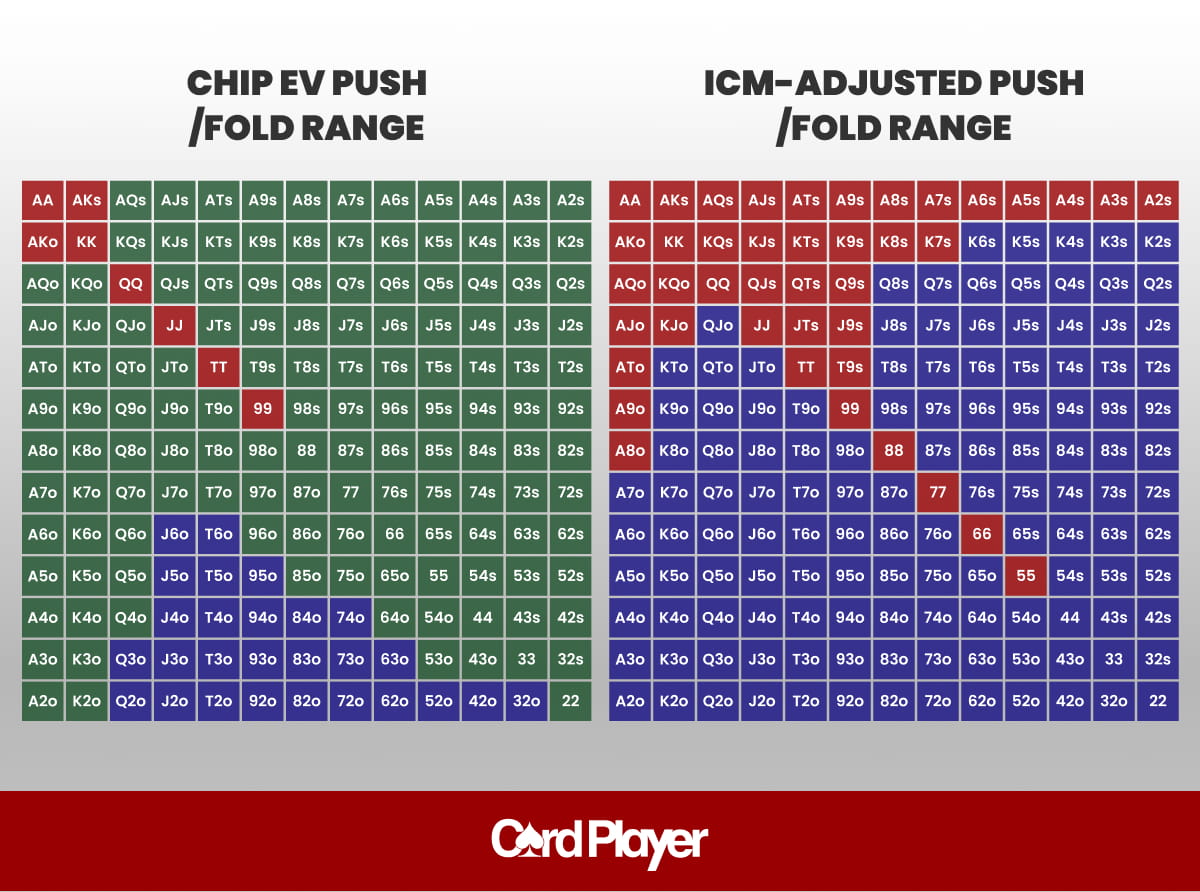
A key difference between ICM and EV is that while ICM is calculated in terms of actual money value, EV is calculated on the gain/loss value in chips. The initial stages of a tournament give more prominence to EV, while toward the latter stages, ICM becomes more important because EV may not directly correspond to increased prize money.
Future Game Simulation (FGS) is an extension of ICM, as it considers the impact of blinds, play habits, and positioning on outcomes. Standard ICM does not account for increasing blinds or upcoming positions, but FGS does by simulating a range of possible future outcomes. FGS is more complex but can provide much better estimates in short-handed or final table play.
Players have asked whether ICM is equivalent to Chip EV. The response is no. Chip EV calculates the value of raw chips; ICM calculates a player’s tournament equity. Models can equally leverage both ICM and Chip EV, although this requires understanding which model to use at what point during the tournament.
ICM Real Examples
The final table bubble is where the strength of poker ICM comes into play. Let’s say there are four players left, with payouts escalating rapidly. A player with a medium stack is faced with an all-in challenge by a player with a larger stack, holding a hand strong enough to call positively based on EV values. The consequence of calling could result in a short-stack scenario or complete elimination. A fold could keep hopes alive to win second or third place.
Players analyzing an example problem involving ICM will realize that folds they could never make in regular cash games are sometimes called for after taking into account actual payouts. The Independent Chip Model is what makes it possible to have tight folds on strong hands during pay jumps.
In satellite tournaments, ICM dynamics become even more significant. With equal prize money for the top ten players, if eleven players remain, most players should follow ICM and perhaps fold almost every hand to preserve their chips. Removing the danger of being eliminated is ideal for maximizing real equity at the expense of EV.
As these types of hands recur quite frequently, it is advisable to constantly review examples of ICM poker, and players can greatly benefit from doing so.
Players participating in a tournament and following ICM can maintain their equity, while those who don’t may be chipping away at it unnecessarily.
A player’s understanding of what ICM is in poker, how the independent chip model functions, and how to apply solid poker ICM strategies will avoid commonsense errors that could result in the loss of money at critical points in the game. Practicing these scenarios through online poker apps is one of the easiest ways to build real tournament discipline.
FAQs
What is ICM in poker?
ICM is an Independent Chip Model. It translates tournament chip values to money winnings.
How is ICM calculated in poker?
Finishing probabilities are assigned to each stack by ICM and are multiplied by payout-positions, which are then added up.
When should you use ICM in poker?
Employ ICM during bubble play, ladder play, satellite qualifying, and final tables where elimination has a very significant financial impact.
Is ICM the same as chip EV?
Chip EV calculates gain/loss in poker chips. ICM calculates value in dollars & cents.
Is ICM important in cash games?
Chip stacks in cash games always equal real money, so ICM doesn’t apply.
What is ICM pressure in poker?
ICM pressure emerges when deep stacks make short stacks fold hands that they might have otherwise played, as elimination would cost significant equity.
What is an ICM calculator?
An ICM calculator is a program that takes input information on stack sizes and payouts to provide information on each player’s equity and to assess what each player can do.