










Limit vs No Limit Poker – What’s the Difference?
Poker is the undefeated king of card games for its diversity. It has many varieties, including draw, stud, and community card games. One of the key variables is also the choice of betting structure: Limit vs No Limit.
This option restricts betting limits or lets players decide. Players are free to use all their chips and go all-in at any time; it is up to them to act.
Limit poker requires a strategy different from that of No Limit poker. Some players would argue that it’s a different game. Here’s why.
Limit vs No Limit Poker – Key Differences
The difference between Limit poker and No Limit poker is elementary.
What is Limit Poker?
In Limit poker (aka Fixed Limit poker), the amount a player can wager is determined by the game rules. The bet limits and rules are built into the game.
It doesn’t matter how strong your hand is; you can bet only what the game allows, which is usually fixed to two sizes: a small bet used on earlier streets (pre-flop and flop), and a bet twice the size used on later streets (turn and river).
The number of raises permitted per betting round is also capped in Limit poker. There can only be one bet followed by up to three raises of the same amount per round. For example, on the flop in a Limit Holdem $1/$2 cash game, you would, at most, see a bet of $2, followed by potential raises from other players in the hand up to three times, up to a total of $8.
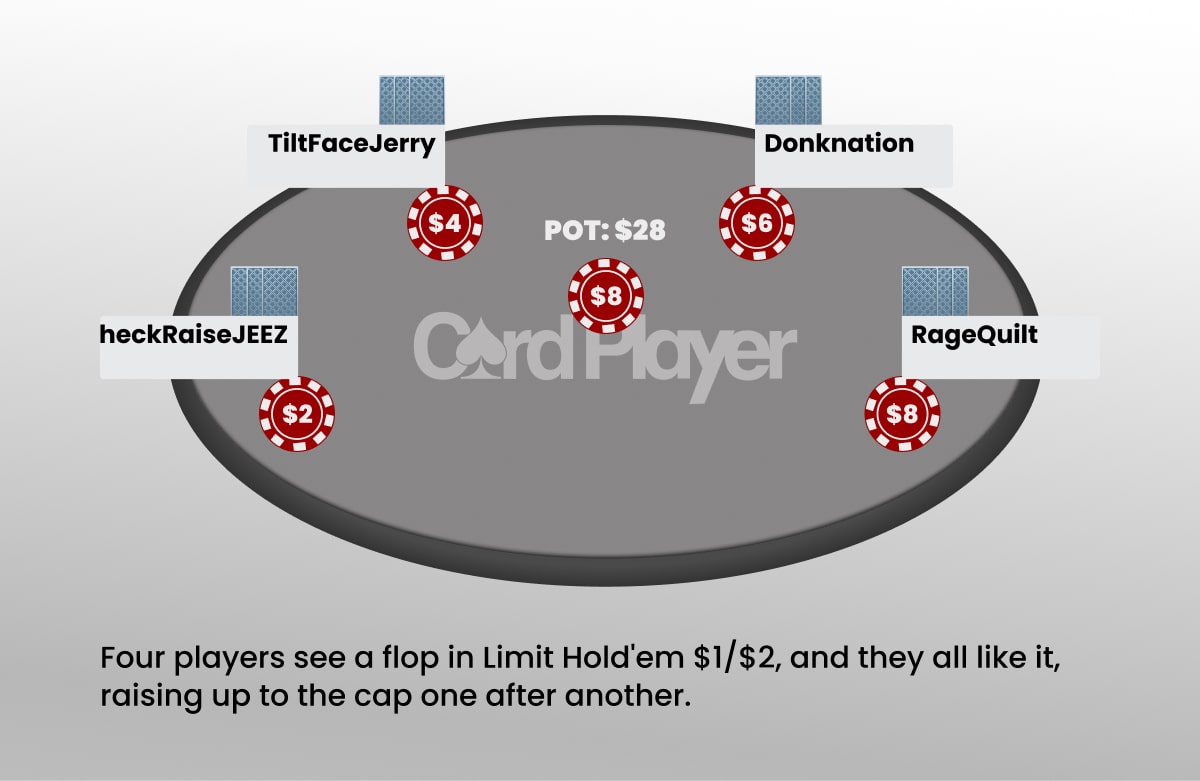
Limit Poker strategy is a subject beloved by many great poker ambassadors, including the legendary Maria Ho.
What Is No Limit Poker?
In No Limit poker, players can bet any amount they wish. Players can bet all their chips with a weak hand to bluff other players off the pot. It transforms the game, and optimal strategy becomes much more complex. As the name implies, there is “no limit” to the bet sizing a player can use, provided it is on them to act, and they bet at least the minimum. The only upper limit is the size of their stack at the time!
Limit vs No Limit Poker – A Side-by-Side Comparison
| Feature | Limit Poker | No Limit Poker |
| Betting structure | Fixed amounts; betting/raising capped | Players can bet any amount |
| Strategy style | Mathematical, positional, long-term focus | Psychological, aggressive, risk-oriented |
| Player risk | Controlled and limited | High risk; your entire stack can be lost in one hand early on |
| Game pace | Slower, more structured | Faster, more volatile |
| Bluffing impact | Less impactful due to bet limits | Strong bluffs can pressure opponents |
| Skill development | Great for learning fundamentals | Tests mental game and decision-making |
| Bankroll volatility | Lower | Higher |
| Popular variants | Texas Hold’em (Fixed Limit), Omaha Hi-Lo, Seven-Card Stud, Razz | No Limit Hold’em, Short Deck Hold’em, Heads-Up poker |
The best and biggest online poker sites have plenty of No Limit and Limit Poker games available, especially cash games. Online Limit Poker tournaments are admittedly a bit thinner on the ground.
Limit vs No Limit Poker History
Limit poker first became popular in the mid-to-late 1900s, as well as being the primary tournament format all the way through the 1970s to the 1990s. Limit Poker betting made the game more appealing to casual players. It discouraged reckless betting and reduced the risk of players going bust in a single hand.
Casinos also preferred Limit poker games because the format kept players at the table, increasing rake and casino profits overall.
No Limit poker has always been an option for skilled and ambitious players, requiring psychological daring and strategic play. It’s not a game for the faint of heart.
No Limit Texas Hold’em gained prominence in the 1970s, in tandem with the evolution of the World Series of Poker. The Main Event, championed by its creator, Benny Binion, has always been a No Limit game. This played a pretty key role in the rise to prominence that No Limit Poker now enjoys in the game worldwide. Indeed, Binion chose No Limit Hold’em in the first place for the Main Event specifically based on its drama, risk, and spectator appeal.
If you like dynamic live hand coverage and the tense balance of risk and reward seen in these huge pots, No Limit poker really is hard to beat.
Game Variants Using No Limit, Pot Limit & Limit Betting
Let’s take a look at some of the key main game types that utilize Limit, No Limit, and Pot Limit betting structures, including No Limit Texas Hold’em, Limit Hold’em, and Pot Limit Omaha.
No Limit Texas Hold’em
No Limit Texas Hold’em, often called simply No Limit Hold’em, is the world’s most popular poker variant. This is the chosen game format for the most famous poker tournament in the world, the World Series of Poker Main Event, and the favorite choice of game for numerous players of all abilities.
No Limit Hold’em is the most famous and well-known form of poker. The game combines the basic, rule-driven strategy of positional poker with the unpredictable chaos of betting seen when there are no limits on the amount you can bet!
No matter how perfect, disciplined, or logical your game is, it is about more than just the math when a rival player shoves all-in. It becomes about instinct, and your sense of how often they are playing out of line. What’s more, you can play perfectly, get all in with the best hand, and still lose, far more easily than in Limit poker.
One of the founding members of the World Series of Poker, Crandell ‘Dandy’ Addington, famously said: “Limit poker is a science, but No Limit is an art.”
This is simply because Limit poker is fundamentally a simpler, and therefore more measurable, form of the game we all know and love.
Limit Poker
Limit poker – or Fixed Limit poker – comes in various formats. Popular games are Limit Hold’em, Omaha Hi-Lo, and Seven Card Stud.
The betting structure is fixed in these games. The amount that players can bet or raise is fixed, regardless of the size of the current pot. All bets and raises are in fixed increments, and there is usually a cap on the number of raises during each betting round. When the cap is reached, players can only call or fold. Limit games allow one bet plus three raises per round, commonly called bet-raise-reraise-cap.
Limit poker is perfect for players with a tight bankroll or beginners learning the game. It’s a great way to learn the value of positional play, poker hand groupings, and hand values.
Limit poker removes the power of the big stack. It removes the impact of a strong bluff and gives players the opportunity to make it all the way to the river without being bullied off the hand.
Players hoping to turn professional can really test the statistical numbers and the power of position, playing a tight Limit poker strategy.
Once you’ve mastered some of the fundamentals, such as position, you can return to No Limit and work on your psychological game and more complex bet sizing strategies.
Pot Limit Omaha
Pot Limit Omaha (PLO) players are dealt four cards instead of two. They must use exactly two of these hole cards to make their final five-card hand. How to play Omaha is a topic for another article, but bet sizing strategy in this most popular form of the game, Pot Limit, is very relevant here.
Bet sizing underpins strategy in this Pot Limit game. Just as it sounds, in Pot Limit players can bet any amount up to the current size of the pot.
For example:
- If the pot is $100 and an opponent bets $50, the pot becomes $150. After you call $50, the pot is $200, so the maximum raise is $200. Your total contribution in that round is $50 call + $200 raise = $250.
- Therefore, the most you can put in the pot in this scenario is $250.
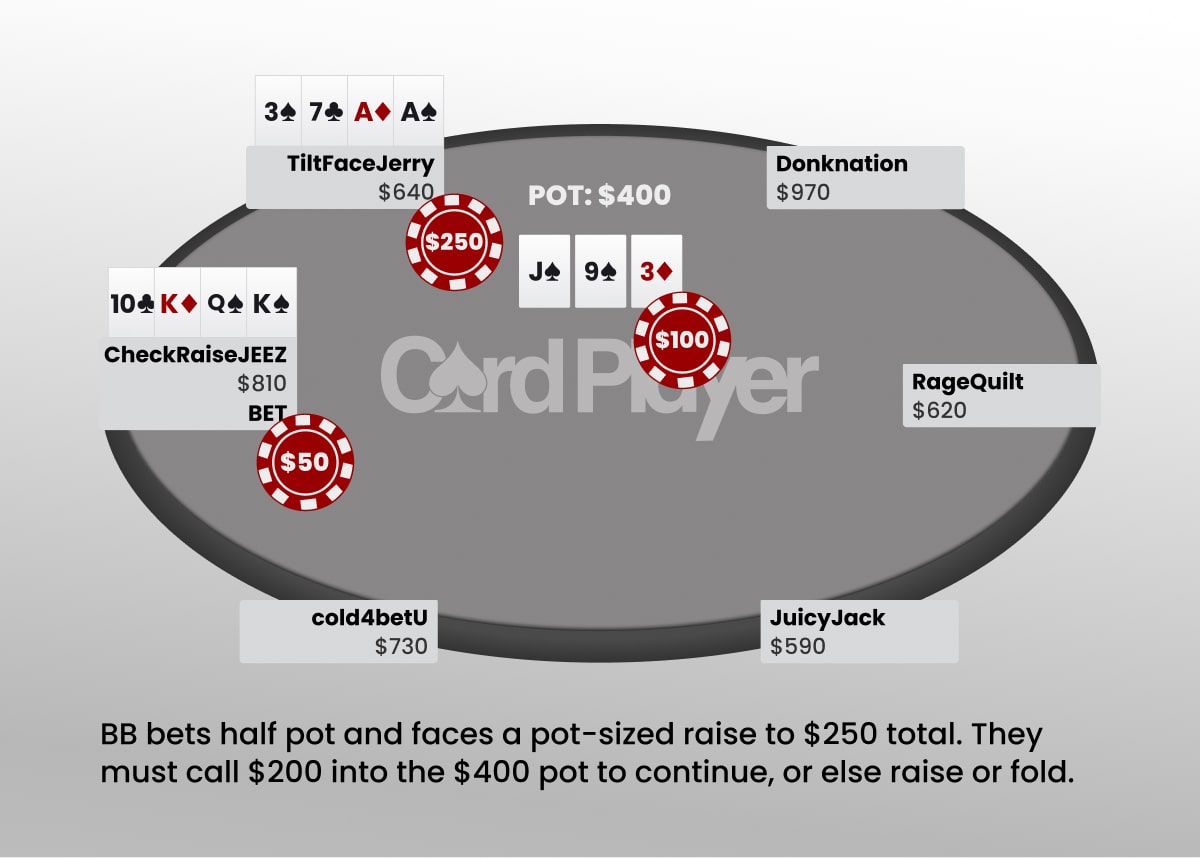
Pot Limit poker restricts bet sizing early in a tournament, often resulting in a more nuanced play and more post-flop action. However, as the pot size increases, the maximum bet becomes more significant. The sizing suits the game of Omaha poker very well, since the combinations in a four-hole-card game lend themselves to big action, and the Pot Limit element contains and channels that natural aggression brought by players hitting big hands more frequently than they would in a game like Texas Hold’em.
What Works Best – Limit or No Limit?
This is like asking if you prefer to walk or drive. It simply depends on where you’re going and what you want to do there!
Limit betting works well for games with multiple rounds of betting, where pot control and long-term strategy are key to the action. A fixed betting structure keeps the game alive and reduces the risk of huge bankroll blowouts.
Let’s give a rundown of some key poker variants and see how they work with regard to bet sizing.
Popular Poker Variants for Limit Betting
Let’s look at some of the most popular game types that use a Fixed Limit betting structure.
Omaha Hi-Lo
- The split-pot nature of Omaha Hi-Lo means that the game matches up well with more contained betting rules
- Players can chase both the high and low draws without risking all their chips
- With more high hands in play, limit betting reduces potential exposure
Seven-Card Stud & Razz
- Limit betting is the preferred option, with up to five rounds of betting
- Gameplay is sustained by protecting early rounds from big bets
Popular Poker Variants for No Limit Betting
No Limit poker offers high-stakes drama and decisive action, which makes it more attractive for players who enjoy maximum pressure and reading opponents in critical moments.
With the freedom to bet any amount of chips at any time, No Limit poker rewards boldness, timing, and strategic aggression, often leading to thrilling showdowns and big swings in chip stacks.
Let’s check out some poker formats that are very well suited to No Limit.
Texas Hold’em
A classically simple game in terms of cards, in Texas Hold’em, each player receives just two, with five community cards. No Limit is a good match for the otherwise fairly straightforward statistics which result from this format.
No Limit Hold’em lets players in position apply maximum pressure, turning chip stacks into strategic weapons that aren’t available in limit format.s
Heads Up Poker
One-on-one poker rewards relentless aggression. No Limit betting fuels this dynamic, turning every hand into a chance to apply pressure and force quick, high-stakes decisions. Constant pressure and quick adaptation are essential, with every hand becoming a potential battleground
Short Deck Hold’em
With only 36 cards in the deck, Short Deck poker, also known as Six Plus Hold’em, is all about bluffing and aggression. This is a perfect match for No Limit betting. Fewer cards mean more action and closer hand values, making big bets and bold moves more common
Conclusion
The beauty of poker lies in its flexibility; it’s a game with so many variations and different ways to play. The choice of betting structure, either Limit or No Limit, makes a huge difference to each game.
No Limit Hold’em is the best example of No Limit poker. It’s a tried and tested classic where bluffing, strategy, and huge collisions all combine to create a great card game, which many players call the best game on earth.
On the other hand, Limit poker is a more conservative game. You can usually play for longer, without the fear of losing all your chips with an unlucky call. Limit poker is perfect for beginners, learners, and hardened grinders alike.
FAQs
Are hand rankings the same in limit and No Limit Poker?
Yes, hand rankings in poker stay the same regardless of the betting structure. Many games are played with several different betting structures at times, even if one form dominates.
Is No Limit Hold’em the same as Texas Hold’em?
Texas Hold’em refers to the game variant. Texas Hold’em can be played as no limit, pot limit, or fixed limit. No limit Hold’em is one of the three options.
Can Limit Poker be profitable?
If you’re a good enough poker player, yes, Limit poker can certainly be profitable. It might just take a little longer for you to cash in.