










 Join more than 150,000 players worldwide who have taken their game to the next level. To develop your poker skills and learn how to crush games, check out PokerCoaching.com.
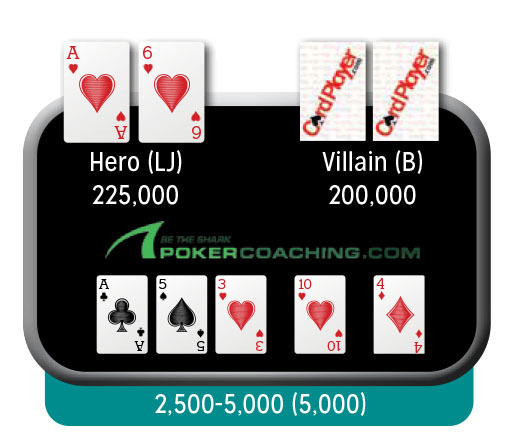
You are eight-handed in a $5,000 tournament, sitting on a stack of 225,000 at 2,500-5,000 with a 5,000 big blind ante. You raise to 11,000 from the lojack with A 6 and only a tight, aggressive, old-school, live pro calls on the button. The flop comes A
 5
5 3.
3.
Question 1: Should you check, bet 8,000, bet 15,000, or bet 30,000?
Answer: When you are out of position in a heads-up pot as the preflop raiser, you should check a decent amount of the time, especially with your marginal made hands like weak top pairs, underpairs, and king high. All of these hands are likely best if only a little money goes into the pot, but could easily be crushed if a lot of money goes in.
You check and the button checks behind. The turn is the 10.
Question 2: Should you check, bet 8,000, bet 15,000, or bet 30,000?
Answer: As on the flop, both betting and checking are viable options. While it may seem way too cautious to check with top pair and a flush draw, continuing to protect your checking range by including some hands that you plan to call down with is always a good play against a competent opponent.
If you are going to bet, a small bet size is ideal to keep your opponent in the pot with many marginal made hands that are drawing thin or dead.
You bet 15,000 and the button calls. The river is the 4 .
.
Question 3: Should you check, bet 20,000, bet 40,000, or bet 60,000?
Answer: You have the best hand a lot of the time if it goes check/check or if you bet small and your opponent calls. The game theory optimal strategy in this spot is to use a small bet size, but if you are unsure how to proceed if you get raised, checking could be ideal.
If your opponent will raise at the GTO frequency or more, calling is mandatory. But if they will not bluff often enough, you should fold when raised. When in doubt, when you do not know how to proceed against a river raise in a tournament (where chips you lose are worth more than chips you gain), it is tough to go too wrong by checking.
You check and the button bets 40,000.
Question 4: Should you fold, call, raise to 80,000, or go all-in?
Answer: It is important to realize that top pair is one of the strongest hands you should have in your range. When that is the case, folding is usually out of the question. Your opponent could easily have a busted flush or straight draw.
Turning your hand into a bluff and raising may seem like a good play because you could potentially make a few better hands fold, but your hand is too strong for that.
You call and your opponent shows A J. Fortunately for you, they played the flop slowly, resulting in you losing only a small pot. ♠
For access to more than 1,200 interactive poker hand quizzes just like this, but in video format, visit PokerCoaching today.