







In my last column, I discussed my first-round action in the PokerStars Caribbean Adventure World Poker Tour event at the Atlantis Resort in the Bahamas. I caught several good starting hands at the first level, but failed to improve my chip position. David Williams was sitting at my table. So far, we had avoided each other, but with the start of the second level, that was about to change.
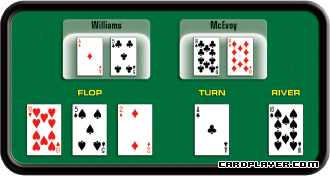
The blinds were now $100-$200. The first hand I played, I had the A Q. I made it $800 to go, and David was the only caller when he defended his big blind. If you want to steal somebody's blind, I would not recommend his. The flop came with an ace and two smaller cards. He checked, I bet, and he folded. So far, so good. The next hand I played was pocket eights. There were five limpers, and I limped, too. The flop came K-K-4 with two diamonds. It was checked to me, and I bet $500. This was a small bet, but I wanted to see if there was a king out. Also, I could beat anybody who had a 4 and thought his hand was good. I was called in two places. As it turned out, one player had the 9 8, drawing to a flush. David Williams had a king, and was slow-playing it. On the turn, the magic card came, the case 8, which gave me a full house. It was checked to me, and I bet $1,200. Both players called. I was now sure that at least one of them had a king, but I could beat three kings, and, of course, the flush draw was drawing dead, but did not know it. A jack was the river card; the flush missed (lucky for him). Williams had played this hand very cautiously. He must have smelled something fishy, because he check-called all the way, including my $2,000 bet on the river. Both players turned over their cards, which is how I knew for sure what each of them had.
My next hand, still at the second level, was pocket queens, and I misplayed them. I raised to $700, and guess who called from the small blind. Yup, you guessed it; David Williams just could not fold a hand to me. The flop came jack high, but all clubs. I did not have a club. David checked, and this is where I made my biggest mistake. I also checked. I wanted to see if a club hit on the turn before making a bet. David could have anything, and I did not want to invest a lot of chips in this hand. The turn card was a 7. This did not complete any straights or flushes, so it looked safe. Wrong again. David checked, I bet $1,200, and he called. Another small card came off on the river. He checked, and I bet $1,500, thinking I had the best hand. When he quickly called, I knew he somehow had found a way to beat me. He showed me 8-7. He had paired his 8 on the flop and made two pair on the turn when the 7 hit. I don't know if he would have folded to a bet on the flop, but hindsight being 20/20, I believe I should have bet.
Not all of my hands were dramatic and went to the river. My next hand was A-K offsuit. Williams raised to $800 and I made it $2,800. Everybody folded, including David. Meanwhile, Isabelle Mercier had come to our table and had made several aggressive plays. She already had raised my big blind more than once, and when she made it $600 to go, I decided to call with the A 5. The flop came with two hearts and the 9
 . I check-called her $800 bet. I made the nut flush on the turn and checked. She bet $1,600, and I decided to raise to $3,200. She thought about it for a while and then folded. I think the better play would have been to flat-call her bet on fourth street and then lead out on the river. In the heat of battle, you don't always think clearly.
My next hand was 10-9 offsuit. Nobody entered the pot and I decided to flat-call from the button. The small blind folded and the big blind raised to $800. Because I had position, I thought I could possibly steal the pot after the flop, so I called. The flop came 7-7-6. The big blind led out for $1,000, and I decided to call with my gutshot-straight draw and two overcards. I was going to try to steal the pot on the turn no matter what came. Fortunately for me, I paired my 10. He checked, I bet $1,500, and he showed his A-K and folded.
My last two hands of the second level both involved pocket tens, and a 10 hit on the flop both times. On the first of these two hands, I was in the big blind with pocket jacks. David (who else?) Williams made it $700 to go. The small blind called, and I decided to just call. The flop came 10-X-X. The small blind checked, I checked, and David bet. The small blind folded, and I called. A blank came on the turn. I checked, and he bet $2,500. Again, I called, and when another blank came on the river, I checked again. David gave me one of his playful grins, and then bet $6,000. He could have anything, so I called. He had flopped a set of tens to win the pot. The very last hand of the level, I had the tens. David limped in with A-5, I made it $900 to go, and he called. The flop came 10-5-2, giving me top set and David a pair of fives. He checked, I bet $1,200, and he called. An ace hit on the turn – which was a very bad card for David. He checked, I bet $1,600, and he flat-called again. Another 10 hit on the river, giving me quads. He checked, I bet $3,000, and he called. The fourth 10 saved David from losing even more chips. The bell sounded for the end of the level. I had increased my stack by more than $7,000 for the level, and was now sitting on $26,700.
To be continued.
Tom McEvoy is a representative of PokerStars.com. He can be found playing under his own name on PokerStars, and is happy to chat when he can.