






Joe Hachem, 2006 World Series of Poker champion and Team PokerStars member, can add teacher to his resume. A day before the launch of the largest poker tournament Asia has ever seen, the Asian Pacific Poker Tour (APPT) Macau event,  Hachem is huddled at a poker table with leading television and newspaper reporters from across Asia. Hachem's Texas hold'em crash course includes small laminated cards that rank hands, and equal parts of enthusiasm and patience. After an hour of explaining hand rankings, betting, and folding, and even eliciting an exciting "all in" yelp from a shy Indonesian journalist, Hachem releases his students. The tutorial translates into favorable media coverage from Jakarta to Tokyo, and Hachem can pat himself on the back for a job well done in helping to broadcast the message that poker is an emerging international sport.
The host location of this fanfare, Macau, is now the gaming capital of the world. Last year, gambling revenues from the special administrative regions' 27 casinos surpassed Las Vegas. While each location brings in about $6 billion a year, the volume of Macau's take has skyrocketed since a law passed in 2001 stripped tycoon Stanley Ho of his 40-year casino monopoly. After the first Western-style casino, Sands Macau, was introduced to the former Portuguese enclave in 2004, 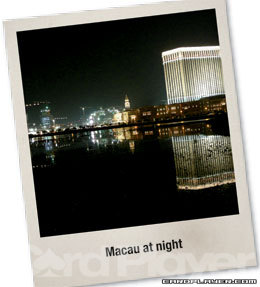 regional revenues have doubled year over year and gaming's billionaire barons Steve Wynn, Kirk Kerkorian, Sheldon Adelson, and Donald Trump all have invested heavily in the sleeping Asian giant. Macau's skyline today is a twisting grid of cranes that are re-creating the Las Vegas Strip. This soon-to-be famous boulevard, dubbed the Coati Strip, is anchored by the second-largest building in the world, the $1.8 billion Venetian Macau, which opened just six months ago.
If you're asking what this has to do with poker, let's get back to Hachem. His crash course took place the day before 352 players bought into the $2,500 APPT Macau Asian Poker Open, the first Western-style poker event in all of mainland China. Add a $15,000 high-roller tournament to this APPT stop's lineup that attracted 64 top players, and Macau's poker coming-out party was wildly successful. While the winners of these events would take home hundreds of thousands of dollars, more importantly, it marked poker's trial run in the world's richest gaming destination. Major players in the poker business are hoping Macau, now dominated by baccarat and free-spending Chinese whales, will shuffle poker into the mix. As Card Player learned, other areas in the region already have embraced poker, and the big question is, will Macau be next?
APPT Invades the Region
The APPT, which launched in August 2007 and has previously held tournaments in the Philippines and South Korea, drew players from more than 35 different nations to Macau. Approximately 210 of the 325 players qualified for their seats on PokerStars, the tour's headline sponsor.
"This tournament represents a historic moment for poker and is perhaps one of the three most important tournaments ever held," stated Jeffrey Haas, APPT president. "Number one, probably, was the 1970 World Series. Number two might be the  2003 World Series of Poker, wherein Chris Moneymaker brought the dream alive … and that event was the beginning of the modern era of poker. And then there is this, the birth of poker in Macau. Macau is about the future of gaming and the future of tourism, and now tournament poker will be a part of that vibrant future."
While poker has boomed in the United States and Europe, it is still an oddity in most of Asia. Prior to this event, the Betfair Asian Poker Tour, held last November in Singapore, was the largest poker event ever held in Asia. That event attracted 313 players.
Poker in Macau did not come easily. According to Haas, organizations and individuals have been working on bringing poker to Macau for years and years. "Applications have gone in for poker rooms and tournaments for at least four years that I know of," he said. However, poker has not been a priority for Macau's Gaming Inspection and Coordination Bureau, which supervises all gaming activities in the region. The rampant growth has been enough to keep them working overtime.
"It took us 14 months to get our first meeting, and it was only a result of us having a successful event in the Philippines," said Haas. He said the World Series, World Poker Tour, and a number of smaller operators all have put applications in with the Macau gaming authority to hold an event like the Macau Asian Poker Open. "After due diligence, we were determined to be the first party to hold an event. We're honored and privileged to be given this opportunity by the Macau government. We plan on carrying through on our initiative to have the permanent largest and most high-profile event here in Asia."
Poker in Asia
The Asian Poker Open's home was the Grand Waldo Hotel and Casino, a Galaxy Entertainment Group Ltd. property. Galaxy holds the claim of having the only "poker room" currently in Macau. It consists of four Poker Pro machines – spreading no-limit hold'em games ranging from $5-$10HKD (75¢-$1.25) to $50-$100HKD ($6-$12) – and two Poker Pro heads-up tournament tables at its flagship property, Star World. "Poker is great for Macau," said Gary Woollard, Grand Waldo Casino general manager. "The game will only attract more and more people to the properties and help Macau become more of an international gaming destination." Woollard's property is also testing a Lightning Poker table, a company operated by professional poker player Brian Haveson.
If poker does indeed take off in Macau, it likely will be in the form of electronic tables like those offered at the Galaxy properties. First, there is an acute shortage of casino dealers in Macau, and, more importantly, nobody in Macau knows how to deal poker. Two months before the APPT event, tournament director Matt Savage's staff traveled to the region in order to train local dealers. While slow at first, the dealers did a remarkable job.
While Macau unquestionably steals the headlines for gambling in Asia, other domiciles already have embraced poker. The  Philippines is the largest area in Asia where legal, regulated poker exists, and numerous casinos and smaller cardroom operators spread a variety of games in Manila, which Haas says is "the beating heart of poker in Asia."
Korea is another region that's ripe for poker. Currently, the only legal place to play is at the Paradise Walkerhill Casino in Seoul, where six tables spread a variety games. Poker, however, is vibrant in the underground scene. Likewise, in Japan, poker is becoming more and more popular. While real-money games are not allowed, bar leagues host a multitude of events each week. In Cambodia, there are a number of poker room operators along the Thai border who target primarily expatriates in Thailand. In addition, there are also other casinos in various places across Asia that have not yet embraced poker, including Myanmar and nations focused on attracting Chinese players, such as North Korea and Mongolia. In various cities across Asia, you're sure to find action. Poker has a foothold, primarily with expatriates, in larger communities such as Shanghai and Beijing, and you can find games every night in Hong Kong at a variety of stakes.
First Chinese Champions
On Nov. 23, history was made. Scotty Nguyen, 1998 World Series of Poker champion and the first Asian player ever to pocket $1 million from a poker tournament, announced, "Shuffle up and deal, baby," after a traditional Chinese lion dance welcomed the players to poker, Macau style.
"Over the next couple of years, this place is going to blow up," Nguyen said. "Tournaments are going to have 700, 800, maybe even thousands of players. Players from the region, China, Vietnam, Thailand, Korea, they all love to gamble, and are going to love poker, baby."
After two days of play, the APPT couldn't have asked for a more high-profile final table for its $2,500 main event. It included  Joe Hachem, Liz Lieu, and two Team PokerStars members from South Korea who are also known for their professional computer-game prowess, Bertrand "ElkY" Grospellier and Guillaume Patry. Rounding out the remaining seats were players from London, Seoul, Singapore, and Australia, and the chip leader, Dinh Le, a 27-year-old resident of Birmingham, England, originally from Vietnam. It took 105 hands, spread over nearly eight hours of play, to declare a winner. In the end, Le defeated Ivan Tan in a short heads-up battle, which gave him the title and $222,640.
The $15,000 high-roller event attracted 64 players, an all-star lineup that included Barry Greenstein, Yosh Nakano, John Juanda, Joe Hachem, Kirk Morrison, Nick Schulman, Travis Rice, Vanessa Rousso, Jeffrey Lisandro, Lee Nelson, Chad Brown, and Isabelle Mercier, among others. The event was action-packed, as it began with  eight eighthanded tables and then switched to sixhanded as play dwindled. A long day one of play left Team PokerStars member and Australian Emad Tahtouh with a commanding 2.5-1 chip lead over the remaining seven players. Also in the hunt were John Juanda and Liz Lieu, who bagged back-to-back final tables in Macau (see the sidebar). Tahtouh could not hold on, however, and the final table saw Eric Assadourian, another Aussie, emerge with the title and $368,640. His road to victory was sealed after hitting a three-outer against Full Tilt's John Juanda (kings versus A-K), and in keeping with the international theme of the event, highly respected Swedish poker pro Bo Sehlstedt was eliminated in second place ($184,320).
Aiming for the Sky
With one year under its belt, the APPT has ambitious plans for its second season. The tour will add a number of stops in 2008 and is considering circuit tours in regions like the Philippines, where poker has taken root. Add PokerStars.net's support with marketing dollars, freerolls, satellites, and Team PokerStars, and the sky seems to be the limit.
"My forecast is that in 2010, the largest prize pool of any poker tournament on the planet will be on the APPT tour," said Haas. 
Poker Diva Does Macau
Liz Lieu made her trip to Macau very worthwhile. She made the final table in both the $2,500 Asian Poker Open main event, finishing seventh ($32,384), and also finished at the final table of the $15,000 high-roller event, finishing in eighth place ($27,648). Card Player caught up with the Vietnam native at the event.
Card Player: So, how did it feel to play and do so well in the first major poker tournament in China?
Liz Lieu: It was incredible! I had been wishing for the chance to play in Asia for some time, and to make the two final tables  back-to-back there was very exciting. I wish I could've taken at least one of those titles, but there will be more chances to win a tournament in Asia.
CP: The Asia Pacific Poker Tour event in Macau was historic; what do you think it means for poker's future in Asia?
LL: This is only the beginning for poker in Asia. When people notice how far people traveled to play there and how successful the first APPT event was, there will be more tournaments in more Asian countries. Macau is an awesome place that will start to attract people from all over the world.
CP: There are so many great Asian players. What type of opportunities do you think the opening of the Asian market will bring?
LL: I think poker will keep getting more popular. As more Asian players fall in love with poker in their own countries, they will start traveling to Europe and America to play, too. There is so much money over in Asia that I think the buy-ins for those tournaments will grow, and we might see some of the biggest tournaments in the world in places like Macau.
CP: So, what is Liz Lieu's poker and non-poker life like these days?
LL: When my father passed away a few months ago, I spent a lot of time making the funeral arrangements in Vietnam and traveling back there several times to pay tribute to him. During those trips, I also took time to do more charity work – visiting hospitals, schools, and poor villages to make sure they have what they need, like food and supplies. I do these things in honor of my father and because it makes me feel like I'm doing something good for the world. When I wasn't there, I was working with my sponsor site, ChiliPoker, and building our business relationship. I haven't played many cash games, but I might have the chance to do that when I go to Bellagio this month for the Five-Diamond main event.